Healthcare Elevator Modernization: Energy Efficiency Incentives & Utility Rebates in California and Texas
For hospitals, medical office buildings, skilled nursing facilities, and outpatient surgery centers in Houston, Dallas, Austin, San Antonio, Los Angeles, and San Diego, elevator modernization is rarely optional — aging equipment affects patient transport, staff efficiency, and regulatory standing. When a capital project is already required, understanding which energy improvements can offset cost through utility rebates or incentive programs adds meaningful financial leverage. The guidance below addresses the full evaluation process for healthcare facilities operating in California and Texas.
What Makes a Healthcare Elevator Modernization “Energy Efficient” Enough to Qualify?
Utility rebate and energy incentive programs generally do not evaluate elevator projects in isolation. They evaluate measurable energy reduction. For a modernization to qualify, the scope of work typically must include at least one of the following upgrades, each of which produces a documented reduction in electrical demand or consumption:
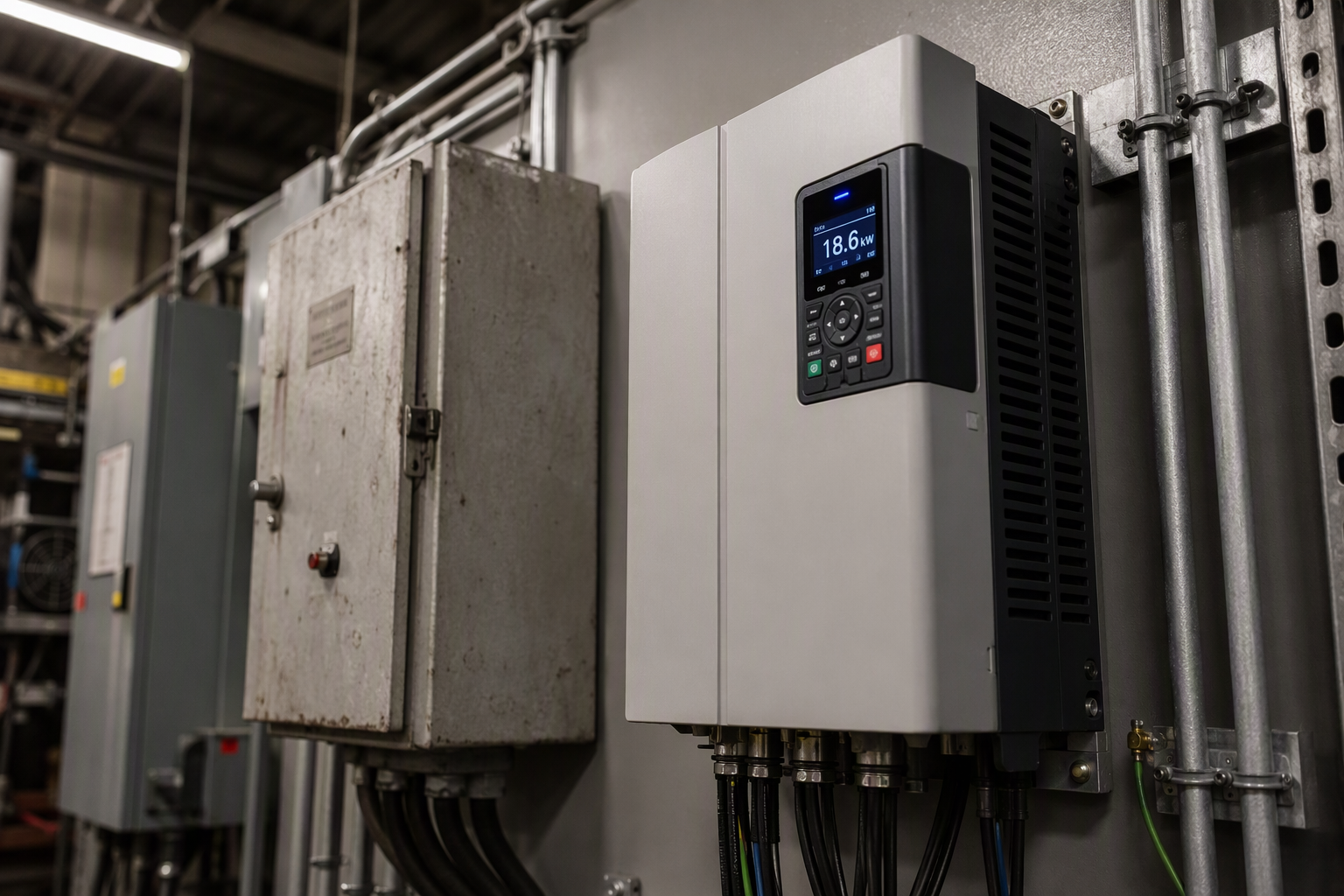
- Variable Voltage Variable Frequency (VVVF) drive replacement — swapping older single-speed or two-speed AC motor controllers for regenerative or high-efficiency VVVF drives reduces motor energy draw and, in regenerative configurations, returns energy to the building’s electrical grid during descent under load.
- LED cab and hoistway lighting conversion — replacing incandescent or fluorescent fixtures with LED arrays and motion-sensing standby controls lowers continuous lighting load.
- Standby/sleep mode controls — modern controllers can dim cab lighting and fan power when an elevator is idle, reducing parasitic load.
- Hydraulic power unit replacement — in healthcare settings with low-rise hydraulic elevators (common in medical office buildings), replacing older pump motor units with variable-speed submersible or above-ground units reduces start-up current draw.
- Destination dispatch systems — in multi-car healthcare installations, destination dispatch reduces unnecessary travel and motor run time.
A project that replaces only cab finishes, handrails, or door panels for aesthetic or ADA compliance purposes will not, on its own, qualify for energy incentives — though those improvements may be bundled with eligible energy upgrades in a single modernization scope.
How Do California Utility Rebate Programs Evaluate Elevator Upgrades in Healthcare Facilities?

California’s investor-owned utilities — Pacific Gas & Electric, Southern California Edison, and San Diego Gas & Electric — administer demand-side management programs under oversight by the California Public Utilities Commission. Healthcare facilities in Los Angeles and San Diego served by SCE or SDG&E have historically had access to commercial and industrial energy efficiency programs that include motor and drive system measures.
Evaluation typically requires a healthcare facility to:
- Identify the eligible measure category in the utility’s current program catalog (often “custom” or “calculated” for elevator drives, since prescriptive rebate tables rarely list elevators as a line item).
- Establish a pre-modernization baseline — documented motor nameplate data, run-hour logs, and utility interval data.
- Engage the utility’s program representative or an approved technical resource center before the project begins, since most programs will not pay rebates on projects that are already installed.
- Submit a project application and receive conditional approval.
- Complete the installation and provide post-installation documentation, including equipment specifications, contractor invoices, and — for custom measures — a measurement and verification report.
- Receive final rebate payment after utility review.
Under California law, any company that performs the elevator modernization work must hold a C-11 Elevator Contractor license issued by the California Contractors State License Board (CSLB) and must be certified by Cal/OSHA as a Certified Qualified Conveyance Company (CQCC). Mechanics performing the work must be certified by Cal/OSHA as Certified Competent Conveyance Mechanics (CCCM). A facility submitting documentation to a utility that includes work performed by an uncertified company risks rebate denial and regulatory exposure under California Labor Code Sections 7300–7324.2 and the California Code of Regulations, Title 8, Elevator Safety Orders.
Additionally, because Cal/OSHA requires a permit before a conveyance is materially altered, the modernization cannot proceed lawfully without prior Cal/OSHA permit approval. Utility documentation packages that lack permit records may be flagged during review.
Los Angeles operates its own elevator and conveyance inspection program through the Los Angeles Department of Building and Safety (LADBS). Healthcare facilities in Los Angeles should confirm local permit and inspection requirements directly with LADBS in addition to meeting Cal/OSHA requirements.
How Do Texas Energy Incentive Programs Evaluate Healthcare Elevator Modernizations?
Texas does not have a state-mandated utility energy efficiency program equivalent to California’s CPUC-administered structure, but investor-owned utilities regulated by the Public Utility Commission of Texas (PUCT) — including Oncor, CenterPoint Energy, AEP Texas, and Texas-New Mexico Power — administer Energy Efficiency Programs under the state’s Energy Efficiency Rule. Healthcare facilities in Dallas, Austin, and San Antonio fall within the service territories of these utilities and may access commercial and industrial incentive programs for qualifying equipment replacements.
The evaluation process in Texas generally mirrors the custom measure pathway:
- Confirm the facility’s utility provider and identify the active commercial energy efficiency program and program year.
- Contact the utility’s program administrator before beginning any work — Texas programs, like California’s, typically prohibit retroactive applications.
- Document existing equipment — motor horsepower, drive type, control system vintage, and historical energy consumption from utility bills.
- Submit a pre-approval application with a projected energy savings calculation using the utility’s approved methodology.
- Complete the modernization and submit post-installation documentation, including contractor credentials, equipment specifications, and invoices.
- Undergo any required inspection or measurement and verification.
- Receive incentive payment, typically calculated as a dollar amount per verified kilowatt or kilowatt-hour saved.
In Texas, elevators are regulated by the Texas Department of Licensing and Regulation (TDLR), Elevator and Escalator Safety program, under Texas Health and Safety Code Chapter 754 and 16 Texas Administrative Code Chapter 74. The adopted code is ASME A17.1/CSA B44, 2016 edition. Any contractor performing modernization work must be registered with TDLR as an elevator contractor and must carry general liability insurance of at least $1,000,000 per occurrence for bodily injury or death. Utility programs that require licensed contractor documentation will expect this registration as part of the submission package.
Important note for Houston facilities: TDLR does not regulate elevators inside Houston city limits. The City of Houston operates its own elevator program. Healthcare facilities in Houston must coordinate permitting and compliance through the city’s program and should verify incentive documentation requirements accordingly.
What Healthcare-Specific Compliance Requirements Must a Modernization Satisfy Before Incentive Applications Are Filed?
Healthcare facilities face a layer of compliance obligations that general commercial buildings do not. A modernization that creates a compliance deficiency — even unintentionally — will complicate both regulatory approval and utility rebate processing. Key requirements include:
- ASME A17.1 / A17.3: The ASME A17.1 Safety Code for Elevators and Escalators governs new installations and alterations. ASME A17.3 applies to existing installations. California has adopted ASME A17.1/CSA B44, 2004 edition (with a proposed Group V update under review as of 2026). Texas has adopted the 2016 edition. A modernization must conform to the applicable adopted edition in the state where work is performed.
- ADA Compliance: Under the Americans with Disabilities Act, healthcare facilities serving patients and visitors must maintain accessible vertical transportation. A modernization that disrupts accessibility — altered car dimensions, non-compliant controls, inadequate door timing — must be remediated before a permit to operate will be issued.
- Firefighters’ Emergency Operation: In Texas, a passenger elevator without working firefighters’ service or with non-working Phase One firefighters’ service must be removed from service immediately under TDLR rules. Healthcare facilities must confirm that modernized control systems retain fully operational emergency recall and in-car firefighters’ service.
- Healthcare Occupancy Standards: Hospitals and other healthcare occupancies must also satisfy applicable provisions of the National Fire Protection Association’s Life Safety Code (NFPA 101) and, where applicable, Joint Commission or CMS Conditions of Participation for physical plant. AmeriTex Elevator recommends coordinating any modernization scope with the facility’s safety officer and compliance team before finalizing the project specification.
- California Permit Before Alteration: Cal/OSHA requires a permit before a conveyance is materially altered. Healthcare facilities in California cannot legally begin modernization work — and should not incur costs they intend to submit for rebates — without prior Cal/OSHA permit approval.
Which Elevator Components Offer the Best Energy Savings Case for a Healthcare Facility?
From an energy documentation perspective, the components most likely to produce verifiable savings — and therefore the strongest rebate applications — in a healthcare setting are:
- Regenerative drive systems on traction elevators in mid- to high-rise hospital towers, where high traffic volumes maximize the frequency of descent-under-load cycles that generate returnable energy.
- LED lighting with occupancy sensing, which is straightforward to document because lighting load reductions are calculable from fixture wattage data alone without complex measurement and verification.
- Variable-speed hydraulic pump units in low-rise medical office or clinic settings, where the existing fixed-speed pump is often significantly oversized for actual load.
- Modern controller replacements that include standby mode and reduced-speed travel options, which lower both demand and consumption during off-peak hours.
What Documentation Should a Healthcare Facility Gather Before Contacting a Utility?
Utility program representatives and third-party reviewers will expect specific documentation. Assembling this before the first conversation shortens the pre-approval timeline:
- Current utility account number and 12 to 24 months of interval energy data (available from the utility’s online portal in most cases).
- Equipment inventory — number of elevator units, type (traction or hydraulic), motor horsepower, controller manufacturer and model, drive type, and year of last major modernization.
- Current inspection certificates — in Texas, the TDLR Certificate of Compliance; in California, the Cal/OSHA permit to operate.
- Proposed scope of work from a qualified elevator contractor, including equipment specifications for the replacement components.
- Contractor credentials — in California, CQCC certification and C-11 license; in Texas, TDLR contractor registration number and insurance certificates.
- Any existing maintenance contract, since California’s two-year permit pathway requires a full maintenance contract with a C-11 licensed company.
What Is the Typical Timeline From Modernization Scoping to Incentive Payment?
Timelines vary by utility program and project complexity, but a healthcare facility planning a modernization in 2026 should allow for the following general phases — described qualitatively because program-specific timelines are set by individual utilities and can change between program years:
- Pre-application and utility engagement — contacting the program, confirming measure eligibility, and receiving preliminary approval can take several weeks depending on program workload.
- Regulatory permitting — in California, obtaining a Cal/OSHA permit for material alteration; in Texas, submitting plans to TDLR and receiving approval before work begins. These processes run concurrently with utility pre-approval but must be complete before work starts.
- Construction and installation — the modernization itself, which varies by scope and the number of elevator units in the facility.
- Post-installation documentation and inspection — in California, Cal/OSHA inspects altered elevators before they are returned to service; in Texas, a TDLR-registered inspector provides an inspection report within five calendar days of inspection and the owner must obtain a Certificate of Compliance.
- Rebate or incentive processing — utility review of the completed application package, which for custom measures can take additional weeks.
AmeriTex Elevator works with healthcare facilities to sequence the regulatory and utility timelines so that compliance approvals and incentive applications move in parallel wherever programs allow, avoiding delays that push a project past a program year deadline.
Are There Federal Programs That Complement State or Utility Incentives for Healthcare Elevator Modernization?
The federal Inflation Reduction Act (IRA) of 2022 introduced or expanded several commercial building energy efficiency tax incentives, including an expanded Section 179D deduction for energy-efficient commercial building property. Elevator drive systems and lighting that contribute to a building’s overall energy reduction may be eligible components within a broader 179D study. Healthcare facilities operated by tax-exempt organizations (such as nonprofit hospital systems) face different rules for passing 179D benefits to designers or contractors. Facilities should consult a qualified tax advisor and energy engineer to determine whether a modernization scope supports a Section 179D claim — this is a tax matter outside the scope of elevator contractor work, but AmeriTex Elevator can provide the technical documentation that a tax advisor or energy modeler would need to support such a claim.
Questions Your Inspector Will Ask
When a Cal/OSHA safety engineer or CCCI (in California) or a TDLR-registered inspector (in Texas) evaluates a modernized elevator in a healthcare facility, the following questions and documentation requests are common:
- Is the permit to operate (California) or Certificate of Compliance (Texas) current and posted? In California, the permit must be posted conspicuously in the elevator car. In Texas, the Certificate of Compliance must be displayed in a publicly visible area of the building.
- Was a permit obtained before the material alteration began? In California, Cal/OSHA requires a permit prior to any material alteration. In Texas, TDLR requires plan submission and approval before installation or alteration begins.
- What edition of ASME A17.1 governs this installation, and does the altered equipment conform? The inspector will compare the equipment to the applicable adopted edition — 2004 in California, 2016 in Texas.
- Is firefighters’ emergency operation fully functional? Phase One recall and in-car (Phase Two) operation must be demonstrated, particularly in healthcare occupancies where evacuation protocols are distinct.
- Are door restrictors operational? In Texas, a passenger elevator without working door restrictors must be removed from service immediately.
- Is the new drive or controller compatible with the existing safety circuit? Modernizations that replace controllers must maintain all safety chain elements required by the applicable code edition.
- Has the Category 5 full-load test been completed if required? In Texas, traction elevators require a Category 5 full-load test every five years. A modernization involving the drive or control system may trigger or reset this requirement.
- Are cab lighting levels and emergency lighting compliant? Healthcare facilities have patient-transport requirements that may set higher lighting minimums than standard commercial occupancies.
- Was the work performed by credentialed personnel? In California, this means CQCC-certified company and CCCM-certified mechanics. In Texas, this means a TDLR-registered elevator contractor.
How Can a Healthcare Facility Vendor-Select an Elevator Contractor Who Supports the Incentive Process?
Not every elevator contractor has experience navigating utility rebate documentation alongside regulatory permitting. When evaluating vendors, healthcare facilities should ask:
- Can the contractor provide equipment specifications in the format the utility’s program requires (often including ENERGY STAR or DesignLights Consortium listing, measured wattage, or manufacturer efficiency curves)?
- Does the contractor carry the required credentials in the state where work will be performed — CQCC certification and C-11 license in California, TDLR registration in Texas?
- Has the contractor previously supported a custom measure rebate application, and can the project team provide contractor invoices and technical submittals in the format the utility requires?
- Can the contractor coordinate the Cal/OSHA or TDLR permit timeline with the utility pre-approval timeline to avoid a situation where work begins before utility approval is received?
AmeriTex Elevator serves healthcare facilities across Houston, Dallas, Austin, San Antonio, Los Angeles, and San Diego with modernization services that include the technical documentation healthcare facility managers need to support utility rebate applications. The team understands that a hospital or medical office building cannot absorb extended elevator downtime, and project scheduling reflects the operational realities of healthcare environments.
What Should a Healthcare Facility Do If Its Modernization Has Already Been Completed?
If a modernization is already installed and operational, retroactive rebate eligibility depends entirely on whether the facility obtained pre-approval from the utility program before work began. Most utility programs in California and Texas explicitly exclude projects that did not receive pre-approval. However:
- Contact the utility program administrator promptly to confirm whether any retroactive or post-installation pathway exists — some programs have short retroactive windows.
- Preserve all contractor invoices, equipment specifications, and permit documentation, since these will be required if any pathway is available.
- Assess whether any additional eligible measures — such as lighting upgrades or standby controls — were not yet completed and could be scoped as a separate qualifying project with proper pre-approval.
- Explore federal tax pathways such as Section 179D, which has different documentation rules than utility rebate programs and does not require pre-approval in the same way.
- Contact AmeriTex Elevator for a review of the completed modernization documentation to identify what technical records exist and what gaps may need to be addressed for any available pathway.
Does ADA Compliance Work Qualify Separately for Incentives?
ADA compliance improvements — such as accessible control panel height adjustments, door timing corrections, or tactile signage — do not typically qualify as energy efficiency measures and would not support a utility rebate application on their own. However, when ADA work is performed as part of a broader modernization that includes energy-reducing components, the combined project may still qualify for energy incentives on the eligible components. The rebate or incentive will be calculated only on the energy-saving measures, not the full project cost. Healthcare facilities should itemize costs by measure type in contractor proposals to support accurate rebate calculations.
The ADA requirements for accessible elevators are federal and apply in both California and Texas regardless of the state-specific elevator code edition in effect. AmeriTex Elevator incorporates ADA compliance review into every modernization assessment for healthcare clients to ensure that energy upgrades do not inadvertently create accessibility deficiencies that would delay permit issuance.
Start With a Free Elevator Assessment
Evaluating whether a healthcare elevator modernization qualifies for an energy efficiency incentive or utility rebate in California or Texas requires accurate equipment documentation, regulatory compliance verification, and utility program coordination — all before a single component is ordered. Getting the sequence wrong can disqualify an otherwise eligible project.
AmeriTex Elevator provides healthcare facilities in Houston, Dallas, Austin, San Antonio, Los Angeles, and San Diego with comprehensive modernization assessments that address equipment condition, ASME A17.1 compliance, state regulatory requirements, and energy upgrade opportunities in a single evaluation.
Contact AmeriTex Elevator for a free elevator assessment: 866-679-4313
Need elevator service you can rely on? AmeriTex Elevator is ready to help.