Healthcare Facility Elevator Code: What Hospital & Clinic Operators Must Know
Elevators in hospitals, outpatient surgery centers, skilled nursing facilities, and medical office buildings operate under a stricter compliance framework than elevators in standard commercial buildings. When a patient on a gurney, a pharmacist pushing a medication cart, or an MRI technician moving sensitive equipment depends on vertical transportation, code compliance is not a formality — it is a patient-safety obligation. This guide covers the full compliance picture for healthcare facility operators in Houston, Dallas, Austin, San Antonio, Los Angeles, and San Diego.
—
Which Codes Apply to Healthcare Facility Elevators?

Healthcare facility elevators sit at the intersection of multiple regulatory frameworks that must be satisfied simultaneously:
- ASME A17.1 Safety Code for Elevators and Escalators — The foundational U.S. standard governing design, installation, inspection, testing, and maintenance of all elevators. Most states adopt this code by reference, and the 2019 and 2022 editions are the basis for current state adoptions as of 2026.
- Americans with Disabilities Act (ADA) — Requires accessible elevator dimensions, door timing, call button height, tactile signage, and auditory indicators in any facility serving the public, including all healthcare settings.
- The Joint Commission (TJC) Environment of Care Standards — Accredited hospitals must maintain documented elevator maintenance programs and demonstrate compliance during surveys.
- Centers for Medicare & Medicaid Services (CMS) Conditions of Participation — CMS-certified facilities must meet Life Safety Code provisions that include vertical transportation equipment.
- NFPA 101 Life Safety Code — Governs fire-service recall modes, phase I and phase II emergency operations, and smoke-barrier considerations relevant to elevator lobbies in healthcare occupancies.
- State and local amendments — Texas (enforced through the Texas Department of Insurance Elevator Safety Program) and California (enforced through the Division of Occupational Safety and Health, Cal/OSHA) each layer additional requirements on top of the base ASME code.
AmeriTex Elevator maintains familiarity with the adopted code editions and local enforcement practices in every market it serves, including Houston, Dallas, Austin, San Antonio, Los Angeles, and San Diego.
—
What Are the Specific Elevator Size Requirements for Hospitals?
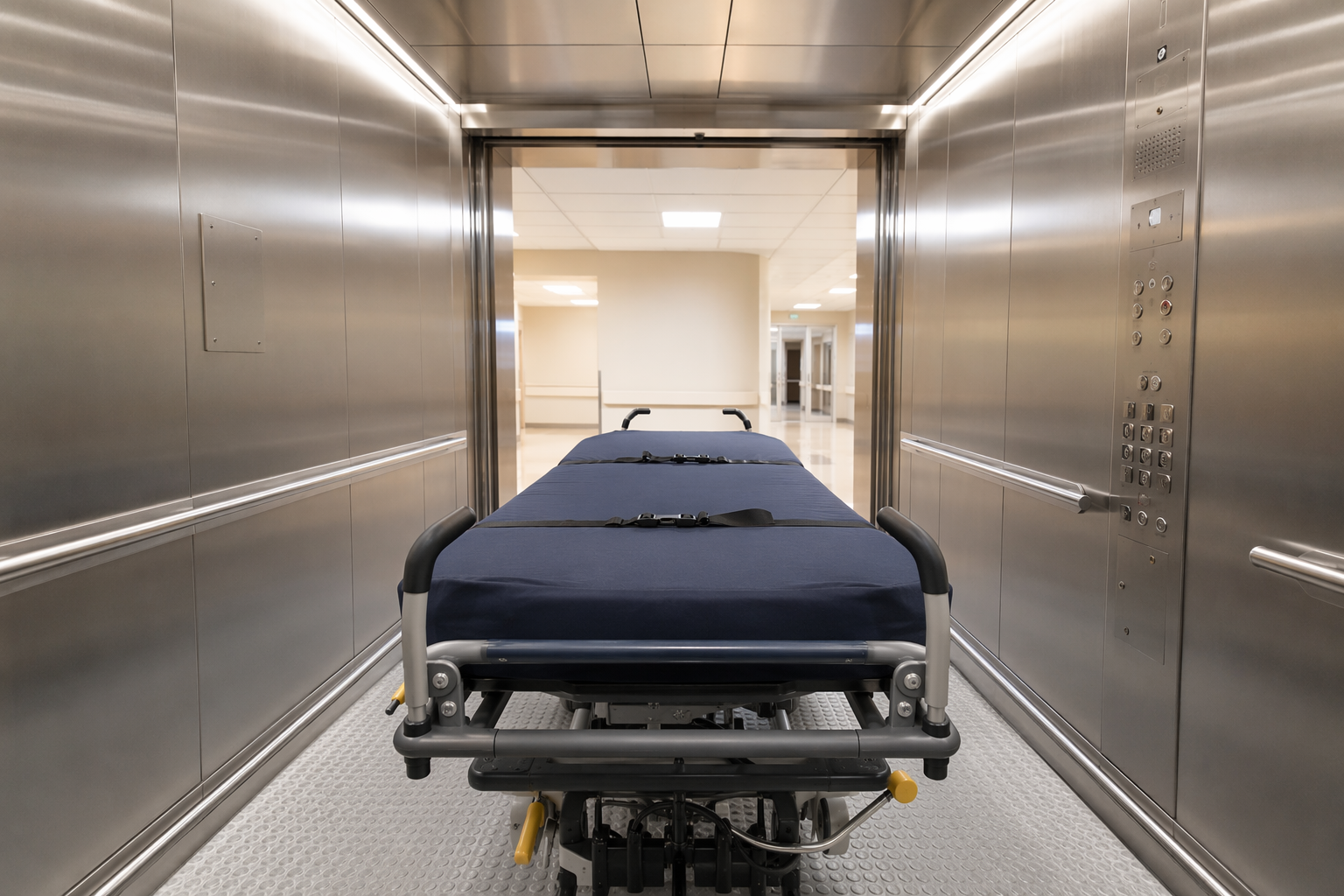
General-purpose commercial elevators are not automatically suitable for healthcare use. Code and clinical guidance establish minimum dimensions to accommodate patient transport:
- Hospital-type elevators (per ASME A17.1 and healthcare design standards) are typically required to accommodate a fully extended gurney or hospital bed with attendants. This generally means a clear cab interior of at least 80 inches deep and 60 inches wide, though project-specific programs often specify larger dimensions.
- Door clear opening width must be sufficient for gurney passage — typically a minimum of 42 inches clear, with many facilities specifying 48 inches or wider for ICU and surgical floors.
- Weight capacity must account for a loaded hospital bed, patient, and multiple attendants. Capacities of 4,000 to 5,000 pounds or greater are common in acute-care settings.
- Door open dwell time under ADA must be adjustable; in clinical settings, extended dwell times accommodate slow-moving patients and equipment.
These are design and planning requirements. For existing facilities undergoing renovation, a qualified elevator consultant or service provider such as AmeriTex Elevator can assess whether existing equipment meets current dimensional standards or requires modernization.
—
What Are the ADA Requirements for Healthcare Elevators?
The ADA requires all elevators in multi-story facilities open to the public — including hospitals and clinics — to meet the following accessibility standards:
- Call buttons no higher than 48 inches above the floor, with a raised dot or raised star on the button for the main entry floor.
- Inside cab dimensions sufficient for wheelchair turning (at minimum 51 inches wide by 51 inches deep for most configurations).
- Door reopening devices that remain effective for at least 20 seconds.
- Visible and audible floor indicators.
- Handrails on at least one cab wall.
- Emergency communication systems accessible to people who are deaf or hard of hearing.
Healthcare facilities that fail ADA elevator requirements risk complaints to the U.S. Department of Justice and loss of federal funding eligibility.
—
How Often Do Healthcare Facility Elevators Require Inspection?
Inspection frequency is set by state-adopted editions of ASME A17.1 and enforced by state elevator safety programs:
- Annual routine inspections are required in Texas and California for most elevator types.
- Periodic (five-year) tests including full-load, safety, and governor testing are required under ASME A17.1.
- Witnessing requirements — In Texas, certain tests must be witnessed by a licensed inspector. In California, a Qualified Elevator Inspector (QEI) or Cal/OSHA elevator unit inspector witnesses category testing.
- Joint Commission surveys may occur at any time and include review of maintenance logs, inspection certificates, and out-of-service records.
Maintaining a complete, current inspection and maintenance record is essential. AmeriTex Elevator provides clients with organized documentation packages that satisfy both state inspectors and accreditation surveyors.
—
What Is Fire Service Recall and Why Is It Critical in Healthcare Facilities?
Fire service recall — also called Phase I Emergency Recall and Phase II Emergency In-Car Operation — is mandated by ASME A17.1 and NFPA 101 for all hospitals and healthcare occupancies:
- Phase I (Automatic/Manual Recall): When a fire alarm activates, all elevators return to the designated recall floor and open their doors, removing passengers from potential smoke-filled floors.
- Phase II (In-Car Operation): Allows authorized emergency personnel (fire department, clinical staff in some protocols) to operate a specific elevator manually to reach affected floors.
- Firefighters’ Emergency Operation (FEO): ASME A17.1 specifies exact key switch locations, signage, and operational logic for FEO compliance.
Failures in fire service recall can prevent evacuation of non-ambulatory patients. Regular testing and documented maintenance of these systems is a non-negotiable compliance element.
—
What Happens During a Healthcare Elevator Compliance Inspection?
Questions Your Inspector Will Ask
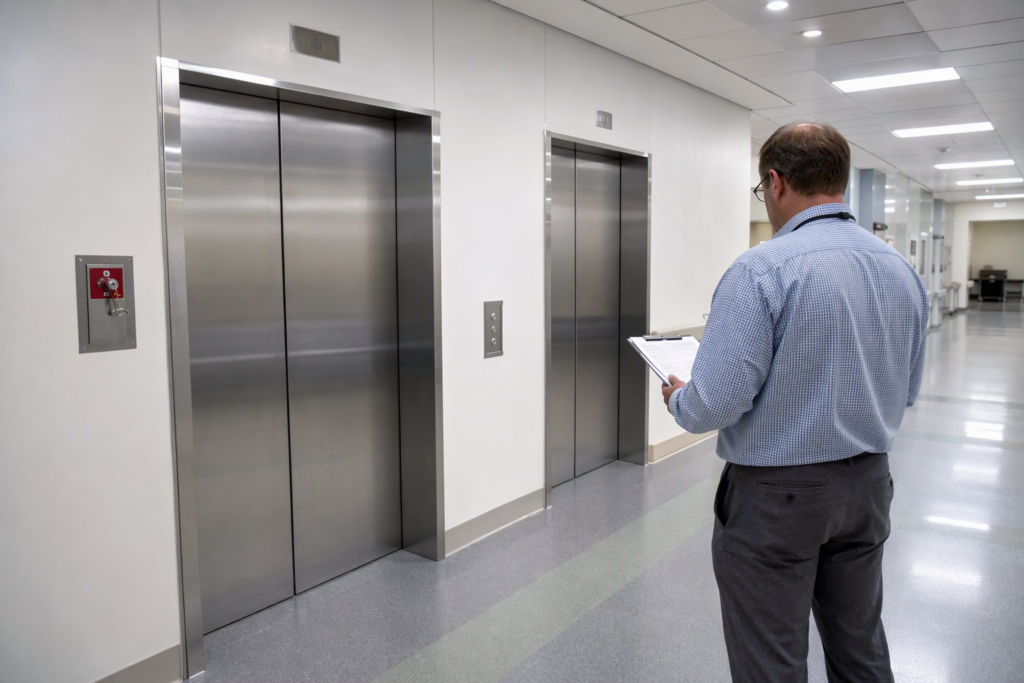
Inspectors conducting elevator reviews in hospitals and healthcare facilities — whether from a state agency, The Joint Commission, or CMS — commonly probe the following areas:
- Is the current state inspection certificate posted in or adjacent to the elevator cab?
- Are maintenance logs current, complete, and available for review on-site?
- Has the annual inspection been performed within the required interval, and was the subsequent test (five-year category test, where due) completed and witnessed?
- Are fire service recall systems (Phase I and Phase II) operational and tested per ASME A17.1 requirements?
- Is the emergency lighting functional inside the cab?
- Is the two-way emergency communication system operational and connected to a continuously monitored location?
- Are door safety devices (infrared curtains or safety edges) functioning properly, and is the door open dwell time set appropriately for patient transport?
- Are the cab’s weight capacity and floor ratings clearly posted?
- Has any out-of-service elevator been tagged, locked out, and documented per OSHA lockout/tagout procedures?
- Are there any open violations or deferred deficiencies from the last inspection, and is there a documented remediation plan?
—
What Are the Consequences of Elevator Code Non-Compliance in a Healthcare Facility?
Non-compliance carries consequences beyond a failed inspection certificate:
- Mandatory shutdown orders — State elevator safety programs can order an elevator taken out of service immediately if an unsafe condition is found, disrupting patient transport operations.
- Joint Commission findings — Elevator deficiencies cited under Environment of Care standards can trigger a Required Improvement report and jeopardize accreditation status.
- CMS survey deficiencies — Serious life-safety deficiencies can put Medicare and Medicaid certification at risk.
- ADA enforcement — Accessibility violations can result in federal civil rights complaints and litigation.
- Liability exposure — A code-deficient elevator involved in a patient injury event creates significant tort liability for the facility.
—
What Is Involved in Elevator Modernization for a Healthcare Facility?
Aging elevators in hospitals often require modernization rather than wholesale replacement. A code-compliant modernization typically addresses:
- Controls upgrade — Replacing relay-logic controllers with solid-state microprocessor controls improves reliability and enables current code-required safety functions.
- Door operator replacement — Modern door operators with variable-frequency drives provide smoother, more reliable door operation and support extended dwell-time programming for patient transport.
- Machine and drive modernization — Upgrading traction machines and drive systems to meet current ASME A17.1 seismic and safety requirements (critical in California markets such as Los Angeles and San Diego).
- Emergency systems update — Bringing fire service recall wiring, lighting, and communication systems into current code compliance.
- ADA compliance upgrades — Replacing buttons, adding tactile signage, and updating auditory indicators.
- Permit and inspection coordination — Modernization work requires permits and final inspection by the applicable state authority.
AmeriTex Elevator approaches healthcare modernization projects with scheduling sensitivity, understanding that elevator downtime in an active hospital must be carefully planned around patient care operations.
—
How Should a Healthcare Facility Choose an Elevator Service Provider?
When evaluating elevator maintenance and service vendors, healthcare facility managers should confirm:
- The vendor holds the required state contractor licenses for elevator work in the applicable jurisdiction (Texas Department of Insurance or California DOSH, as applicable).
- The vendor demonstrates documented familiarity with healthcare-specific code requirements, including Joint Commission and CMS documentation expectations.
- The vendor provides organized, audit-ready maintenance records that support accreditation surveys.
- The vendor has established protocols for emergency service calls that minimize elevator downtime in clinical environments.
- The vendor can manage full-service modernization under permit, including coordination with state inspectors for witnessing of category tests.
AmeriTex Elevator serves healthcare clients across Texas and California, including Houston, Dallas, Austin, San Antonio, Los Angeles, and San Diego, providing maintenance programs and modernization services designed for the compliance demands of healthcare occupancies.
—
Does Elevator Code Vary Between Texas and California for Healthcare Facilities?
Yes. While both states base their requirements on ASME A17.1, enforcement mechanisms and adopted code editions differ:
- Texas: The Texas Department of Insurance (TDI) administers the elevator safety program. Licensed elevator contractors and inspectors must be registered with TDI. Inspection certificates are issued by TDI or its authorized inspectors.
- California: Cal/OSHA administers elevator safety through its Elevator, Ride, and Tramway Unit. California also maintains its own amendments to the base ASME standard, and seismic requirements in Los Angeles and San Diego add complexity for traction elevator installations and modernizations.
Facilities operating in multiple states — such as health systems with campuses in both Texas and California — benefit from a service provider with multi-state operational capability, as AmeriTex Elevator maintains in its service markets.
—
What Should a Healthcare Facility Do if an Elevator Fails Inspection?
- Review the inspection deficiency report immediately to determine whether the elevator must be taken out of service or may continue operating under a conditional notice.
- Post required out-of-service notices and implement lockout/tagout procedures per OSHA standards if the elevator is removed from service.
- Activate the facility’s vertical transportation contingency plan to route patient transport through available compliant elevators.
- Contact a licensed elevator contractor to assess and remediate the cited deficiencies.
- Document all corrective actions taken, including parts replaced, adjustments made, and dates of service.
- Coordinate with the state authority for a re-inspection or witnessing of required tests before returning the elevator to service.
- Update maintenance records and ensure the new certificate is posted before resuming operation.
- Notify the facility’s accreditation liaison and risk management of the event and resolution for Environment of Care documentation purposes.
—
How Much Does Healthcare Elevator Compliance Maintenance Cost?
Maintenance and compliance costs vary based on the number of elevators, equipment age, cab type, required test categories, and local labor markets. Facilities in urban markets such as Los Angeles, San Diego, and Houston will experience different cost structures than smaller markets. Because pricing depends on a site-specific assessment of equipment condition, configuration, and compliance gaps, any meaningful cost guidance requires an on-site evaluation. A free elevator assessment from AmeriTex Elevator provides a documented baseline of current compliance status and a clear picture of what maintenance or modernization investment is required.
—
Get a Free Healthcare Elevator Compliance Assessment
Healthcare facility operators in Houston, Dallas, Austin, San Antonio, Los Angeles, and San Diego can schedule a no-obligation elevator assessment with AmeriTex Elevator. A qualified representative will evaluate your equipment’s current compliance status against applicable ASME A17.1, ADA, and state-specific requirements, and provide a documented findings report suitable for facility management review.
Contact AmeriTex Elevator for a free elevator assessment: 866-679-4313
Need elevator service you can rely on? AmeriTex Elevator is ready to help.