What Happens If My Building Elevator Fails Inspection and Gets Shut Down by the State?
A state-ordered elevator shutdown is one of the most disruptive events a building owner or property manager can face. Understanding the full process — from the initial shutdown notice through violation correction, re-inspection, and return to service — is essential to minimizing downtime, legal exposure, and liability. This comprehensive FAQ covers every stage of the process, including applicable codes, state-specific requirements in Texas and California, and practical steps to get your elevator running again as quickly as possible.
1. What does it mean when a state inspector “shuts down” an elevator?
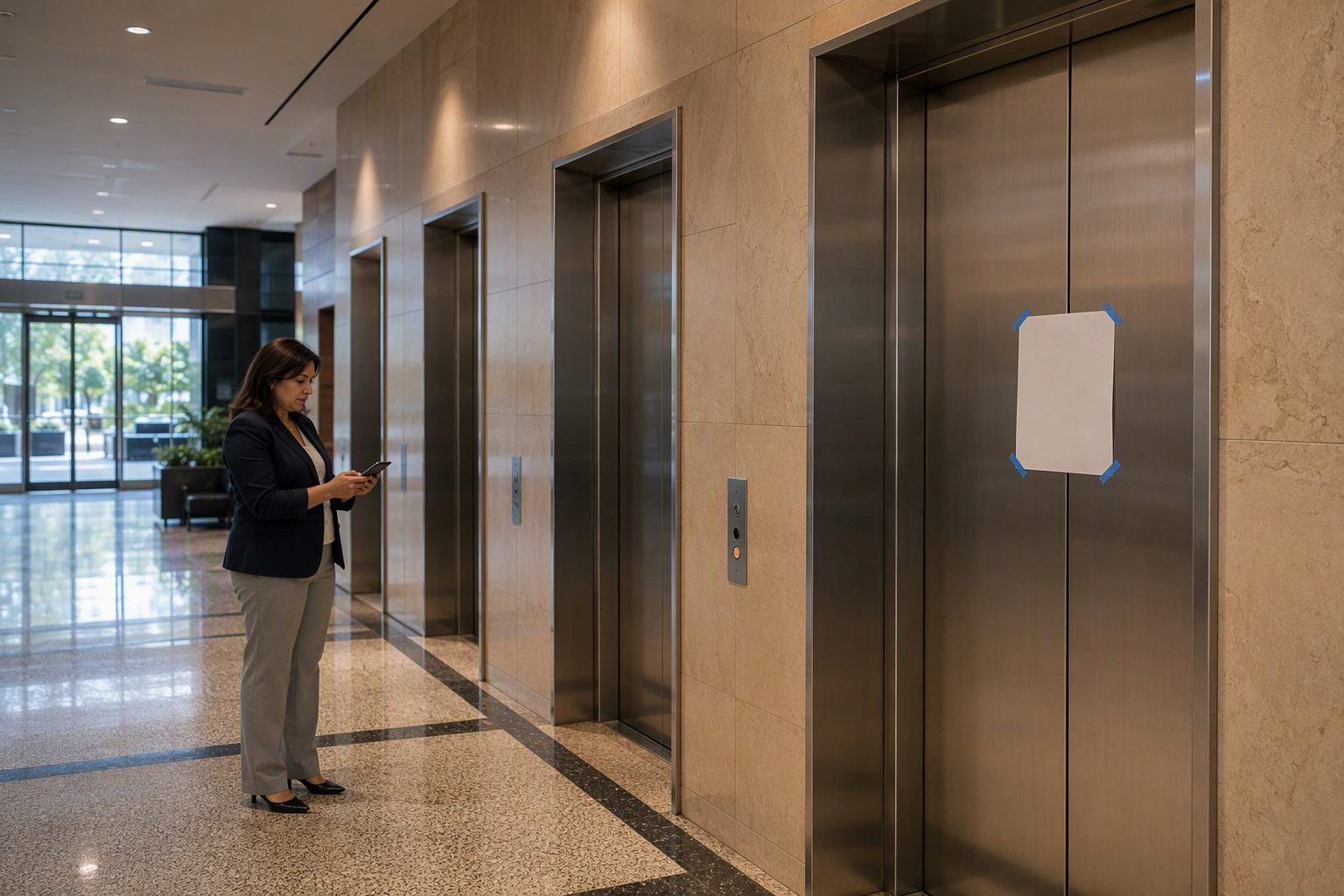
A state-ordered shutdown means the elevator has been officially removed from service by a government authority after failing to meet minimum safety standards, and the unit may not be operated — even briefly — until compliance is restored and a new certificate of operation is issued.
When a state elevator inspector determines that an elevator presents a hazard or fails to meet applicable code requirements, they have the legal authority to post a shutdown notice, remove or revoke the certificate of operation, and in some jurisdictions physically lock or tag the equipment out of service. The shutdown is a legal order, not a suggestion. Operating a shut-down elevator exposes building owners to significant civil and criminal penalties, and any injuries that occur on an illegally operating elevator create enormous liability exposure.
The governing safety standard for elevator design and maintenance in the United States is the ASME A17.1 Safety Code for Elevators and Escalators. Both Texas and California adopt and enforce editions of this standard through their respective state agencies.
2. Which state agencies have authority to shut down an elevator in Texas and California?
In Texas, the Texas Department of Insurance (TDI) oversees elevator safety and enforcement; in California, the Division of Occupational Safety and Health (Cal/OSHA) holds that authority.
In Texas, TDI’s Elevator Safety Program licenses elevator contractors, registers equipment, and enforces compliance with the adopted edition of ASME A17.1. Inspections may be conducted by TDI inspectors or by TDI-licensed third-party inspectors. In California, Cal/OSHA’s Elevator, Ride, and Tramway Unit (ERT Unit) enforces Title 8 of the California Code of Regulations as it applies to elevators, and its regulations incorporate ASME A17.1 by reference. Buildings in cities such as Los Angeles and San Diego interact with Cal/OSHA as the primary enforcement body.
3. What are the most common reasons an elevator fails inspection and gets shut down?
The most common causes of elevator shutdown include governor and safety device failures, overdue or missing annual inspections, broken door interlocks, hydraulic fluid leaks, worn or broken hoistway equipment, and non-functional emergency communication systems.
Under ASME A17.1, every elevator must maintain a functional governor, safety device, buffers, guide rails, door interlocks, and emergency lighting. Inspectors also verify that the certificate of operation is current and posted inside the car. Failure in any of these areas can trigger a shutdown order. Common housekeeping violations — such as an expired certificate or missing pit lighting — can also result in shutdown even when the mechanical systems are otherwise functional.
4. What should a building owner or property manager do immediately after receiving a shutdown order?
The moment a shutdown order is received, building management must stop elevator operation immediately, notify occupants, contact a licensed elevator service company, and begin documenting all cited violations.
- Stop all elevator operation. Post clear signage on every landing indicating the elevator is out of service. Do not allow anyone — including maintenance staff — to operate the unit.
- Read the shutdown notice carefully. The notice will list specific code violations by section number. Retain this document; it is the roadmap for re-inspection.
- Notify all building occupants and tenants. If the building houses individuals with mobility impairments, activate your ADA accommodation plan immediately. Review your obligations under the Americans with Disabilities Act.
- Contact a licensed elevator service company. Only a contractor licensed in the relevant state may perform corrective work. Contact AmeriTex Elevator to dispatch a certified technician to assess the violations and provide a scope of repair.
- Do not attempt unauthorized repairs. Unauthorized or uncertified repairs can result in additional violations, added penalties, and may void any insurance coverage.
- Request a copy of the inspection report. This provides the official record of every cited deficiency and is required for the re-inspection application.
- Notify your insurance carrier. An elevator shutdown is a material change in building conditions that may affect your liability coverage.
- Establish an ADA-compliant accommodation plan. Depending on building type and occupancy, you may need to provide alternative access or assistance to residents or employees with disabilities for the duration of the shutdown.
5. Are building owners legally required to notify tenants when an elevator is shut down?
Yes — building owners have notification obligations to tenants under local landlord-tenant laws, and may have additional obligations under the ADA when the shutdown affects accessible routes for people with disabilities.
In Texas, landlord-tenant statutes require that landlords maintain rental property in a habitable and safe condition. An extended elevator outage in a high-rise residential building can be considered a habitability issue, particularly for tenants on upper floors or those who rely on the elevator for accessibility. California has similarly strong tenant protection statutes. The Americans with Disabilities Act requires that buildings covered under Title II or Title III maintain accessible routes; a prolonged elevator shutdown without alternative accommodation can constitute an ADA violation independent of the elevator safety violation itself.
6. How long does a building typically remain shut down after a failed elevator inspection?
The shutdown duration depends entirely on the nature and severity of the violations — minor administrative issues may be resolved in days, while major mechanical failures or code upgrades can extend a shutdown to several weeks or longer.
There is no fixed statutory timeline for how long a shutdown lasts, because the duration is driven by parts availability, the scope of repairs required, the backlog for re-inspection scheduling, and contractor availability. Simple violations such as an expired certificate or missing pit stop switch may be corrected within one to three business days. Complex violations involving hoistway equipment, traction machine overhaul, or hydraulic cylinder replacement can take weeks. Working with an experienced elevator service company that maintains parts inventory and has established relationships with state inspection offices is the most effective way to minimize downtime.
7. What violations typically require the most time to correct?
Violations involving hydraulic cylinders, governor replacements, machine room fire protection upgrades, and hoistway structural modifications typically require the longest repair timelines due to parts lead times and the complexity of the work.
| Violation Type | Applicable Code Reference | Typical Complexity | General Timeline |
|---|---|---|---|
| Expired certificate of operation | State-specific registration requirement | Administrative | 1–3 business days |
| Missing or non-functional pit stop switch | ASME A17.1 | Low | 1–5 business days |
| Door interlock failure | ASME A17.1 | Low to Medium | 2–7 business days |
| Governor or safety device deficiency | ASME A17.1 | Medium to High | 1–3 weeks |
| Hydraulic fluid leak / cylinder deficiency | ASME A17.1 | High | 2–6 weeks |
| Hoistway or machine room code upgrade | ASME A17.1 / State adoption rules | High | 4–12 weeks or more |
| Emergency communication system failure | ASME A17.1 / ADA | Low to Medium | 3–10 business days |
| Fire service recall non-compliance | ASME A17.1 | Medium | 1–2 weeks |
Note: Timelines are general estimates and will vary based on parts availability, contractor scheduling, and state re-inspection backlogs. They are not a guarantee of service duration.
8. What are the financial penalties for operating an elevator after it has been shut down?
Operating a state-shutdown elevator can result in civil fines, criminal penalties, forced closure orders, and dramatically increased liability exposure if an injury occurs.
In Texas, TDI has authority to assess civil penalties for elevator law violations. In California, Cal/OSHA may issue citations with associated civil penalties for serious violations. Beyond regulatory fines, the liability exposure from an injury on an illegally operated elevator is severe — courts in personal injury cases routinely treat operation of equipment after a government shutdown order as evidence of willful negligence. No building owner should weigh the cost of repairs against the cost of fines and litigation; the risk calculus overwhelmingly favors immediate corrective action. OSHA standards may also apply in workplaces where elevators are used by employees, adding a federal enforcement layer on top of state penalties.
9. Can a building owner appeal or contest an elevator shutdown order?
Yes — both Texas and California provide formal appeal or variance processes, but the elevator must remain out of service during any appeal unless a specific interim order is granted by the state agency.
If a building owner believes a violation citation was issued in error — for example, if an inspector misidentified a compliant component as deficient — the owner may file a formal written appeal with the relevant state agency. In Texas, appeals go through TDI’s dispute resolution process. In California, Cal/OSHA has a formal appeals process through the Occupational Safety and Health Appeals Board. Appeals take time, and the elevator remains shut down during the process. In practice, it is almost always faster and less costly to correct the violation than to pursue an appeal, unless the cited violation genuinely does not exist.
10. What is the re-inspection process after elevator repairs are completed?
After all cited violations are corrected, the building owner or licensed elevator contractor must submit a re-inspection request to the state agency, which will schedule a follow-up inspection; only upon passing re-inspection and receiving a new certificate of operation may the elevator legally return to service.
The re-inspection process typically involves submitting documentation of repairs performed, including parts records and technician reports, along with the re-inspection application and applicable fees. The state agency or its licensed third-party inspector then schedules the re-inspection. In Texas and California, re-inspection scheduling can sometimes take days to weeks depending on inspector availability and workload. AmeriTex Elevator assists building owners through every step of this documentation and coordination process to reduce delays.
11. Who is responsible for correcting the violations — the building owner or the elevator maintenance company?
The building owner bears ultimate legal responsibility for elevator compliance, but the physical repair work must be performed by a state-licensed elevator contractor — making the choice of service company a critical factor in how quickly the elevator returns to service.
The citation is issued against the building and its owner or operator. The building owner is responsible for hiring a licensed contractor to perform corrections. If the elevator was under a full maintenance contract at the time of the failed inspection, the maintenance agreement may cover some or all corrective work, depending on the contract terms. Building owners should review their maintenance agreements carefully and, if there is any dispute, consult legal counsel. Regardless of contractual arrangements, the state’s citation and shutdown order bind the building owner, not the contractor.
12. Does a failed inspection mean the elevator maintenance company is at fault?
Not necessarily — a failed inspection may indicate deferred maintenance, aging equipment, a change in code requirements, or an administrative lapse, and fault depends entirely on the specific circumstances and the terms of any existing maintenance agreement.
Some elevator failures are the result of genuinely unpredictable equipment failures. Others reflect years of deferred maintenance or a maintenance contract that did not include all necessary services. Buildings with full-service maintenance agreements that cover parts, labor, and code compliance should have fewer surprise shutdowns than buildings with basic service agreements or no maintenance contract at all. When evaluating responsibility, it is essential to compare what services were actually contracted against what the inspection found deficient.
13. What ongoing maintenance obligations exist under ASME A17.1 to prevent future shutdowns?
ASME A17.1 requires a documented maintenance program that includes periodic examination and testing of all safety devices, and both Texas and California require that maintenance records be retained and made available to inspectors.
The ASME A17.1 Safety Code for Elevators and Escalators contains requirements for periodic testing and examination, including governor and safety tests, buffer tests, and door system examinations, at specified intervals. Both Texas and California require these records to be retained by the elevator owner or maintenance contractor. A comprehensive preventive maintenance program is the most reliable way to avoid failed inspections. Building owners should request documentation of all maintenance activities performed and verify that their contractor is completing required tests on schedule.
14. How do ADA requirements interact with an elevator shutdown?
An elevator shutdown can trigger independent ADA obligations — building owners covered by the ADA must provide equivalent access to people with disabilities during any outage that affects an accessible route, or risk an ADA compliance violation separate from the elevator safety violation.
Under the Americans with Disabilities Act, Title II covers government-owned buildings and Title III covers places of public accommodation. Both require that accessible routes be maintained. When an elevator that serves as the accessible route is shut down, building owners must implement interim measures — such as providing staff assistance, rescheduling services to accessible floors, or in some cases arranging temporary alternative access — for the duration of the outage. Residential buildings covered under the Fair Housing Act face analogous obligations. Failure to provide equivalent access during an elevator shutdown can result in ADA complaints and civil rights litigation entirely separate from the elevator safety enforcement action.
15. Are there differences in elevator shutdown procedures between Texas and California?
Yes — while both states enforce editions of ASME A17.1, the enforcement agency, inspection fee structures, re-inspection scheduling processes, and specific adopted code editions differ between Texas and California.
Texas elevator regulation is administered by TDI, which uses both state inspectors and licensed third-party inspection companies. California regulation is administered by Cal/OSHA’s Elevator, Ride, and Tramway Unit, which conducts inspections through its own inspectors and through Qualified Elevator Inspectors (QEIs) operating under Cal/OSHA authority. Permit and re-inspection fees, cycle times, and documentation requirements vary. Building owners in Houston, Dallas, Austin, and San Antonio operate under TDI rules; those in Los Angeles and San Diego operate under Cal/OSHA rules. AmeriTex Elevator is familiar with the specific procedural requirements in all six markets and can guide building owners through the correct re-inspection pathway for their jurisdiction.
16. What happens if a building’s elevator has been shut down but the building houses elderly or disabled residents who cannot use stairs?
Buildings with residents who have mobility limitations must take immediate interim accommodation steps, which may include arranging temporary relocation assistance, providing staff support, or coordinating with local emergency services for residents who cannot safely remain without elevator access.
This situation represents one of the most serious consequences of an elevator shutdown in a residential setting. Under the ADA and applicable state fair housing laws, building management has affirmative obligations to ensure that disabled residents are not stranded without access. In some cases, local fire departments or emergency management agencies may become involved if residents are effectively trapped. The most effective way to prevent this scenario is through a proactive maintenance program that prevents shutdown in the first place. When a shutdown does occur, building management should immediately contact local social services or the building’s designated disability accommodation coordinator to activate an emergency access plan.
17. Can a building owner get a temporary variance or conditional operating permit to keep the elevator running while repairs are arranged?
In limited circumstances, state agencies may issue a temporary conditional operating permit or variance that allows restricted elevator use while specific repairs are being arranged, but this is not automatic and requires a formal application demonstrating that the variance does not create an imminent safety risk.
Both TDI in Texas and Cal/OSHA in California have variance processes, though approvals are not guaranteed and are typically reserved for situations where the violation does not represent an imminent hazard. For example, a deficiency in a secondary system that does not directly compromise the structural safety of the car or hoistway may be more suitable for a variance than a failed governor or broken safety device. Building owners seeking a variance should work with their licensed elevator contractor to prepare the application and supporting documentation. The likelihood of approval is significantly higher when the building has a documented history of good maintenance practices.
18. How can building owners prevent elevator failures and shutdowns proactively?
The most effective prevention strategy combines a comprehensive full-service maintenance contract with an experienced licensed elevator contractor, proactive code compliance reviews, and timely completion of all state-required periodic tests and examinations.
Building owners should ensure their maintenance agreement explicitly covers all safety device testing required under ASME A17.1, including governor tests, safety tests, and buffer tests at the required intervals. They should request written maintenance logs after each service visit and review them periodically. Annual certificate renewal deadlines should be tracked and renewals scheduled well in advance. Aging equipment should be evaluated for modernization — older hydraulic and traction systems are statistically more likely to generate inspection violations as components reach the end of their service life. AmeriTex Elevator provides preventive maintenance programs designed to help building owners in Houston, Dallas, Austin, San Antonio, Los Angeles, and San Diego stay ahead of inspection requirements.
19. What should building owners look for when selecting an elevator service company to handle violations and re-inspection?
Building owners should prioritize state licensure in the relevant jurisdiction, demonstrated familiarity with the specific inspection agency’s processes, the ability to source parts and perform repairs without excessive lead times, and transparent communication throughout the repair and re-inspection process.
Not all elevator service companies are licensed in every state. In Texas, elevator contractors must be licensed by TDI; in California, by the Contractors State License Board with appropriate classification and Cal/OSHA registration. Building owners should verify licensure before engaging any contractor. Additionally, familiarity with the specific agency’s re-inspection documentation requirements — which differ between TDI and Cal/OSHA — can significantly reduce re-inspection delays. A contractor that handles violations infrequently may not know the fastest pathway through the re-inspection process. AmeriTex Elevator operates across all six markets and works regularly with both TDI and Cal/OSHA on behalf of building owners navigating the corrective action and re-inspection process.
20. What is the single most important thing a building owner should do after an elevator is shut down?
The single most important action is to immediately engage a state-licensed elevator service company to conduct a technical assessment of the cited violations, because the speed and quality of that initial response determines how quickly the elevator can legally return to service.
Every day an elevator is out of service has real costs: tenant dissatisfaction, potential ADA liability, lost lease value in commercial buildings, and — in residential high-rises — genuine hardship for residents who depend on the elevator for basic access. The fastest path back to service is a thorough, professionally documented corrective action plan executed by a licensed contractor with the parts inventory, inspector relationships, and jurisdictional knowledge to complete repairs and navigate re-inspection efficiently. Delaying that first call adds days or weeks to an already stressful situation. Building owners should not wait to see if the problem resolves itself — it will not.
Summary: Key Takeaways for Building Owners Facing an Elevator Shutdown
- A state-ordered elevator shutdown is a legal order. Operating the elevator before receiving a new certificate of operation is illegal and creates severe liability.
- The shutdown notice lists specific ASME A17.1 violations that must be corrected before re-inspection.
- ADA obligations under the Americans with Disabilities Act continue — and may intensify — during a shutdown that affects accessible routes.
- Only a state-licensed elevator contractor may perform corrective repairs. Verify licensure before hiring.
- Texas buildings (Houston, Dallas, Austin, San Antonio) are regulated by TDI. California buildings (Los Angeles, San Diego) are regulated by Cal/OSHA.
- Proactive maintenance under a full-service contract aligned with ASME A17.1 requirements is the most effective way to prevent shutdowns.
- Repair timelines range from days for administrative issues to weeks or months for major mechanical or code compliance work.
- Document everything: the shutdown notice, all repairs performed, parts replaced, and communications with the state agency.
Get Your Elevator Back in Service — Contact AmeriTex Elevator Today
A failed elevator inspection does not have to mean weeks of downtime. AmeriTex Elevator works with building owners across Houston, Dallas, Austin, San Antonio, Los Angeles, and San Diego to assess cited violations, perform state-licensed corrective repairs, and coordinate re-inspection with TDI and Cal/OSHA — getting buildings back in compliance as efficiently as possible.
Contact AmeriTex Elevator for a free elevator assessment: 866-679-4313
Do not wait — every day your elevator is out of service increases your liability exposure and the disruption to your building’s occupants. Reach out to AmeriTex Elevator today and speak directly with a licensed elevator professional about your situation.
Need elevator service you can rely on? AmeriTex Elevator is ready to help.