Is It Cheaper to Repair or Replace an Elevator That Keeps Breaking Down?
Repair is typically the lower upfront cost, but replacement often delivers lower total cost over time when an elevator experiences chronic failures. The decision hinges on the unit’s age, the nature of the breakdowns, parts availability, current code compliance status, and the hidden cost of downtime. There is no universal answer — the right path requires a systematic evaluation of the specific unit, its service history, and the building’s operational requirements.
The sections below walk through every dimension of this decision, from cost benchmarks and compliance obligations to what triggers a mandatory replacement under ASME A17.1 Safety Code for Elevators and Escalators and applicable state and local regulations in Texas and California.
What Is the Average Useful Service Life of a Commercial Elevator?

Most commercial elevator systems are designed for a functional service life of roughly 20 to 25 years before major modernization or replacement becomes necessary, though actual longevity depends heavily on maintenance quality, usage intensity, and component type.
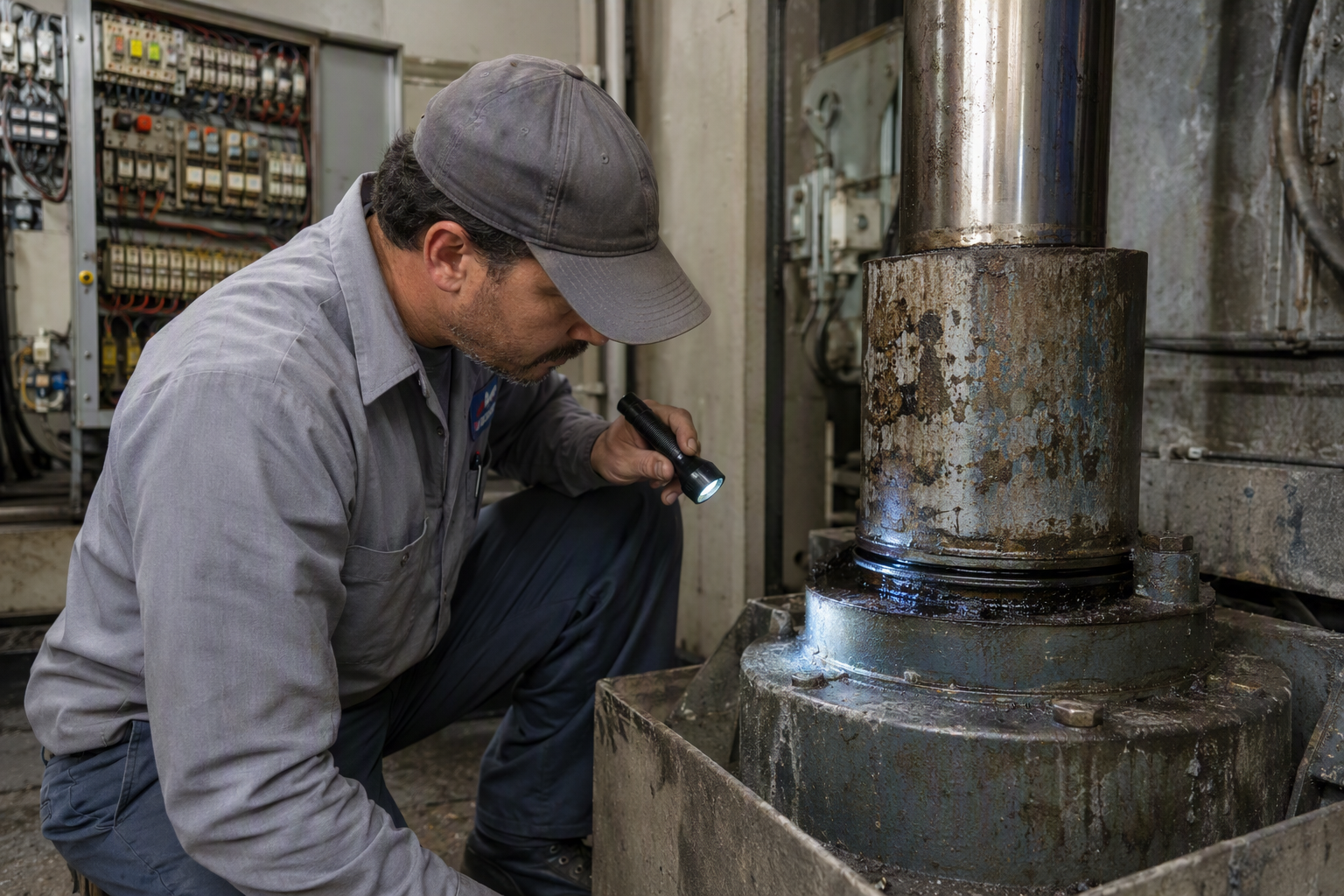
Hydraulic elevators and traction elevators have different wear profiles. Hydraulic units are subject to jack seal deterioration, fluid leakage, and cylinder corrosion — issues that can accelerate significantly after 15 to 20 years of service. Traction elevators with older relay-logic controls often outlast their control systems before the mechanical components reach end of life. When components such as the motor, sheave, guide rails, or cab structure begin failing, the elevator may be approaching the point where continued patching is economically irrational.
In 2026, many buildings are operating elevators installed in the late 1990s and early 2000s. These units are entering or past the window where comprehensive modernization is typically the most cost-rational path. A qualified elevator service company should review the complete service history and component age — not just the installation date — to project remaining service life accurately.
What Are the True Costs of Repeatedly Repairing a Failing Elevator?
The true cost of recurring repairs goes far beyond the invoice for each individual service call — it includes operational downtime, tenant or occupant dissatisfaction, potential liability exposure, and emergency call premiums.
Each unplanned outage carries costs that building owners and facility managers often underestimate. In a multi-tenant commercial building, elevator downtime can trigger lease disputes, reduce property value, and in buildings serving people with disabilities, create immediate ADA compliance risk. In healthcare, hospitality, or multifamily residential settings, the operational impact is even more acute. Emergency repair calls — those dispatched outside normal business hours — also command premium labor rates that can significantly inflate the annual repair spend for a chronically unreliable unit.
Building owners should calculate their annual repair spend over a rolling three-year period and compare it to the amortized annual cost of a replacement or modernization project financed over a standard equipment loan term. When annualized repair costs are a substantial fraction of what replacement would cost per year, the financial case for continued repair weakens considerably.
What Is the “50% Rule” for Elevator Repair vs. Replacement?
The “50% rule” is a widely used capital planning benchmark that suggests replacement or major modernization becomes the more cost-rational choice when cumulative repair costs over a defined period approach or exceed 50% of the total cost to replace or fully modernize the unit.
This benchmark is borrowed from broader capital equipment management practice and is frequently referenced by facility managers and elevator consultants as a practical decision threshold. It is not a code requirement under ASME A17.1, but it is a useful financial lens. The rule should be applied over a rolling window — typically three to five years of repair expenditure — rather than a single year, since one expensive but non-recurring repair (such as replacing a damaged cab) should not automatically trigger replacement consideration.
The benchmark is most meaningful when combined with an assessment of trajectory: if repair frequency is accelerating — meaning more calls per quarter than the year prior — it indicates the unit is entering a failure cascade, and the 50% threshold may be reached sooner than historical data suggests.
What Types of Elevator Failures Signal It Is Time to Replace Rather Than Repair?
Certain failure patterns are strong signals that replacement or comprehensive modernization is more appropriate than continued component-by-component repair, particularly when those failures involve core structural or safety-critical systems.
The following failure types most strongly indicate that a unit has reached end of economic life:
- Repeated hydraulic jack or cylinder failures — especially in older single-bottom hydraulic units where the cylinder is buried underground and is susceptible to external corrosion, replacement of the jack assembly is a major cost that may justify full system replacement.
- Motor and drive system failure — when the motor, gearbox, or variable-frequency drive fails in an older traction unit, replacement parts for legacy equipment may be unavailable or prohibitively expensive.
- Control system obsolescence — relay-logic or early solid-state controllers for which replacement boards are no longer manufactured require costly workarounds or full control modernization.
- Structural cab or rail damage — damage to guide rails, counterweights, or the cab structure itself indicates the system has suffered a failure that goes beyond normal wear.
- Repeated door operator failures — door systems are the most common source of elevator outages; persistent door failures after multiple repairs suggest the operator, clutch, and related hardware have collectively exceeded their service life.
- Rope or sheave wear beyond acceptable limits — under ASME A17.1, hoisting ropes must meet specific safety factor requirements; when ropes or the sheave they ride on are repeatedly out of tolerance, the unit poses a direct safety risk.
How Do ASME A17.1 and State Regulations Affect the Repair vs. Replace Decision?
Code compliance is not optional — when an elevator is out of compliance with ASME A17.1 Safety Code for Elevators and Escalators or applicable state regulations, the cost of bringing it into compliance must be factored into any repair estimate, and in some cases code deficiencies make continued operation of the existing unit legally untenable.
In Texas, elevator safety is regulated by the Texas Department of Insurance (TDI) under the Boiler and Pressure Vessel and Elevator Division. Texas generally adopts ASME A17.1 as its governing standard. In California, the Division of Occupational Safety and Health (Cal/OSHA) enforces elevator safety under Title 8 of the California Code of Regulations, which also references ASME A17.1. Building owners in Houston, Dallas, Austin, San Antonio, Los Angeles, and San Diego should be aware that local jurisdictions may have additional requirements layered on top of state standards.
When a repair triggers a “change of use” or involves alterations above a defined scope, the relevant edition of ASME A17.1 may require that the altered components — and sometimes adjacent systems — be brought up to the current code edition. This means a seemingly straightforward repair can cascade into a code-compliance project that effectively costs as much as modernization. A thorough pre-repair code review is essential before committing to a repair path on an older unit.
ADA requirements also apply: elevators serving the public must meet accessibility standards for cab dimensions, door timing, control height, and Braille signage. Older units may be non-compliant, and any significant alteration can trigger an obligation to remediate ADA deficiencies as well.
What Is the Typical Cost Comparison Between Elevator Repair and Modernization?
Cost ranges for elevator repair, modernization, and replacement vary significantly by unit type, building configuration, geographic market, and scope — the table below provides general benchmark ranges to help building owners frame budget expectations, not as fixed quotes.
| Scope of Work | Typical Unit Type | General Cost Range | Key Variables |
|---|---|---|---|
| Single component repair (door operator, safety device, controller board) | Hydraulic or Traction | Low-to-mid four figures | Parts availability, labor market, emergency vs. planned |
| Control system modernization only | Traction (mid-rise) | Mid-to-high five figures | Number of stops, existing wiring condition, code upgrades required |
| Partial modernization (controls + door system) | Hydraulic or Traction | Mid five figures to low six figures | Scope of code compliance upgrades, cab work included or excluded |
| Full modernization (controls, drive, doors, cab, rails) | Traction (mid-rise) | Mid-to-high six figures | Building height, freight vs. passenger, local permitting costs |
| Full replacement (new hydraulic unit, low-rise) | Hydraulic (2–4 stops) | Mid five figures to low six figures | Hoistway condition, soil conditions for jack, machine room layout |
| Full replacement (new traction unit, mid-rise) | Traction (5–10 stops) | High five figures to mid six figures | Overhead clearance, machine room or MRL configuration, local labor rates |
Note: These ranges are general industry reference points. Actual project costs require an on-site assessment. AmeriTex Elevator provides free elevator assessments for properties in Houston, Dallas, Austin, San Antonio, Los Angeles, and San Diego.
How Does Parts Availability Affect the Decision to Repair or Replace an Aging Elevator?
Parts availability is one of the most underappreciated factors in the repair-vs.-replace decision — when an elevator manufacturer has discontinued support for a product line or a controls vendor no longer produces replacement boards, repair costs can spike dramatically and lead times can stretch from days to months.
The elevator industry has experienced several significant manufacturer consolidations over the past few decades. As a result, a meaningful portion of the installed base in Texas and California consists of units for which OEM parts are no longer stocked by distributors. Technicians may be able to source refurbished or reverse-engineered alternatives, but these carry their own reliability and warranty risks. When a building is already experiencing frequent breakdowns on a unit with limited parts availability, the risk of a future breakdown that cannot be quickly remedied — leaving the elevator out of service for weeks — is a critical factor that tilts the decision toward replacement or modernization.
How Does Elevator Downtime Impact ADA Compliance and Liability?
Under the Americans with Disabilities Act, buildings that are required to provide accessible vertical transportation must maintain that accessibility — extended elevator downtime can constitute an ADA violation, creating legal exposure for building owners.
The ADA does not require perfection, but it does require that accessibility features be maintained in operable working condition. When an elevator that serves as the only accessible route to upper floors is repeatedly out of service due to chronic failures, the building owner faces potential complaints, civil rights investigations, and litigation. In multi-tenant commercial, retail, or hospitality properties, this liability exposure is a material financial risk that should be quantified alongside direct repair costs when evaluating the repair-vs.-replace decision.
What Should Building Owners Do Immediately When an Elevator Keeps Breaking Down?
When an elevator begins experiencing repeated failures, there is a defined sequence of actions that building owners and facility managers should take to protect safety, preserve documentation, and make an informed decision about the path forward.
- Take the unit out of service immediately if any failure involves a safety-critical system — including unexpected movement, leveling errors, door entrapment, or abnormal noise. Do not operate the elevator until a qualified technician has cleared it.
- Notify your elevator service company and request an emergency inspection and written failure report documenting the specific component that failed, the likely cause, and any related systems that may be at risk.
- Document every service call — date, nature of failure, component replaced or adjusted, and cost. This maintenance log becomes the foundation of any repair-vs.-replace analysis.
- Pull the elevator’s inspection and violation history from the relevant state authority — TDI in Texas or Cal/OSHA in California — to identify any open violations or overdue inspections.
- Request a comprehensive condition assessment from a qualified elevator service provider. This should include evaluation of all major systems: controls, drive, roping, doors, safeties, buffers, and cab structure.
- Obtain a modernization or replacement estimate alongside any repair estimate so both options can be compared on a total cost of ownership basis, not just immediate outlay.
- Consult with a licensed elevator consultant or your insurance carrier if the unit has a history of entrapments or safety-related incidents, as these events may affect your coverage terms.
- Notify affected tenants or occupants in writing of the status and expected timeline, and document that notification to demonstrate good-faith compliance effort if an ADA complaint is filed during the outage.
What Is Elevator Modernization and How Does It Differ From Full Replacement?
Elevator modernization involves replacing major subsystems — typically the control system, drive, and door equipment — while retaining the existing hoistway structure, guide rails, and cab shell, whereas full replacement removes and replaces the entire elevator system including the structural components.
Modernization is generally less expensive and faster to complete than full replacement because it avoids the cost of hoistway construction or modification. It is the most common intervention for traction elevators in the 15-to-30-year age range that have sound structural bones but outdated or failing electromechanical systems. Modernization also typically delivers significant improvements in ride quality, energy efficiency, and code compliance that repair alone cannot achieve.
Full replacement is appropriate when the hoistway, jack assembly (for hydraulic units), or structural components are themselves compromised, when the building’s vertical transportation requirements have changed substantially (additional floors, higher traffic volume, different load requirements), or when the cost differential between modernization and full replacement is narrow enough that replacement’s longer service life provides better long-term value.
AmeriTex Elevator evaluates both paths for clients across its Texas and California markets, providing side-by-side analysis to help ownership teams make the decision with full cost and compliance context.
Does the Type of Elevator (Hydraulic vs. Traction) Affect Whether Repair or Replacement Is Better?
Yes — the elevator’s drive type significantly affects the repair-vs.-replace calculus because hydraulic and traction systems have different failure modes, component costs, and modernization options.
Hydraulic elevators are common in low-rise applications (typically two to five stops) and are generally less expensive to install than traction systems. However, aging hydraulic units face specific challenges: underground cylinder corrosion is a serious and expensive problem in older single-bottom-jack installations, and environmental regulations in many jurisdictions require leak detection or secondary containment for hydraulic fluid systems. The cost to address a compromised cylinder, combined with required environmental compliance upgrades, can make replacement more attractive for hydraulic units than the same situation would for a comparable traction elevator.
Traction elevators — including conventional geared and gearless machines, as well as more recent machine-room-less (MRL) designs — have longer expected service lives for their mechanical components, but their control systems and door equipment are typically the first to fail. Because the structural components of a traction elevator are often still serviceable long after the controls and doors have reached end of life, modernization (rather than full replacement) is frequently the right answer for traction units in the 20-to-30-year range.
How Do Energy Efficiency Considerations Factor Into the Repair vs. Replace Decision?
Modern elevator systems — particularly those with variable-frequency drives, regenerative drives, and LED cab lighting — consume substantially less energy than legacy equipment, and in a high-usage building, the energy savings from modernization or replacement can contribute meaningfully to the overall return on investment calculation.
Older hydraulic systems with single-speed motors are particularly inefficient by current standards, as they run the motor at full load during every start cycle regardless of actual load in the cab. Older traction systems with DC motors and resistance-based speed control also waste significant energy as heat. When a building owner is comparing the total cost of repair against the total cost of modernization, the utility savings from a modern drive system — which can be estimated based on the building’s actual usage patterns — should be added to the modernization side of the ledger.
Some utility providers in Texas and California offer rebate programs for energy-efficient building equipment upgrades. Building owners should consult with their utility representative to determine whether elevator modernization qualifies for any available incentives in their market.
What Role Does Insurance Play in the Elevator Repair vs. Replace Decision?
An elevator’s claims history — including entrapments, injuries, and property damage — can affect a building’s insurance premiums and, in some cases, an insurer’s willingness to continue coverage without requiring specific upgrades.
When a unit has a documented history of repeated mechanical failures, insurers may flag it as an increased risk during policy renewal. Some carriers include elevator-specific endorsements or exclusions that are triggered by a unit’s maintenance status or inspection record. A building owner contemplating continued repair on a chronically failing elevator should review their current policy terms and consult with their broker to understand whether the unit’s condition creates coverage gaps or premium impacts that should be factored into the decision.
OSHA standards also apply in occupational settings — when elevator failures create risk of injury to building workers, maintenance staff, or the public, the regulatory and liability stakes go beyond the equipment itself.
How Long Does Elevator Modernization or Replacement Take, and What Is the Disruption Impact?
The timeline for elevator modernization typically ranges from several weeks to several months depending on the scope of work, parts lead times, permitting, and inspection scheduling — full replacement projects generally take longer and involve a more intensive construction phase.
For building owners in Houston, Dallas, Austin, San Antonio, Los Angeles, and San Diego, permitting timelines vary by jurisdiction and can add weeks to a project schedule. Local inspection authority backlogs — particularly in high-activity urban markets — should also be factored into timeline planning. In multi-elevator buildings, modernization or replacement projects can often be sequenced so that at least one elevator remains in service throughout, minimizing occupant disruption. In single-elevator buildings, a temporary lift or hoisting provision may be required, or the project may need to be staged around occupancy schedules.
The disruption cost of a planned modernization or replacement project — where the elevator is intentionally taken out of service on a known schedule with advance notice — is typically far more manageable than the cumulative disruption of repeated unplanned outages over the same period.
What Questions Should Building Owners Ask When Getting Elevator Repair or Replacement Bids?
Selecting an elevator service provider for a repair, modernization, or replacement project requires asking the right questions to ensure the bid accurately reflects the full scope, code compliance requirements, and long-term support commitment.
- Does the estimate include all required code compliance upgrades? A low bid that excludes code-required work will have change orders that inflate the final cost.
- What is the warranty on parts and labor? Understand both the duration and what is covered — some warranties exclude wear items or require the same contractor to perform ongoing maintenance.
- Are replacement parts proprietary or open-market? Proprietary systems can lock a building into a single-vendor service relationship for the life of the equipment.
- Who will perform the work — direct employees or subcontractors? This affects accountability and consistency of workmanship.
- What is the expected timeline and how will permitting be managed? The contractor should be responsible for securing all permits and coordinating inspections.
- What does the post-completion maintenance plan include? A modernization or replacement that is not followed by a comprehensive preventive maintenance program will begin degrading immediately.
- Does the contractor have experience with this specific equipment type and building configuration? Traction high-rise work, underground hydraulic cylinder replacement, and MRL installations each require specific expertise.
AmeriTex Elevator serves commercial and residential property owners across Houston, Dallas, Austin, San Antonio, Los Angeles, and San Diego with full-service repair, modernization, replacement, and ongoing maintenance programs. Requesting a free assessment is the recommended first step for any building owner facing a chronic elevator problem.
How Often Should an Elevator Be Inspected to Catch Problems Before They Become Costly Failures?
Under ASME A17.1 Safety Code for Elevators and Escalators, elevators must undergo periodic inspections by a qualified inspector at intervals defined by the applicable jurisdiction — in Texas and California, annual inspections are required at minimum, and most jurisdictions require both an annual periodic inspection and a periodic no-load safety test.
Inspections are a legal requirement, not a best-practice recommendation. In Texas, certificates of inspection are issued by the TDI and must be posted in the elevator car. In California, Cal/OSHA enforces inspection requirements and certificates must similarly be maintained. Operating an elevator with an expired certificate is a violation that can result in mandatory shutdown.
Beyond mandatory inspections, a well-structured preventive maintenance program — typically monthly or quarterly visits depending on usage intensity — is the most effective tool for identifying developing problems before they become failures. Elevators that receive consistent, thorough preventive maintenance have demonstrably longer intervals between unplanned outages than those that receive only reactive repair service. Building owners who are experiencing frequent breakdowns should audit whether their current maintenance contract is truly comprehensive or primarily reactive in its scope.
Can Preventive Maintenance Alone Fix a Chronically Failing Elevator?
Preventive maintenance can significantly reduce failure frequency and extend the useful life of elevator components, but it cannot reverse the effects of end-of-life equipment or restore the functionality of components that have worn beyond serviceable limits.
A comprehensive preventive maintenance program includes lubrication of all mechanical components, adjustment of door timing and sensitive edges, testing of safety devices and governors, inspection of roping and sheave wear, cleaning of machine room and pit, and evaluation of control system performance. When performed consistently and thoroughly, this type of program catches developing problems early — before a failing contact, drying lubricant, or misadjusted door causes an outage.
However, when an elevator’s core systems — its control logic, drive motor, or hydraulic power unit — are at end of life, no amount of preventive maintenance will prevent eventual failure. Maintenance extends the useful life of components that are still within their serviceable range; it does not indefinitely defer the inevitable replacement of components that have reached the end of theirs. The distinction matters because building owners sometimes invest in enhanced maintenance contracts hoping to avoid a modernization capital expenditure, only to find that outage frequency continues to climb regardless.
How Should a Building Owner Evaluate an Elevator Service Company for This Type of Decision?
When an elevator is chronically failing, the building owner needs a service partner who can provide an objective, documented condition assessment — not simply a company motivated to sell the highest-value intervention or, conversely, to keep billing recurring repair calls.
Key indicators of a trustworthy elevator service company for this purpose include: willingness to provide a written condition assessment that documents specific component conditions rather than general opinions; experience with the specific equipment brand and type in question; familiarity with local permitting and inspection requirements in the building’s jurisdiction; and a transparent explanation of what both the repair and replacement or modernization paths would entail, including code compliance implications.
AmeriTex Elevator offers free elevator assessments for properties in Houston, Dallas, Austin, San Antonio, Los Angeles, and San Diego — providing building owners with the documented, objective information they need to make a sound capital decision about their elevator system.
What Financing Options Are Typically Available for Elevator Modernization or Replacement?
Elevator modernization and replacement projects are capital expenditures that many building owners finance through equipment loans, building improvement lines of credit, or capital lease arrangements rather than paying entirely from operating budgets.
The availability and terms of financing depend on the building owner’s credit profile, the property type, and the lender. Some elevator manufacturers and service companies offer financing programs for qualified customers. For properties in HOA-governed residential communities, a special assessment or reserve fund draw may be the appropriate funding mechanism. For commercial landlords, the cost of elevator modernization or replacement may qualify as a depreciable capital improvement under applicable tax treatment — building owners should consult their tax advisor regarding the specific treatment under current IRS guidance.
Regardless of the financing mechanism, comparing the annual debt service cost of a modernization project against the annual cost of continued repair — including emergency service premiums, downtime-related costs, and insurance impacts — often makes the financial case for modernization clearer than a simple upfront cost comparison would suggest.
Contact AmeriTex Elevator for a Free Elevator Assessment
If an elevator in a building you own or manage is experiencing repeated breakdowns, the first step is an objective, documented condition assessment by a qualified elevator service company — not another reactive repair call.
AmeriTex Elevator serves commercial and residential property owners across Houston TX, Dallas TX, Austin TX, San Antonio TX, Los Angeles CA, and San Diego CA with comprehensive elevator repair, modernization, replacement, and preventive maintenance services. A free elevator assessment includes a review of the unit’s service history, a physical inspection of all major systems, identification of any open code compliance issues, and a clear comparison of the repair, modernization, and replacement options available for the specific unit.
Do not wait for the next breakdown to make this decision. Proactive evaluation protects building occupants, reduces liability exposure, and gives ownership teams the information they need to plan intelligently for a capital investment rather than reacting to a crisis.
Contact AmeriTex Elevator for a free elevator assessment: 866-679-4313
Need elevator service you can rely on? AmeriTex Elevator is ready to help.