How Many Elevator Breakdowns Per Year Is Normal — and When Should You Start Worrying?
One to three minor service interruptions per year is a reasonable baseline for a properly maintained elevator operating under normal load conditions. When breakdowns become more frequent, involve entrapments, repeat the same failure pattern, or trigger citations during state inspections, building owners should treat that as a red flag requiring immediate professional evaluation — not routine scheduling.
The full picture is more nuanced. Breakdown frequency depends on equipment age, maintenance contract quality, traffic volume, local code compliance, and how quickly issues are reported and addressed. The sections below answer every related question building owners, property managers, and facilities directors typically ask about elevator reliability, compliance, and when to escalate to a specialist.
What Is a “Normal” Number of Elevator Breakdowns Per Year?
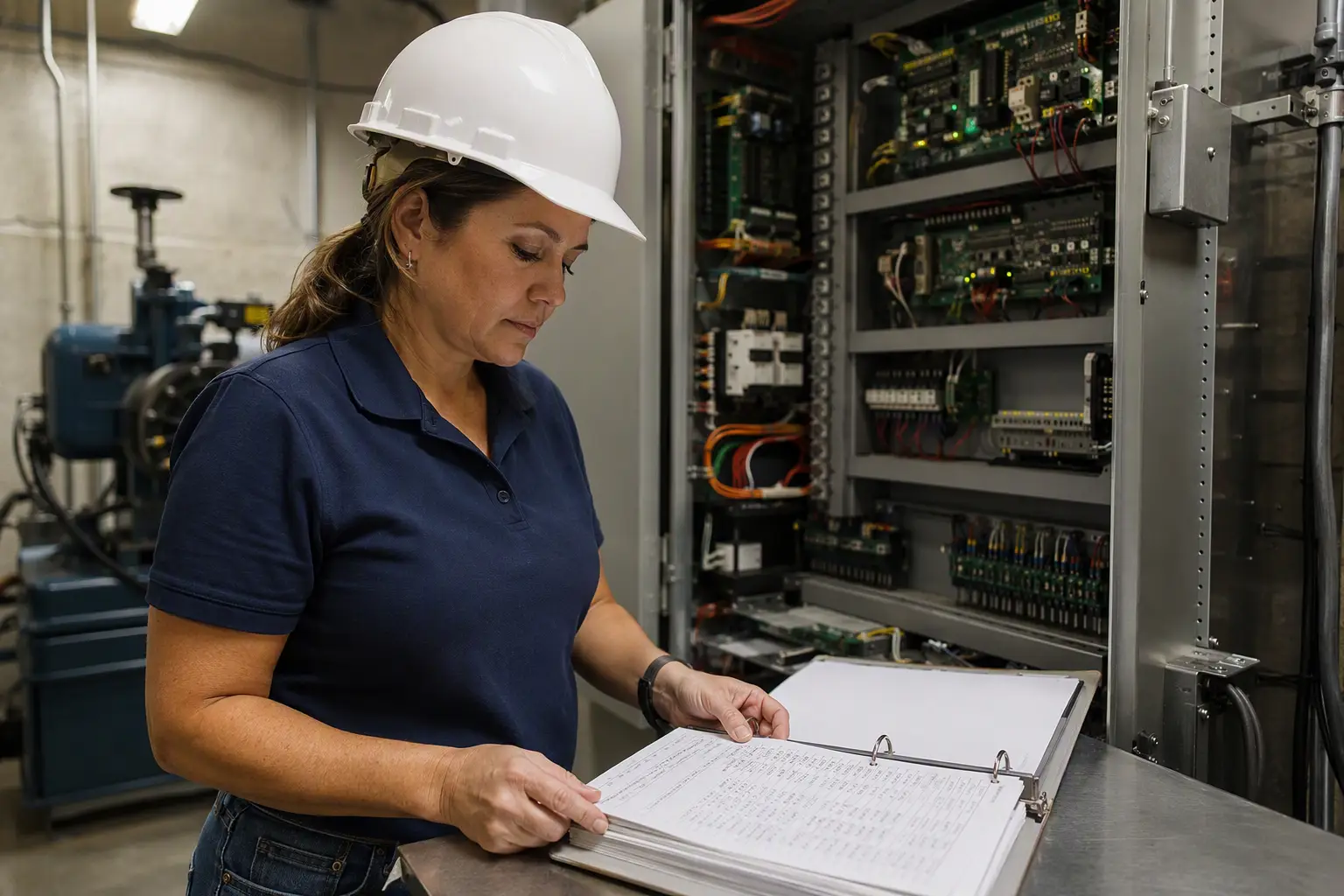
For a well-maintained elevator in average commercial use, one to three service calls per year for minor issues is within an acceptable range; anything beyond that warrants a closer look at maintenance practices and equipment condition.
The word “breakdown” covers a wide spectrum. A door that hesitates and requires a technician reset is categorically different from a hydraulic system failure that traps passengers for an hour. Property managers benefit from distinguishing between nuisance calls — minor faults cleared quickly — and genuine mechanical failures that take the unit out of service for extended periods.
High-traffic installations such as hospitals, large office towers, and multi-family residential buildings with dozens of daily trips will naturally experience wear patterns different from low-rise office buildings with moderate use. Age is another critical variable: older traction or hydraulic systems without modernized controls generate more fault codes and require more frequent intervention than recently installed or recently modernized units.
If a single elevator is generating five or more service calls per year — particularly for the same recurring fault — that pattern suggests a systemic issue rather than ordinary wear, and a comprehensive diagnostic inspection is warranted.
What Are the Industry Benchmarks for Elevator Reliability?
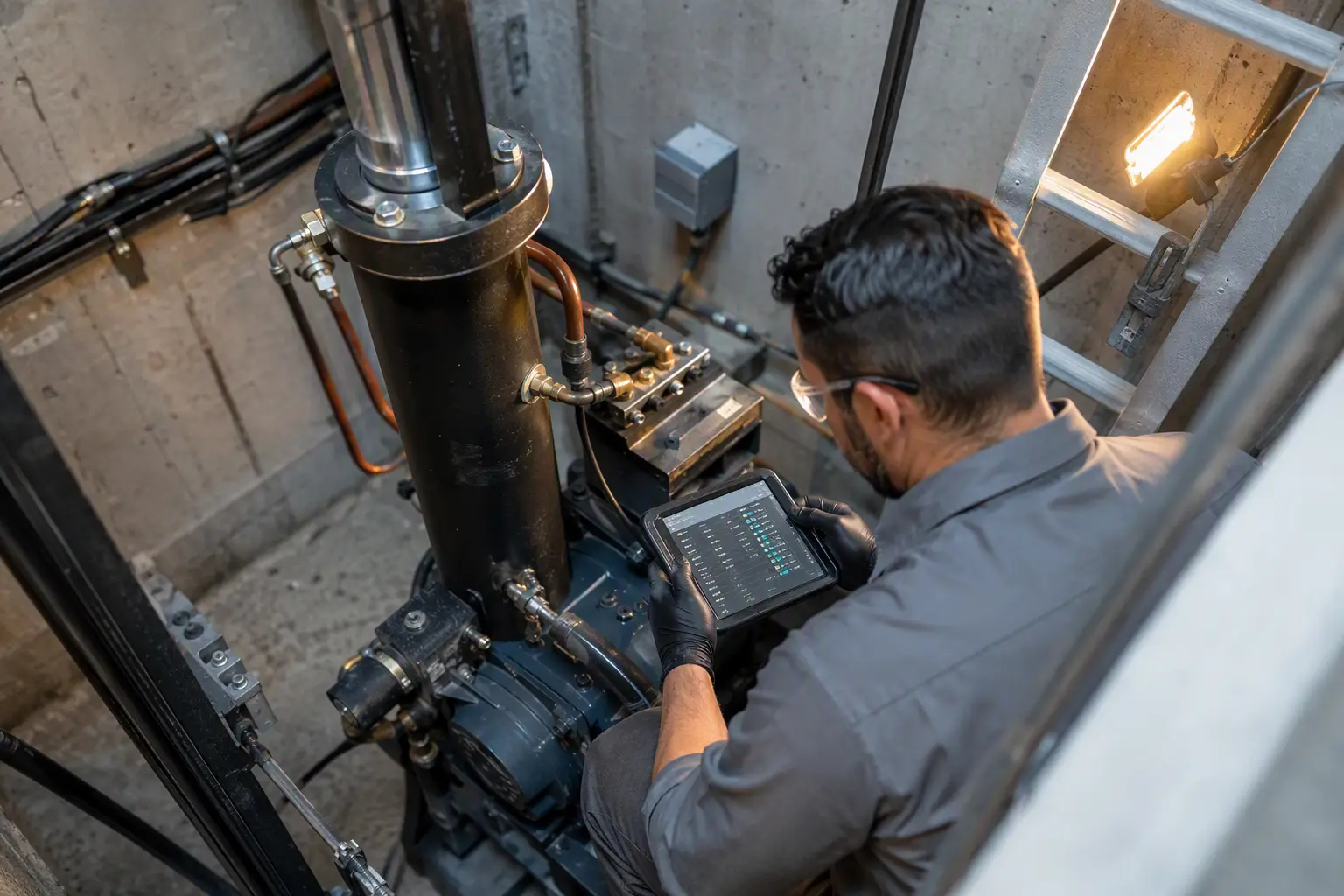
While no single universal reliability standard exists for all elevator types, maintenance contract specifications and elevator consulting guidelines consistently treat repeat breakdowns, entrapments, and extended outages as measurable KPIs that building owners should track.
The table below provides a practical benchmark framework that facilities managers can use to evaluate their own elevator’s performance relative to reasonable expectations. These ranges reflect general industry guidance and should be calibrated to the specific equipment, age, and traffic profile of each installation.
| Performance Indicator | Acceptable Range | Concern Threshold | Critical / Act Now |
|---|---|---|---|
| Service calls per elevator per year (minor) | 1 – 3 | 4 – 5 | 6+ |
| Passenger entrapments per year | 0 | 1 | 2+ |
| Mean time between failures (MTBF) | Improving or stable | Declining year-over-year | Sharp decline within 12 months |
| Repeat same-fault callbacks within 30 days | 0 | 1 | 2+ |
| Total downtime per year (hours) | Under 8 hours cumulative | 8 – 24 hours | Over 24 hours |
| Failed state inspection items | 0 | 1 minor item | Any major violation or shutdown order |
| Equipment age without modernization | Under 15 years | 15 – 25 years | 25+ years |
Building owners should request a written service log from their elevator maintenance provider and review it at least quarterly. A pattern of escalating calls, even for apparently minor faults, is one of the most reliable early indicators of a system approaching the end of its reliable service life.
What Code Standards Govern Elevator Maintenance and Safety in the United States?
The primary governing standard is the ASME A17.1 Safety Code for Elevators and Escalators, which establishes design, installation, inspection, testing, and maintenance requirements adopted by most U.S. jurisdictions.
ASME A17.1 is updated on a regular publication cycle, and the 2022 edition represents the most recent baseline as of 2026. States and municipalities adopt editions on varying schedules, so the applicable code version in Houston, Dallas, Austin, San Antonio, Los Angeles, or San Diego may differ slightly from the most current national edition. That is why working with a locally certified elevator company that tracks jurisdiction-specific adoptions is essential.
The companion standard ASME A17.2 covers inspector qualifications and inspection procedures. Together these documents define what constitutes a properly maintained elevator, what must be tested and at what intervals, and what deficiencies require immediate correction versus scheduled repair.
For accessibility, the Americans with Disabilities Act (ADA) mandates that elevators serving public accommodations and commercial facilities remain accessible and operational. Repeated or extended outages in buildings where elevator access is the only ADA-compliant vertical transportation route can create legal exposure under the ADA beyond ordinary maintenance liability.
Workplace elevator safety in facilities where elevators are used by employees also falls under OSHA general duty clause obligations, meaning employers have a duty to keep equipment in safe operating condition.
How Often Are Elevators Required to Be Inspected?
Most U.S. jurisdictions require a full annual inspection by a licensed elevator inspector, with periodic testing (such as five-year load tests for hydraulic units) mandated at longer intervals under ASME A17.1.
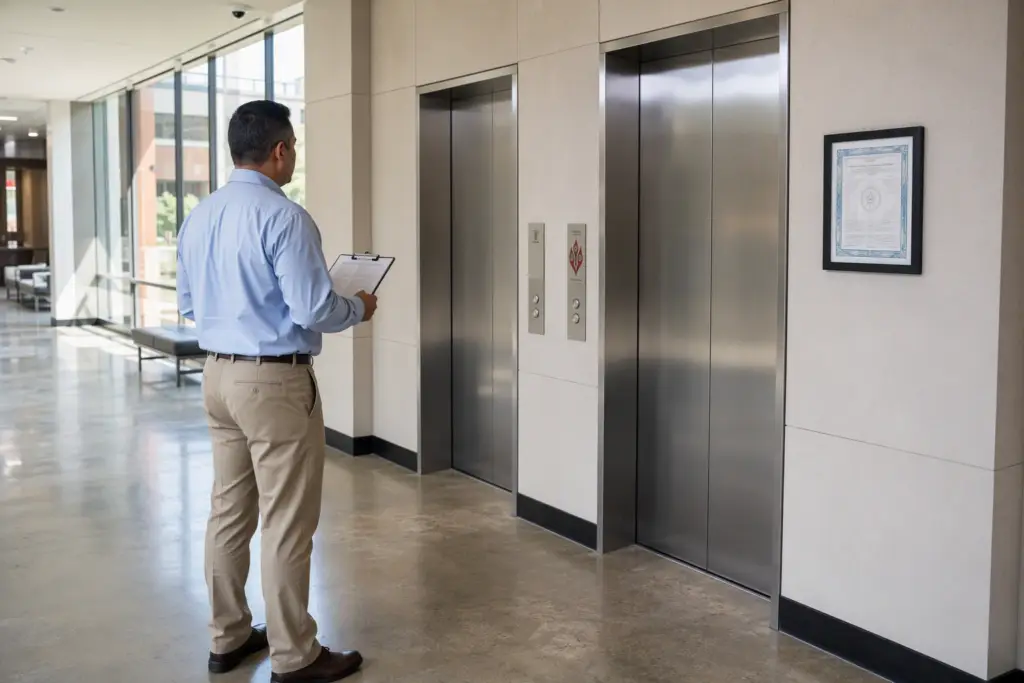
Texas state law requires annual inspections of most commercial elevators conducted by a licensed inspector, with certificates of operation posted inside the elevator cab. California similarly mandates annual inspections through the Division of Occupational Safety and Health (Cal/OSHA) for most elevator types. Failing to maintain a current inspection certificate is itself a code violation independent of the elevator’s actual mechanical condition.
Inspections are distinct from routine maintenance visits. A maintenance visit by a service technician does not substitute for a statutory inspection by a licensed third-party or state inspector. Building owners should maintain both maintenance records and inspection certificates and make them available on request.
What Are the Most Common Causes of Elevator Breakdowns?
Door system malfunctions — including worn rollers, misaligned tracks, and faulty door operators — represent the single most frequent cause of elevator service interruptions, followed by control system faults, hydraulic fluid issues, and brake or drive component wear.
Door-related problems are so prevalent because elevator doors cycle thousands of times per year and are frequently subjected to impact, obstruction, and environmental exposure. A door that does not close properly triggers safety sensors that hold the elevator at the floor, which building occupants often experience as a “breakdown” even though the underlying fault is relatively minor.
Other common failure points include:
- Control board and software faults: Modern microprocessor-based controllers can generate fault codes from electrical noise, power fluctuations, or software corruption that do not reflect physical wear.
- Hydraulic fluid leaks or contamination: In hydraulic elevators, degraded or low fluid causes sluggish travel, pressure anomalies, and potential shutdown by safety systems.
- Brake and drive machine wear: Traction elevator motors, gearboxes, and braking systems experience progressive wear that eventually manifests as leveling problems, vibration, or outright failure.
- Rope and sheave wear: Hoist ropes stretch and wear over time; sheave grooves wear unevenly, requiring periodic re-grooving or replacement.
- Safety sensor malfunctions: Light curtains, overload sensors, and pit safety devices can fail or drift out of calibration, triggering nuisance shutdowns.
When Should Building Owners Start Worrying About Breakdown Frequency?
Concern is warranted when breakdowns occur more than four times per year, when any entrapment occurs, when the same fault repeats within 30 days, or when a state inspector issues a violation or shutdown order.
Beyond raw frequency, the nature of failures matters enormously. A pattern of door holdbacks caused by worn rollers is a maintenance issue. A pattern of the elevator stopping between floors or failing to respond to calls suggests a control system or safety circuit problem that carries serious passenger safety implications.
Red flags that should prompt an immediate call to a qualified elevator service company include:
- Any passenger entrapment, regardless of duration
- Unusual noises — grinding, banging, or squealing — during travel
- Leveling problems where the cab does not align flush with the floor landing
- Visible hydraulic fluid outside the cylinder or in the pit
- Burned electrical smell or visible scorch marks near control panels
- Erratic behavior such as the elevator traveling to the wrong floor
- A state inspector citation requiring corrective action
What Should You Do Immediately After an Elevator Breakdown or Entrapment?
Passenger safety is the first priority; follow this sequence immediately when a breakdown or entrapment occurs.
- Do not attempt to force open elevator doors or have passengers attempt self-rescue. Self-rescue from a stopped elevator creates fall and crush hazards and is explicitly prohibited by ASME A17.1 safety protocols.
- Contact passengers via the in-car emergency phone. Confirm their status, communicate calmly, and advise them to remain in the cab and avoid the doors.
- Call 911 if there is a medical emergency or if passengers are in distress. Fire departments in most jurisdictions are trained for elevator rescue operations.
- Contact your elevator service provider immediately to dispatch a qualified technician for emergency response.
- Do not return the elevator to service until a qualified technician has inspected it and cleared it for operation.
- Document the incident — date, time, floor location, number of passengers, duration, and any symptoms observed — for your maintenance records and potential regulatory reporting.
- Report the incident as required by local jurisdiction. Texas and California both have reporting obligations for certain elevator accidents and entrapments.
How Does Elevator Age Affect Breakdown Frequency?
Elevator reliability typically declines meaningfully after 20 years of service, and units older than 25 years without modernization frequently experience accelerating breakdown rates as multiple aging systems reach end-of-life simultaneously.
This is sometimes called the “bathtub curve” of mechanical failure: early in an elevator’s life, installation and commissioning faults are most common; in the middle years, failures are relatively rare with proper maintenance; in the later years, cumulative wear across multiple systems drives failure rates upward.
Older elevators also present a specific compliance challenge: as jurisdictions adopt newer editions of ASME A17.1, some safety features required in new code editions may be mandated as retrofits on existing equipment. Building owners of older units may face both escalating repair costs and code-driven modernization requirements simultaneously.
What Is the Difference Between a Maintenance Contract and an Emergency Repair Call?
A preventive maintenance contract covers scheduled inspections, lubrication, adjustments, and minor part replacements on a planned basis, while emergency repair calls address unexpected failures — and the quality of the maintenance contract directly determines how often emergency calls become necessary.
Not all maintenance contracts are equivalent. A full-service or comprehensive contract typically covers both labor and parts for covered components; a basic or oil-and-grease contract covers only labor for routine visits and bills separately for all parts and repairs. Building owners should scrutinize contract scope carefully, particularly exclusions for aging components, to understand their true cost exposure.
AmeriTex Elevator offers maintenance programs tailored to the equipment types and usage profiles common across its Texas and California service markets, helping building owners reduce unplanned downtime through structured preventive care rather than reactive repair.
What Is Elevator Modernization and When Does It Make More Sense Than Ongoing Repair?
Modernization — replacing major subsystems such as controls, drive machines, or door operators while retaining the hoistway structure — becomes more cost-effective than continued repair when annual repair costs consistently approach or exceed a significant fraction of modernization costs, or when repeated failures can no longer be reliably prevented.
A well-executed modernization can extend a useful service life by 20 or more years, restore compliance with current ASME A17.1 and ADA requirements, improve energy efficiency, and substantially reduce breakdown frequency. For building owners facing both an aging unit and code-driven retrofit requirements, modernization often addresses both issues in a single project.
The decision framework for modernization versus continued repair generally considers equipment age, annual maintenance and repair spend, breakdown frequency, energy consumption, compliance gap, and passenger experience. AmeriTex Elevator’s team conducts equipment assessments that help building owners in Houston, Dallas, Austin, San Antonio, Los Angeles, and San Diego make this determination based on the actual condition of their specific equipment rather than generic rules of thumb.
Does Breakdown Frequency Differ Between Hydraulic and Traction Elevators?
Hydraulic and traction elevators have different failure modes and maintenance profiles; neither type is inherently superior in reliability, but the specific components most likely to fail differ significantly between the two systems.
Hydraulic elevators — common in low-rise buildings up to five or six stories — are susceptible to fluid leaks, seal degradation, pump and valve wear, and thermal expansion issues that affect leveling. They also require periodic environmental compliance attention given the presence of hydraulic fluid in underground or surface cylinders.
Traction elevators — used in mid- and high-rise applications — are more exposed to hoist rope, sheave, and drive machine wear, as well as the complexity of counterweight and brake systems. Modern machine-room-less (MRL) traction elevators introduce additional control and drive system considerations.
In both cases, the single most reliable predictor of low breakdown frequency is consistent, high-quality preventive maintenance rather than the elevator type itself.
How Do Texas and California Elevator Regulations Compare for Building Owners?
Both Texas and California operate mandatory elevator inspection and licensing programs with annual inspection requirements, but the administering agencies, fee structures, and specific code adoption timelines differ between the two states.
In Texas, elevator regulation is administered by the Texas Department of Insurance (TDI) under the Elevator Safety and Licensing Act. Elevators must be inspected annually, and owners must maintain a current Certificate of Inspection. Texas has adopted a version of ASME A17.1 as its baseline safety standard.
In California, elevator regulation falls under Cal/OSHA’s Elevator, Ride, and Tramway Unit. California has its own Title 8 regulations that reference and in some areas modify ASME A17.1 requirements. Annual permits and inspections are required, and California has specific requirements around accessibility under both state law and the ADA.
Building owners operating in multiple states — or managing properties in both the Texas markets (Houston, Dallas, Austin, San Antonio) and California markets (Los Angeles, San Diego) served by AmeriTex Elevator — benefit from working with a provider familiar with both regulatory environments rather than navigating the differences independently.
What Role Does Building Management Play in Reducing Elevator Breakdowns?
Building management practices — including prompt fault reporting, controlling elevator use during moves or oversized load transport, ensuring clean machine rooms, and maintaining proper pit conditions — directly affect breakdown frequency regardless of maintenance contract quality.
Elevators are frequently damaged by misuse: propping doors open for extended periods burns out door operators; overloading beyond rated capacity stresses drive systems; allowing water infiltration into the pit damages control equipment and creates safety hazards. Building staff should be trained to recognize and report symptoms early rather than waiting until an elevator stops completely.
Machine rooms must be maintained at appropriate temperature ranges, kept free of stored materials, and remain accessible to service technicians. A machine room used for storage — a common code violation — can compromise ventilation, obscure warning indicators, and prevent technicians from working safely.
How Long Does It Take to Repair a Broken-Down Elevator?
Repair time varies enormously based on the nature of the fault, parts availability, and whether a technician is dispatched immediately; a minor door adjustment may take under an hour, while a major control board or hydraulic cylinder repair can take days or weeks if parts must be sourced.
Parts availability is one of the most underappreciated factors in elevator downtime. For elevators with proprietary controls from manufacturers that have been acquired or have exited the market, sourcing compatible replacement parts can be extremely difficult and time-consuming. This is a significant argument for modernization of legacy equipment: it replaces proprietary components with current-generation parts that are reliably available.
Building owners in multi-elevator buildings should ensure that at least one elevator remains operational during planned maintenance whenever possible. Single-elevator buildings face particular risk since any extended outage creates ADA accessibility issues and significant operational disruption.
What Questions Should Building Owners Ask Their Elevator Service Provider?
Building owners should ask for documented service history, breakdown frequency data, a written explanation of any repeat faults, and a clear statement of what is and is not covered under the maintenance contract.
Specific questions worth asking at every service review include:
- How many service calls has this unit generated in the past 12 months, and what was the nature of each?
- Are any components approaching end-of-life, and what is the recommended replacement timeline?
- Is the unit currently in compliance with the applicable edition of ASME A17.1 and state regulations?
- What parts, if needed, have long lead times that could extend future downtime?
- Would a modernization assessment be appropriate given the current performance pattern?
A professional elevator service company should be able to answer each of these questions in writing and provide supporting documentation from service logs.
Can Poor Maintenance Void Elevator Warranty or Create Legal Liability?
Yes — failing to maintain an elevator in accordance with ASME A17.1 requirements and manufacturer specifications can void equipment warranties and expose building owners to significant liability in the event of an injury or entrapment.
From a liability standpoint, building owners have a duty of care to maintain vertical transportation equipment in safe operating condition for all users, including those protected under the ADA. A history of ignored maintenance, deferred repairs, or failure to address repeated breakdown patterns can constitute evidence of negligence in litigation following an injury.
Elevator maintenance records are discoverable in litigation, which means a building owner’s service logs — or the absence of them — can directly affect legal outcomes. Maintaining complete, accurate, and well-organized service records is both a regulatory requirement and a risk management best practice.
How Does Traffic Volume Affect How Many Breakdowns Are Normal for a Specific Building?
Higher traffic volume accelerates component wear and increases the statistical probability of faults, meaning that a high-rise apartment building or hospital elevator operating hundreds of trips per day should be evaluated against a different baseline than a low-traffic office building.
Elevator maintenance programs should be calibrated to actual usage intensity, not just equipment type. A hydraulic elevator in a busy medical office building may legitimately require more frequent maintenance visits — and may generate more service calls — than an identical unit in a low-traffic building, without that difference reflecting poor maintenance quality on either side.
This is why a one-size-fits-all benchmark for “normal” breakdown frequency is inherently imprecise. Building owners are better served by tracking their own unit’s performance trend over time — is breakdown frequency stable, improving, or worsening? — than by comparing a single annual number to a generic industry figure.
What Is Predictive Maintenance and Can It Reduce Elevator Breakdowns?
Predictive maintenance uses real-time monitoring, sensor data, and fault pattern analysis to identify components approaching failure before they cause an outage — and when properly implemented, it can meaningfully reduce both breakdown frequency and unplanned downtime.
Modern elevator control systems increasingly include remote monitoring capabilities that transmit fault codes, door cycle counts, motor temperature data, and other performance metrics to service teams in real time. This allows technicians to schedule targeted interventions — replacing a bearing showing early wear signatures, for example — before that component fails and causes a breakdown.
Not all building owners have access to predictive monitoring through their current maintenance provider. Asking about remote monitoring capabilities is a worthwhile addition to any service contract evaluation.
What Should a Building Owner Do If Their Elevator Is Breaking Down More Than Five Times Per Year?
A building owner facing more than five breakdowns per year should immediately request a comprehensive diagnostic assessment, review the current maintenance contract scope, and obtain an independent evaluation of whether modernization is more cost-effective than continued repair.
The steps to take are straightforward:
- Pull the full service log from the current maintenance provider and document every service call, including fault type, resolution, and recurrence.
- Identify recurring fault patterns — if the same component is failing repeatedly, it is not being properly repaired or replaced.
- Request a written condition assessment from a qualified elevator technician covering all major subsystems: door system, control system, drive machine, ropes/cables, hydraulics (if applicable), safety devices, and pit condition.
- Obtain a modernization cost estimate to compare against projected annual repair costs over a five-year horizon.
- Verify current code compliance to determine whether any mandatory upgrades are required regardless of the repair-versus-modernize decision.
- Consider switching service providers if the current provider cannot explain the recurring failures or provide a credible remediation plan.
- Contact AmeriTex Elevator for a professional equipment assessment across any of its Texas and California service markets.
How Can Building Owners in Houston, Dallas, Austin, San Antonio, Los Angeles, and San Diego Get a Professional Elevator Assessment?
Building owners in AmeriTex Elevator’s service markets can contact the company directly to schedule a comprehensive equipment assessment that evaluates breakdown history, current mechanical condition, code compliance status, and the cost-benefit of maintenance versus modernization.
AmeriTex Elevator serves commercial, residential, and institutional building owners across Houston, Dallas, Austin, San Antonio, Los Angeles, and San Diego, providing maintenance, repair, modernization, and inspection support for a wide range of elevator types and makes. The assessment process gives building owners documented, actionable information about their specific equipment rather than generic guidance — which is the only reliable basis for deciding whether current breakdown frequency is acceptable or requires intervention.
Understanding breakdown patterns, maintenance contract quality, and code compliance status is not a one-time exercise. Proactive building owners revisit these questions annually and after any significant service event. The combination of structured preventive maintenance, accurate record-keeping, and periodic independent assessments is the most reliable strategy for keeping elevator breakdown frequency within acceptable bounds and avoiding the safety, legal, and operational consequences of a system that has been neglected past the point of easy remediation.
Get a Free Elevator Assessment from AmeriTex Elevator
If your elevator is breaking down more often than it should — or if you simply want an independent, documented picture of your equipment’s condition and compliance status — AmeriTex Elevator is ready to help. Serving building owners in Houston, Dallas, Austin, San Antonio, Los Angeles, and San Diego, AmeriTex Elevator provides professional assessments that give you the facts you need to make informed maintenance and modernization decisions.
Contact AmeriTex Elevator for a free elevator assessment: 866-679-4313