What Are the Signs My Elevator Needs Maintenance Before It Actually Breaks Down?
Elevator failures rarely happen without warning. Long before a unit traps passengers or triggers a shutdown, it sends a series of measurable, observable signals that a trained technician can act on. Understanding those signals — and responding to them early — is the difference between a scheduled service call and an emergency breakdown that disrupts building operations, triggers regulatory citations, and creates liability exposure. The sections below address every dimension of pre-failure elevator maintenance, from the earliest warning signs to compliance timelines and what building managers should do the moment a symptom appears.
1. What Are the Most Common Early Warning Signs That an Elevator Needs Maintenance?
The most common early warning signs are audible abnormalities, movement irregularities, door malfunctions, and leveling errors — each indicating wear in a specific mechanical or electrical subsystem before that subsystem reaches failure.
Grinding or squealing sounds typically point to worn guide shoes, dry roller guides, or deteriorating hoist-rope grooves in traction elevators. Banging noises during travel often indicate a loose counterweight, worn buffer, or failing motor coupling. Vibration or rough, jerky movement during travel can signal a worn drive sheave, contaminated rails, or an aging variable-frequency drive (VFD) that is no longer smoothly ramping motor speed.
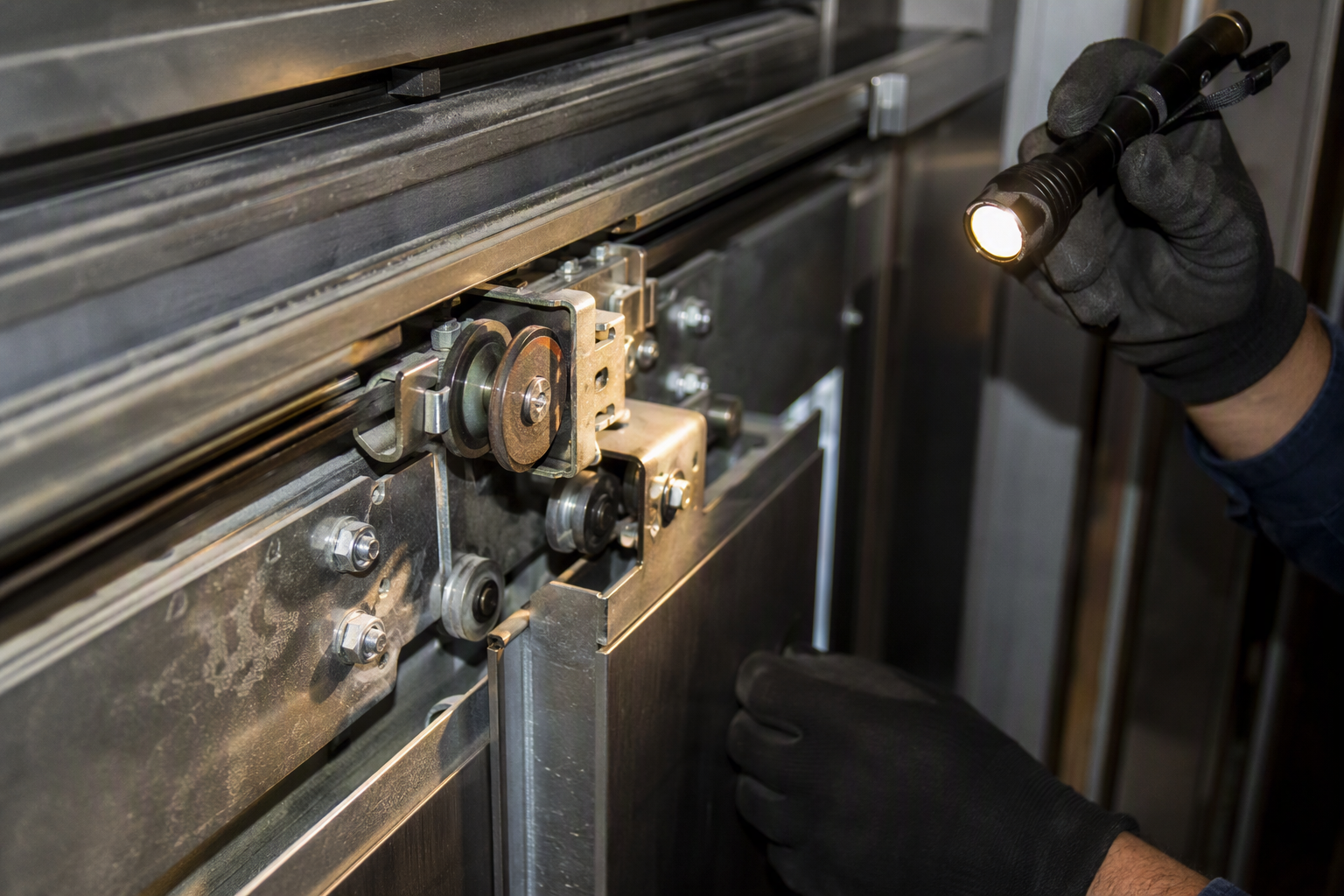
Door hesitation — where the doors pause, reverse, or close slower than normal — is one of the highest-risk pre-failure signs because door-related incidents account for a significant share of elevator-related injuries tracked by OSHA. Door issues typically stem from worn clutch mechanisms, misaligned hangers, degraded door operator boards, or failing safety edges and light curtains.
Leveling errors, where the cab floor stops an inch or more above or below the landing, indicate encoder drift, worn brake linings, or hydraulic fluid issues in hydraulic units. Even a small leveling discrepancy creates a tripping hazard that violates ADA accessibility standards and can result in facility-level liability.
2. Why Do Elevators Show Warning Signs Before They Break Down?
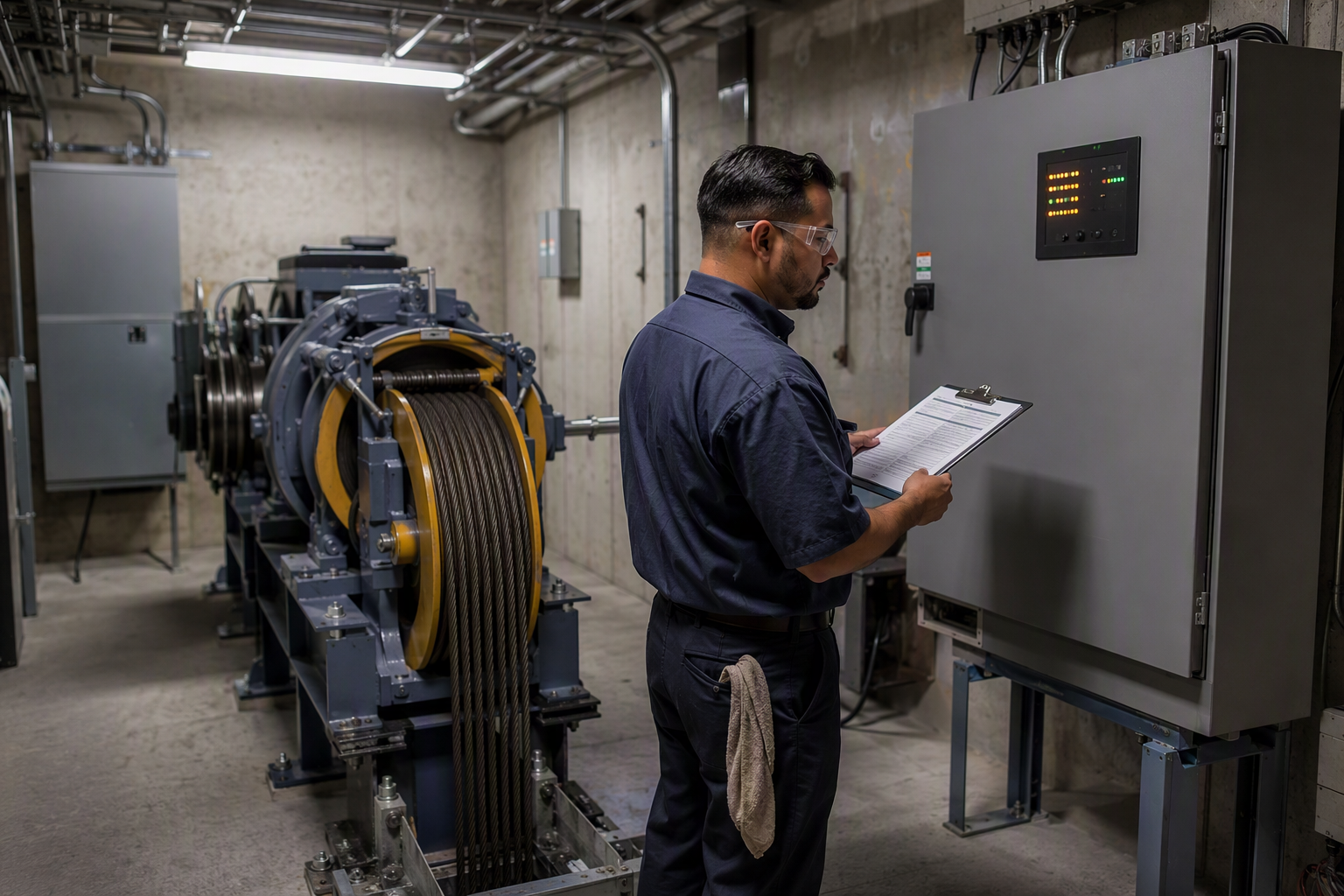
Elevators show warning signs before breaking down because mechanical and electrical components degrade gradually, producing measurable changes in performance — noise, speed, alignment, and current draw — before they reach the threshold of complete failure.
Modern traction and hydraulic elevators are engineered with layered safety redundancies, meaning multiple components must fail before the unit actually stops operating. This design intentionally creates a “warning window” — a period during which performance degrades noticeably but the unit continues to function. Ignoring that window eliminates the redundancy, leaving a single remaining component to carry the full load until it fails catastrophically.
Control systems in contemporary elevators often log fault codes internally, giving technicians access to a pre-failure diagnostic record. Buildings that lack a maintenance agreement miss this data entirely, and the warning window closes unobserved.
3. How Does Door Performance Indicate Upcoming Elevator Problems?
Door performance is one of the most reliable leading indicators of elevator health because the door operator, clutch, hanger system, and safety devices interact continuously and degrade in detectable, progressive patterns.
Signs of door-related pre-failure include: doors that take longer than normal to open or close; doors that reverse without contact (indicating a failing light curtain or safety edge); doors that bounce on closing; and a grinding or slapping sound as the hoistway door couples with the car door. Under ASME A17.1 Safety Code for Elevators and Escalators, door closing forces and reopening device sensitivity are tested at each periodic inspection, but these parameters can fall out of specification between inspections. Buildings should log door behavior between service visits and flag any change immediately.
4. What Do Unusual Noises Reveal About Elevator Condition?
Unusual noises are diagnostic signals that map directly to specific failing components — each type of sound corresponds to a distinct subsystem requiring attention.
The table below provides a reference guide for matching noise types to their most probable causes:
| Noise Type | Probable Location | Most Likely Cause | Risk Level If Ignored |
|---|---|---|---|
| Grinding (travel) | Guide rails / guide shoes | Dry or worn guide shoes; contaminated rails | High — accelerated rail wear, rough ride |
| Squealing (start/stop) | Hoist ropes / sheave | Worn rope grooves, rope slippage | High — rope degradation, brake slip |
| Banging (travel) | Counterweight / pit | Loose counterweight fillers, worn buffers | Critical — counterweight derailment risk |
| Clicking / popping (doors) | Door operator / clutch | Worn clutch vane, misaligned hanger rollers | Medium — door entrapment risk |
| Humming (machine room) | Motor / transformer | Electrical imbalance, bearing wear | Medium — motor overheating over time |
| Thudding (stopping) | Brake / motor coupling | Brake lining wear, coupling backlash | High — leveling failure, rollback risk |
| Hissing (hydraulic) | Hydraulic power unit | Seal leak, valve wear | High — uncontrolled descent risk |
5. How Does Slow or Erratic Movement Signal a Maintenance Need?
Slow or erratic cab movement indicates deterioration in the drive system, motor controller, or — in hydraulic elevators — the pump, valve assembly, or fluid condition, all of which worsen progressively and predictably.
A traction elevator that accelerates or decelerates unevenly has often developed a fault in its variable-frequency drive programming, a worn drive sheave, or degraded rope tension equalization. Hydraulic elevators that descend more slowly than they rise, or that drift downward after stopping (known as “lowering drift”), typically have worn packing seals or a leaking control valve — conditions that can eventually result in an uncontrolled slow descent, a scenario addressed in the safety requirements of ASME A17.1.
6. What Does a Burning Smell in or Near an Elevator Indicate?
A burning smell near an elevator almost always signals electrical overheating, brake lining friction, or hydraulic fluid contact with a hot surface — each representing an urgent pre-failure condition that warrants immediate service.
An acrid, electrical smell coming from the machine room can indicate an overloaded motor, failing contactors, or a transformer running at excessive temperatures. A burning rubber or friction smell during stopping suggests that the electromagnetic brake is dragging or that lining material is worn to the point of metal-on-metal contact. Hydraulic elevators may produce a burning oil smell if fluid is leaking onto the motor casing. Any burning odor should be treated as an urgent maintenance call, not a cosmetic concern.
7. How Do Lighting and Display Failures Predict Elevator Breakdown?
Flickering cab lights, a dim emergency light, or a blank floor indicator display often reflect failing power supply boards, aging wiring connections, or a deteriorating battery backup system — issues that compound into control system failures if unaddressed.
The emergency lighting circuit is a life-safety system. Under ASME A17.1, elevator cabs must maintain emergency lighting for a defined minimum duration following a power interruption. A flickering emergency light during normal operation typically means the battery is near end of life and cannot fulfill that requirement. Control boards governing lighting often share circuits with call registration and door logic, so an early lighting fault can be the first symptom of a broader board failure.
8. What Role Do Safety Device Trips Play in Pre-Failure Detection?
Frequent, nuisance trips of safety devices — such as the governor, safeties, buffers, or oil temperature switches — are the elevator’s built-in early-warning system flagging that one or more parameters have moved outside their design range.
When an elevator repeatedly trips its overspeed governor, shuts down on a high-oil-temperature fault, or triggers its door-reversal circuit without apparent contact, those events are not random. They indicate that the system is operating at or near its safety threshold. Each nuisance trip that is simply reset without root-cause investigation represents a missed diagnostic opportunity and moves the unit closer to an unrecoverable failure or a forced shutdown by an elevator inspector. AmeriTex Elevator’s technicians review fault logs during every service visit to identify repeated safety device activations before they escalate.
9. How Does Leveling Accuracy Indicate Hydraulic or Mechanical Wear?
Poor floor leveling — where the cab stops noticeably above or below the landing — is a measurable indicator of brake wear, encoder drift, or hydraulic seal degradation, and it directly violates ADA accessibility requirements when the gap exceeds allowable limits.
The ADA requires that accessible elevators level within a tolerance that prevents tripping hazards for wheelchair users and ambulatory passengers alike. Hydraulic elevators are especially prone to drift leveling, where the car settles downward after stopping due to internal valve leakage — a condition that worsens with temperature and fluid viscosity changes, making it more pronounced on hot summer days in cities like Houston and San Antonio. Traction elevators with leveling errors often need brake adjustment, encoder replacement, or drive parameter recalibration.
10. How Often Should Elevators Be Inspected to Catch Problems Early?
Inspection frequency is governed by state law and the ASME A17.1 Safety Code for Elevators and Escalators, with most jurisdictions in Texas and California requiring annual or more frequent periodic inspections — but routine maintenance visits should occur far more frequently than inspections alone.
State-mandated inspections verify code compliance at a single point in time; they do not substitute for ongoing preventive maintenance. Texas elevator inspections are administered through the Texas Department of Insurance (TDI), while California inspections fall under the Division of Occupational Safety and Health (Cal/OSHA). Both jurisdictions reference ASME A17.1 as their foundational code. Inspections catch code deficiencies, but a well-structured maintenance agreement catches wear patterns between inspections — which is where pre-failure detection actually lives.
Building managers in Houston, Dallas, Austin, San Antonio, Los Angeles, and San Diego should ensure that their maintenance intervals match the usage intensity of their equipment, not just the minimum inspection calendar required by law.
11. What Maintenance Tasks Specifically Prevent Elevator Breakdowns?
Targeted preventive maintenance tasks — lubrication of guide rails and ropes, brake adjustment and lining measurement, hydraulic fluid analysis, door clutch and hanger inspection, and controller diagnostic review — address the root causes of the most common elevator failures before those failures occur.
Key preventive tasks and their prevention targets include:
- Rail lubrication: Prevents accelerated guide shoe wear and vibration.
- Rope inspection and tension equalization: Prevents rope slippage and premature sheave groove wear.
- Brake lining measurement: Ensures stopping distance and leveling accuracy remain within ASME A17.1 tolerances.
- Hydraulic fluid sampling: Detects moisture contamination and oxidation before they damage the control valve.
- Controller board cleaning and connection tightening: Prevents intermittent faults caused by dust accumulation and thermal cycling of terminal connections.
- Door clutch and hanger roller inspection: Prevents door entrapment incidents and operator motor burnout.
- Safety device testing: Confirms that governors, safeties, and buffers will perform as designed in an emergency.
12. What Should Building Managers Do Immediately When They Notice Warning Signs?
When a warning sign is observed, building managers should follow a structured response to protect passenger safety, document the event, and engage a qualified elevator technician as quickly as possible.
- Remove passengers from service if the symptom poses an immediate safety risk (unusual smell, severe leveling error, unresponsive doors). Post an out-of-service notice.
- Document the symptom in writing, noting the time, floor, type of symptom, and any conditions that preceded it (load, weather, time of day).
- Do not reset and return to service without a technician evaluation if the symptom involves safety devices, leveling, or burning smells.
- Contact a licensed elevator service company — such as AmeriTex Elevator — to dispatch a qualified technician for diagnosis.
- Preserve the fault log data by requesting that the technician download the controller’s event log before performing any resets, so the diagnostic record is not overwritten.
- Notify your elevator inspection authority if the condition may represent a code violation, per your jurisdiction’s reporting requirements.
- Review your maintenance agreement to determine whether the condition is covered under a full maintenance contract or requires a separate service order.
13. How Do Environmental Conditions in Texas and California Affect Elevator Wear Rates?
Climate and building environment directly influence how quickly elevator components wear, making the warning signs above appear on shorter timelines in hot, humid, or high-traffic environments like those found in Houston and Los Angeles.
High ambient temperatures in Texas and Southern California accelerate hydraulic fluid degradation and increase motor operating temperatures, shortening the service life of seals, insulation, and electronic components. Houston’s humidity introduces moisture contamination into hydraulic systems and promotes corrosion on guide rails and pit equipment. High-rise buildings in Dallas and Los Angeles that run their elevators continuously through peak business hours generate heat cycles in machine rooms that stress contactors, drive boards, and brake coils beyond what lower-traffic installations experience. These environmental factors mean that the warning signs described throughout this page may appear sooner in high-use or climate-stressed installations, and that maintenance intervals should be calibrated accordingly.
14. How Do Older Elevators Differ From Newer Ones in Terms of Warning Signs?
Older relay-logic elevators and early-generation solid-state controllers produce warning signs differently than modern microprocessor-controlled units — older equipment often fails more abruptly while newer systems generate fault codes that make pre-failure detection more systematic.
Elevators built prior to the widespread adoption of digital control systems in the 1990s lack onboard diagnostics. Warning signs in those units must be identified entirely through physical inspection and operational observation — technicians rely on sound, vibration, contact wear measurements, and visual assessment of relay coil conditions. Modern elevators with microprocessor controllers log fault codes, track door cycle counts, and can alert service companies to out-of-range parameters remotely in systems equipped with monitoring capability. Buildings operating older equipment have a narrower pre-failure detection window and benefit from higher-frequency maintenance visits to compensate for the absence of automated diagnostics.
15. What Is the Difference Between a Maintenance Visit and a State Inspection?
A state inspection is a compliance verification performed by a licensed inspector to confirm that the elevator meets the code requirements in force at the time of inspection, while a maintenance visit is an ongoing service relationship focused on mechanical condition, wear monitoring, and failure prevention.
State inspections in Texas (administered through TDI) and California (under Cal/OSHA, referencing the California Elevator Safety Construction and Maintenance Regulations) produce a pass/fail compliance determination. They do not include the lubrication, adjustment, cleaning, and component measurement work that constitute preventive maintenance. An elevator can pass a state inspection and still be weeks away from a breakdown if wear items between safety-critical thresholds are not being actively monitored. AmeriTex Elevator recommends treating the inspection certificate as a compliance baseline and the maintenance agreement as the ongoing protection layer above that baseline.
16. Can Passenger Behavior or Building Usage Patterns Accelerate the Warning Signs?
Yes — overloading, door obstruction habits, and high-cycle usage patterns all accelerate component wear and cause the warning signs of maintenance need to appear earlier than they would under normal design loads and usage cycles.
Repeatedly overloading an elevator beyond its rated capacity stresses the hoist motor, brake, and rope system, and is a safety violation under ASME A17.1. Passengers or delivery personnel repeatedly blocking doors with objects — carts, boxes, limbs — override the reopening device and stress the door operator motor. Buildings in dense urban environments like downtown Houston, Dallas, or Los Angeles with heavy weekday peaks and infrequent weekend use experience thermal cycling stress on electronic components that differs from a consistently loaded residential building. Usage data should inform maintenance frequency decisions.
17. What Are the Compliance and Liability Consequences of Ignoring Early Warning Signs?
Ignoring documented warning signs creates a chain of consequences: accelerated failure, forced shutdown by inspectors, regulatory citations under state elevator safety codes, and potential civil liability if a passenger is injured on an elevator whose deficiencies were known or discoverable.
Under Texas and California elevator regulations — both of which adopt the ASME A17.1 Safety Code for Elevators and Escalators as their technical standard — building owners and operators are responsible for maintaining equipment in a safe operating condition between inspections. A documented complaint, a building manager’s log entry noting a symptom, or a prior service report identifying a deficiency that was not corrected can constitute constructive notice of a hazardous condition in premises liability claims. Proactive maintenance with documented service records is both the technically correct and legally defensible position.
18. How Do Hydraulic Elevators Differ From Traction Elevators in Pre-Failure Warning Signs?
Hydraulic and traction elevators produce overlapping but distinct sets of warning signs, because their drive mechanisms, safety systems, and wear modes differ fundamentally — recognizing the difference helps in accurate diagnosis.
Hydraulic elevators are more likely to show signs of fluid leakage (oil spots in the pit, hissing sounds, a hydraulic smell), lowering drift after stopping, slow upward travel during hot weather as fluid viscosity drops, and sluggish response from the power unit. They do not have hoist ropes, sheaves, or counterweights, so grinding rope noises and counterweight banging are not relevant. Traction elevators, by contrast, are more likely to show rope-related symptoms, sheave groove wear indicators, governor overspeed trips, and brake-related leveling errors. Both types share common failure modes in the door system, cab lighting, and control electronics.
19. How Should Building Managers Evaluate an Elevator Service Provider’s Pre-Failure Detection Capability?
A qualified elevator service provider should demonstrate the ability to perform systematic fault log review, calibrated wear measurement, and documented preventive maintenance reporting — not simply respond to breakdowns after they occur.
When evaluating a service provider, building managers should ask whether technicians download and review controller fault logs at every visit, whether maintenance reports document specific wear measurements (brake lining thickness, rope diameter, sheave groove depth) rather than just listing tasks performed, and whether the provider has direct experience with the specific equipment make and model installed. Providers serving multiple major markets — as AmeriTex Elevator does across Houston, Dallas, Austin, San Antonio, Los Angeles, and San Diego — develop familiarity with a wide range of equipment types and regional environmental conditions that single-market companies may lack.
20. What Is the Cost-Benefit Case for Addressing Warning Signs Before a Breakdown Occurs?
Addressing elevator warning signs proactively is substantially less costly than emergency repairs, replacement of components damaged by secondary failures, regulatory fines, building disruption, and potential liability — making preventive maintenance a financially sound strategy, not just a safety obligation.
When a component is repaired at the early wear-indicator stage, the repair is typically limited to that component. When failure is allowed to occur, the failing component frequently damages adjacent parts — a worn sheave groove that accelerates rope degradation, a dragging brake that overheats the motor, or a leaking hydraulic seal that allows contaminated fluid to damage the control valve. Emergency service calls also carry premium labor rates and parts delays that scheduled maintenance avoids. The documentation of proactive maintenance also reduces insurance premium exposure and strengthens a building owner’s legal position in the event of a claim. AmeriTex Elevator structures its maintenance agreements to prioritize early intervention precisely because the cost curve strongly favors prevention over reaction.
Take the Next Step: Schedule a Free Elevator Assessment
Recognizing the warning signs covered on this page is only half the equation — acting on them with qualified service is what prevents breakdowns, protects passengers, and keeps buildings in compliance with Texas and California elevator regulations. Whether the elevator in question is a traction high-rise unit in downtown Dallas, a hydraulic mid-rise system in Los Angeles, or a low-rise commercial elevator in San Antonio, the pre-failure indicators are the same, and the response should be equally prompt.
Contact AmeriTex Elevator for a free elevator assessment. AmeriTex Elevator serves commercial and residential properties throughout Houston TX, Dallas TX, Austin TX, San Antonio TX, Los Angeles CA, and San Diego CA with comprehensive elevator maintenance, repair, and compliance services.
Call today: 866-679-4313