Elevator Service Contract Terms and Clauses You Should Watch Out For Before Signing

Elevator service contracts are long-term, binding commitments that affect the safety, uptime, and operating budget of any building. Yet many building owners and facility managers sign them without fully understanding the fine print. This comprehensive FAQ hub covers every major clause, term, and risk category you should evaluate before putting pen to paper — whether you manage a commercial high-rise in Houston, a mixed-use property in Los Angeles, or a medical facility in San Antonio.
What Is an Elevator Service Contract and Why Does the Language Matter So Much?

An elevator service contract is a legally binding agreement that defines who is responsible for maintaining, repairing, inspecting, and ensuring the code compliance of an elevator system — and vague or unfavorable language in that agreement can expose a building owner to significant unplanned costs, liability, and regulatory violations.
Unlike many routine vendor contracts, elevator service agreements often run for multiple years, involve complex technical scope, and carry real safety and legal consequences if obligations are not met. Courts in Texas and California have consistently held building owners — not just elevator companies — responsible for maintaining elevators in safe operating condition. That makes contract clarity a matter of both financial and legal protection.
Most major elevator OEM service divisions offer standardized contract templates that heavily favor the vendor. Independent service providers can often negotiate more balanced terms. Regardless of which company you choose, understanding the structure of these contracts gives you the leverage to negotiate fair terms before signing.
What Are the Most Common Types of Elevator Service Contracts?
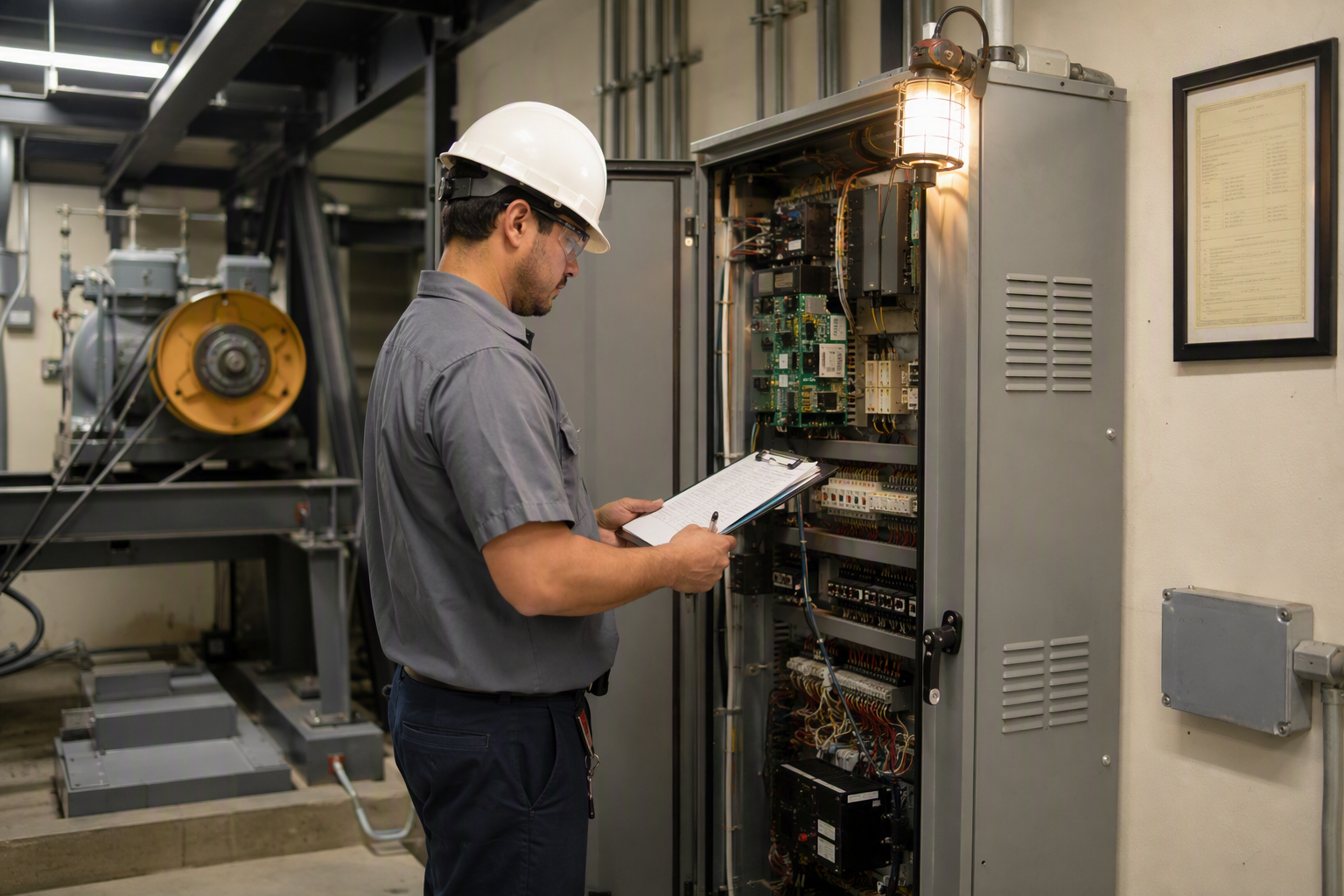
The most common elevator service contract types are full-maintenance agreements, oil-and-grease (lubrication-only) agreements, and examination-only agreements — and the type you choose determines how much financial risk you retain versus transfer to the service provider.
Understanding these tiers is foundational before evaluating any specific clause:
| Contract Type | What Is Typically Included | Building Owner Retains Risk For | Best Suited For |
|---|---|---|---|
| Full Maintenance (Comprehensive) | Labor, routine parts, callbacks, adjustments, code compliance updates | Modernization-level replacements, vandalism, third-party damage | High-traffic commercial, healthcare, Class A office |
| Partial / Semi-Comprehensive | Labor + selected parts (e.g., listed components only) | Unlisted parts, major components (motors, controllers) | Mid-range commercial, multifamily |
| Oil and Grease / Lubrication Only | Routine lubrication, visual inspection, minor adjustments | All parts and most labor | Low-traffic buildings with newer equipment |
| Examination / Inspection Only | Periodic inspection and written report only | All repairs, parts, and callbacks | Owners who self-manage repairs through separate contracts |
The gap between what a contract is called and what it actually covers is one of the most dangerous areas in elevator service agreements. A contract marketed as “full maintenance” may contain a parts exclusion list that carves out the very components most likely to fail.
What Parts and Labor Exclusions Should I Look for in a Service Contract?
Parts and labor exclusion clauses — sometimes buried in appendices or defined in narrow component lists — are the single most common source of billing disputes between building owners and elevator service companies.
Even comprehensive-sounding agreements frequently exclude major cost items such as:
- Hydraulic cylinders and liners
- Mainline contactors and drives (variable frequency drives / VFDs)
- Hoist ropes and governor ropes
- Door operators and door equipment beyond routine adjustment
- Microprocessor-based controllers and printed circuit boards
- Fixtures, cab interiors, and flooring
- Firefighter’s service and emergency communication systems
- Work required to bring the unit into compliance with new codes adopted after contract signing
Before signing, request a written list of every component explicitly included and every component explicitly excluded. If the vendor cannot provide this list, treat the gap as a liability you will carry. AmeriTex Elevator recommends that building owners compare the included-parts list against the specific model and age of their equipment to estimate realistic out-of-pocket exposure over the contract term.
How Do Automatic Renewal Clauses Work and Why Are They Risky?
Automatic renewal clauses — also called evergreen clauses — cause an elevator service contract to renew for a new full term (often one to five years) if the building owner does not provide written notice of cancellation within a narrow window, typically 60 to 90 days before the expiration date.
These clauses are standard in the elevator industry but are structured in ways that make it easy for building owners to miss the cancellation window. The renewal may also include a price escalation provision, meaning the rate increases automatically upon renewal — often tied to a Consumer Price Index (CPI) multiplier or a fixed annual percentage — without requiring the vendor to notify you of the new rate in advance.
Key items to negotiate on renewal clauses:
- Extend the cancellation notice window to at least 120–180 days
- Cap any automatic price escalation at a defined percentage per year
- Require written notice from the vendor of the upcoming renewal date and new rate at least 90 days in advance
- Negotiate a right to terminate without penalty if the escalation exceeds the agreed cap
What Response Time Language Should I Scrutinize in an Elevator Contract?
Response time clauses that use qualitative terms like “prompt,” “reasonable,” or “as soon as practicable” provide no enforceable standard and leave the building owner with no contractual recourse when service is delayed.
Elevator outages directly affect building occupants, ADA accessibility obligations under the Americans with Disabilities Act, and in some buildings, fire and emergency egress plans. A response-time clause should specify:
- Defined clock-start (e.g., time of phone call, time of ticket creation)
- Separate response windows for emergency calls (entrapment) versus routine callbacks versus scheduled maintenance
- Hours of coverage (standard business hours only, or 24/7/365)
- Escalation procedures and penalties if defined windows are missed
In markets like Houston and Dallas, where elevator populations are dense and heat-related service demand spikes seasonally, vague response language has historically led to extended outages. Confirm in writing whether after-hours, weekend, and holiday calls are included in the base contract rate or billed as extras.
How Should an Elevator Service Contract Address Code Compliance?
A service contract should explicitly state which party is responsible for ensuring the elevator remains in compliance with applicable codes — including ASME A17.1 Safety Code for Elevators and Escalators, state-level elevator safety acts, and any local amendments — because without this language, building owners often bear compliance costs that were not budgeted.
Texas and California both have active elevator safety programs. In Texas, the Texas Department of Insurance (TDI) administers elevator safety under the Texas Elevator Safety Act and requires periodic inspections by licensed inspectors. In California, the Division of Occupational Safety and Health (Cal/OSHA) under OSHA frameworks governs elevator safety, and local jurisdictions including Los Angeles and San Diego may layer additional requirements on top of state rules.
Key compliance clauses to look for:
- A clear statement that the vendor will maintain the unit to the code edition in effect at the time of contract signing
- Clarity on who pays for mandatory upgrades triggered by newly adopted code editions during the contract term
- An obligation for the vendor to coordinate and facilitate annual or periodic inspections required by state authority
- A provision requiring the vendor to provide copies of all inspection reports and violation notices to the building owner
What Are Liability Limitation Clauses and How Do They Affect Building Owners?
Liability limitation clauses cap the dollar amount the service provider can be held responsible for — even in cases of negligence — and they frequently limit recovery to no more than the annual value of the service contract, which may be a small fraction of actual damages.
These clauses are enforceable in most U.S. jurisdictions, including Texas and California, if they are clearly written and mutually agreed. The concern is that a cap equal to one year of contract fees may be wholly inadequate in a serious incident. Building owners should:
- Review the liability cap amount and compare it against their property insurance deductibles and coverage limits
- Verify the vendor carries adequate general liability and workers’ compensation insurance, and request certificates of insurance
- Evaluate whether the limitation clause carves out gross negligence and intentional misconduct, as these are sometimes negotiable
- Confirm indemnification language does not inadvertently shift liability for vendor errors back to the property owner
What Termination and Cancellation Penalties Should I Watch For?
Early termination clauses in elevator service contracts can require the building owner to pay the remaining balance of the full contract term — sometimes multiple years of fees — as a penalty for cancellation, regardless of the reason for termination.
This is one of the most significant financial risks in elevator service agreements, particularly in multi-year contracts. Before signing, negotiate the following protections:
- A right to terminate for cause (vendor failure to perform) without financial penalty
- A cap on termination fees — for example, no more than three to six months of remaining fees rather than the full remaining term
- Clear definition of what constitutes a material breach that entitles the building owner to terminate
- A cure period (typically 30 days) during which the vendor has the opportunity to correct a deficiency before the owner can terminate
- Property sale provisions: the ability to assign the contract to a buyer or terminate upon sale of the property without penalty
How Do I Evaluate the Scope of Scheduled Maintenance in a Contract?
The maintenance scope clause defines how frequently the elevator is serviced and what tasks are performed at each visit — and if it does not align with the manufacturer’s recommended maintenance intervals and ASME A17.1 requirements, the building owner may unknowingly be operating outside of safe and compliant maintenance standards.
What to verify in the maintenance scope:
- Minimum visit frequency (quarterly, monthly, or more frequent for high-traffic units)
- A written maintenance task list or checklist that will be used at each visit
- Documentation and reporting requirements — will you receive a written service record after each visit?
- Whether 24-hour callback service for entrapments and emergency shutdowns is included
- Lubrication intervals and the type of lubricants specified for your equipment model
AmeriTex Elevator performs maintenance services across Houston, Dallas, Austin, San Antonio, Los Angeles, and San Diego, and their team recommends that any service contract specify maintenance tasks in an attached exhibit rather than relying on general language like “industry-standard maintenance.”
What Should a Contract Say About Proprietary Parts and Vendor Lock-In?
Some elevator service contracts — particularly those offered by original equipment manufacturers — include clauses that restrict the building owner from using any other service provider during the contract term, limit access to proprietary diagnostic tools, or void coverage if a third-party technician touches the equipment.
This creates a form of vendor lock-in that can significantly inflate long-term maintenance costs. Key protections to seek:
- Confirm the contract does not prohibit you from obtaining a second opinion or competitive bid for major repair work
- Ask whether the vendor uses proprietary parts that cannot be sourced from alternative suppliers — and what happens to parts availability if the vendor exits your market
- For OEM-controlled systems with proprietary software locks, negotiate for access rights or escrow arrangements for diagnostic software
- Review whether the contract requires you to use the same vendor for any future modernization work
How Are Price Escalation Provisions Structured in Elevator Contracts?
Price escalation provisions — also called rate adjustment clauses — allow the service provider to increase the annual contract price, typically tied to the Consumer Price Index, a fixed percentage, or a combination of both, and they can substantially increase costs over a multi-year contract term.
When evaluating escalation language, building owners should:
- Identify the specific index used (CPI-U, CPI-W, local CPI) and the cap on any single-year increase
- Calculate the compounding effect of escalation over the full contract term to understand total cost of ownership
- Negotiate a mutual escalation cap — for example, no more than a defined percentage per year regardless of actual index movement
- Confirm whether parts cost increases can be passed through separately from the labor escalation
What Insurance Requirements Should the Elevator Service Contract Specify?
An elevator service contract should require the service provider to maintain general liability, workers’ compensation, and umbrella insurance at levels commensurate with the scope of work — and the building owner should be named as an additional insured on those policies.
At minimum, verify before signing:
- The vendor’s general liability policy limits and whether they cover elevator-specific risks
- Workers’ compensation coverage for all technicians who will work on your property
- Additional insured endorsement naming your entity on the vendor’s policy
- A requirement that the vendor notify you of any cancellation or material reduction in coverage
- How the contract allocates responsibility when a third-party claim arises from an elevator incident
What Should the Contract Say About Emergency and Entrapment Response?
Emergency entrapment response is one of the highest-stakes clauses in any elevator service agreement — the contract should specify a defined maximum response time for passenger entrapments and identify the procedures the technician will follow upon arrival.
Steps a building owner should take to evaluate emergency response provisions:
- Confirm the contract explicitly covers passenger entrapment response as a distinct service category from routine maintenance callbacks.
- Verify that emergency calls are available 24 hours a day, 7 days a week, 365 days a year — not limited to business hours.
- Confirm there is no additional per-call charge for after-hours entrapment responses.
- Ask for documentation of the vendor’s nearest service location and typical technician dispatch process for your building’s city.
- Ensure the contract specifies that the vendor will coordinate with local fire departments and emergency services as required by local jurisdictions in Houston, Dallas, Austin, San Antonio, Los Angeles, or San Diego.
- Request a written emergency communication plan to post in the machine room and near elevator telephone equipment.
Does an Elevator Service Contract Cover ADA Compliance Obligations?
An elevator service contract does not automatically cover ADA compliance upgrades — the Americans with Disabilities Act places the accessibility obligation on the building owner, not the service vendor, and unless the contract explicitly includes ADA-related maintenance and upgrade work, those costs remain with the property.
ADA requirements relevant to elevator maintenance include proper operation of accessible controls, audible and visual floor indicators, door timing and reopening devices, and Braille/tactile signage. If any of these systems are not functioning correctly, the building owner — not the elevator company — may face civil rights complaints or enforcement action.
Before signing a service contract, request clarity on:
- Whether routine ADA-related adjustments (door timing, button sensitivity, audible signals) are included in the maintenance scope
- How the vendor handles newly identified ADA deficiencies discovered during a maintenance visit
- Whether the contract includes any representation about ADA compliance of the maintained unit
How Should a Contract Handle Equipment Modernization and Capital Replacements?
Elevator service contracts almost universally exclude full modernization work — defined as the replacement of major systems such as controllers, machines, or hydraulic systems — and building owners who do not understand this distinction frequently discover large capital expenditures are not covered at exactly the wrong time.
The distinction between a “repair” (typically contract-covered) and a “replacement” or “modernization” (typically excluded) is frequently a source of contractual disputes. To minimize risk:
- Ask the vendor to define in writing the threshold at which a repair becomes a replacement or modernization
- Request an assessment of your equipment’s condition and remaining useful life before signing a multi-year contract
- Evaluate whether the contract provides any discounted pricing on modernization work as a benefit of the maintenance relationship
- Understand whether code-mandated upgrades triggered during the contract term are treated as repairs or modernizations under the contract’s definitions
AmeriTex Elevator serves building owners across Texas and California and can provide equipment condition assessments that help ownership teams understand realistic capital planning horizons before committing to a service agreement.
What Dispute Resolution Clauses Should I Look for in an Elevator Contract?
Dispute resolution clauses determine how — and where — disagreements about the contract are resolved, and clauses that require mandatory arbitration in a distant jurisdiction, or that waive the right to jury trial, can significantly disadvantage building owners who need to pursue a claim.
Key elements to evaluate:
- Whether disputes go to binding arbitration or remain litigable in court
- The venue requirement — disputes should be resolvable in the state and county where the elevator is located, not at the vendor’s home jurisdiction
- Whether the prevailing party is entitled to recover attorney’s fees
- Whether there is a mandatory mediation step before arbitration or litigation
- Whether class action waivers are included and how those may affect your rights
What Questions Should I Ask a Vendor Before Signing an Elevator Service Agreement?
Before signing any elevator service agreement, building owners should obtain direct, written answers to a defined set of questions that reveal the vendor’s actual service capabilities, contractual transparency, and technical qualifications.
A practical pre-signature checklist includes asking the vendor:
- What specific parts are included and excluded — in writing, as a contract exhibit?
- Where is the nearest service location to my building, and who are the technicians assigned to my account?
- What is the defined response time for entrapments, and is that commitment contractually binding?
- How are code compliance obligations allocated between the vendor and the building owner?
- What happens to my contract if the vendor is acquired by another company or exits my market?
- Can I see a sample inspection report and maintenance log from a comparable building you currently service?
- What is the process for disputing a bill for out-of-scope work?
- Is this contract assignable if I sell the property?
How Do Elevator Service Contract Terms Differ Between Texas and California?
While elevator service contracts are governed primarily by their written terms, the regulatory environment in Texas and California creates different baseline compliance obligations that affect what a service contract must minimally address in each state.
In Texas, the Texas Department of Insurance oversees elevator safety, requiring periodic inspections by a licensed third-party inspector. Building owners in Houston, Dallas, Austin, and San Antonio should confirm whether the service contract facilitates or includes coordination with TDI inspection requirements.
In California, Cal/OSHA under the OSHA framework administers elevator safety, and the California Elevator Safety Construction and Maintenance Act establishes requirements for elevator maintenance entities. In Los Angeles and San Diego, local amendments and additional permit requirements may apply. Service contracts in California should address how the vendor maintains compliance with California-specific code editions and local amendments that may differ from the base ASME A17.1 Safety Code for Elevators and Escalators.
Building owners with properties in multiple states should ensure their contracts are reviewed for jurisdiction-specific compliance language in each state where elevators are located. AmeriTex Elevator operates across both Texas and California markets and is familiar with the regulatory requirements in each jurisdiction it serves.
What Is a Step-by-Step Process for Reviewing an Elevator Service Contract Before Signing?
A structured, step-by-step review process helps building owners and facility managers systematically identify unfavorable terms before signing an elevator service contract, rather than discovering problems after a dispute arises.
- Obtain the full contract document, including all exhibits, appendices, and referenced schedules — do not rely on a summary sheet or verbal representation of what is included.
- Identify the contract type (full maintenance, partial, oil and grease, or examination only) and verify that the actual scope language matches the represented contract type.
- Compile the included and excluded parts list and cross-reference it against the make, model, and age of your elevator equipment to estimate realistic out-of-pocket risk.
- Locate all renewal, term, and cancellation clauses and note every date and notice window on a calendar or contract management system.
- Flag all price escalation provisions and calculate the total projected cost over the full initial term using the maximum allowable escalation rate.
- Verify code compliance obligations are clearly assigned and confirm the vendor’s obligations under ASME A17.1 Safety Code for Elevators and Escalators and applicable state regulations are explicitly addressed.
- Review response time language and confirm emergency, callback, and scheduled maintenance windows are defined with measurable, enforceable standards.
- Request certificates of insurance confirming the vendor’s coverage and your status as an additional insured before signing.
- Submit a written list of proposed modifications to the vendor and negotiate changes before executing the agreement.
- Retain a signed copy of the final executed contract, all exhibits, and all correspondence regarding negotiated terms in a readily accessible file.
How Can AmeriTex Elevator Help Me Navigate a Service Contract Decision?
AmeriTex Elevator offers transparent service agreements designed to address the most common contract risks that building owners face, with clear scope definitions, defined maintenance task lists, and coverage for the markets it serves across Texas and California.
Building owners in Houston, Dallas, Austin, San Antonio, Los Angeles, and San Diego can engage AmeriTex Elevator for a free elevator assessment that evaluates the current condition of their equipment, identifies any existing code compliance concerns, and helps establish an accurate baseline before entering into any service agreement. Understanding the condition of the equipment before signing a contract is one of the most practical steps a building owner can take to negotiate terms that reflect realistic maintenance requirements rather than accepting a vendor’s standard template.
AmeriTex Elevator’s service team is familiar with the regulatory environments in both Texas (TDI oversight) and California (Cal/OSHA framework), allowing them to provide guidance on what a compliant service contract should address in each state. Their approach to service agreements prioritizes transparency in scope, defined response standards, and clear code compliance obligations — the areas where standard vendor contracts most frequently create problems for building owners.
Need elevator service you can rely on? AmeriTex Elevator is ready to help.