Elevator Maintenance & Inspection Requirements for Certificate of Occupancy Renewal in Texas and California
Renewing a Certificate of Occupancy (CO) in Texas or California requires building owners to demonstrate that every elevator on the property is safe, code-compliant, and currently certified. Failing to meet elevator inspection requirements is one of the most common — and most preventable — reasons a CO renewal is delayed or denied. This comprehensive FAQ covers every requirement building owners, property managers, and facility directors need to understand before their next renewal deadline.
What are the basic elevator inspection requirements for Certificate of Occupancy renewal in Texas?
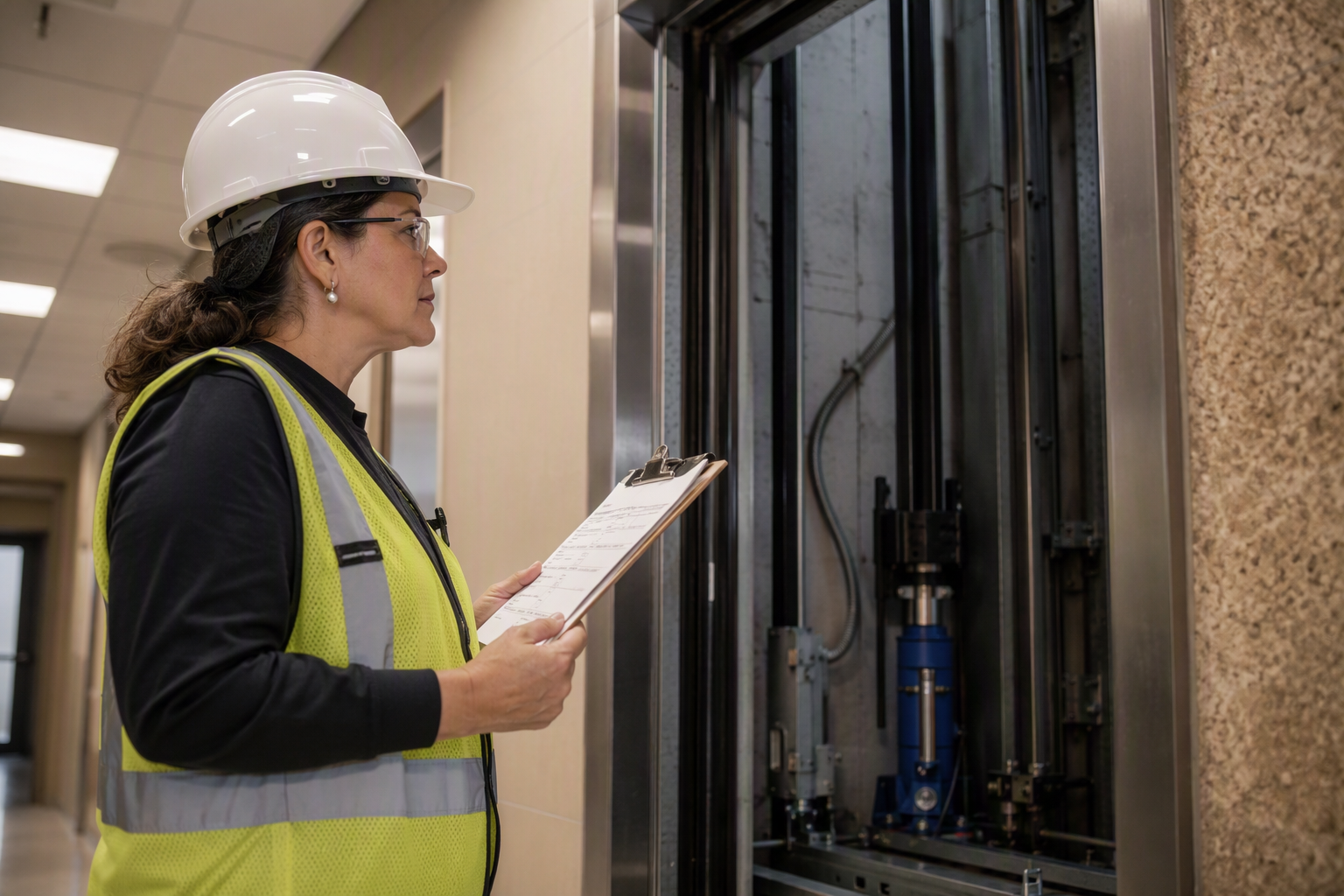
Texas requires all elevators, escalators, and related conveyances to hold a current Certificate of Inspection issued by a licensed elevator inspector before a Certificate of Occupancy can be renewed or maintained.
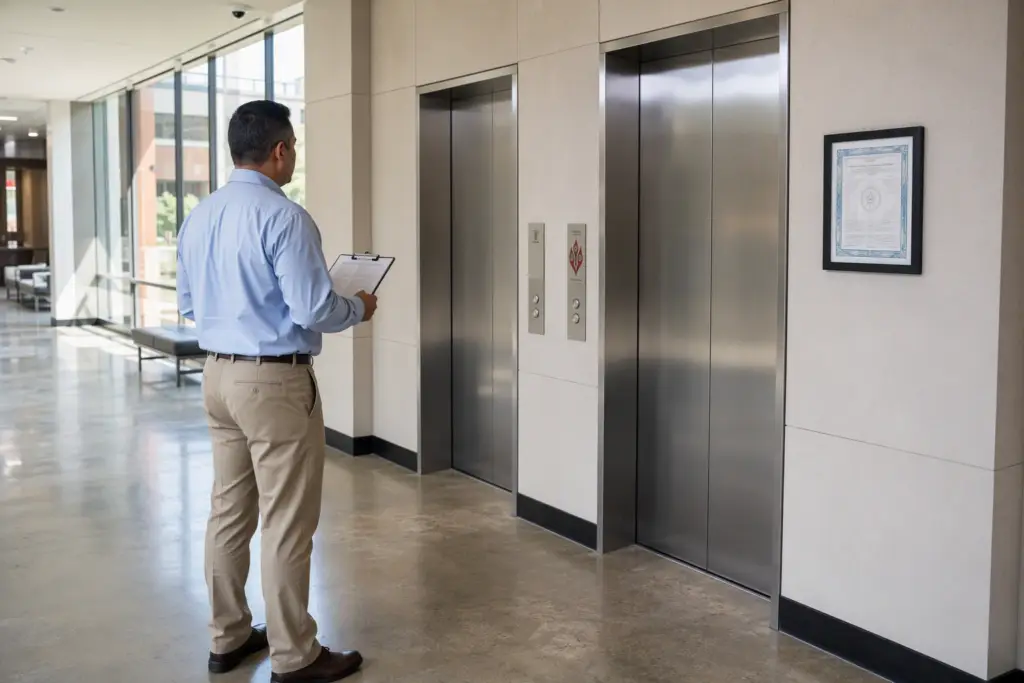
Under the Texas Elevator Safety Act (administered by the Texas Department of Insurance, or TDI), every elevator in a commercial or multifamily building must undergo a periodic safety inspection. The inspection evaluates the elevator’s mechanical systems, safety devices, electrical components, and overall compliance with the ASME A17.1 Safety Code for Elevators and Escalators. Once the elevator passes inspection, the inspector issues a Certificate of Inspection that must be posted inside the elevator cab. Local Authorities Having Jurisdiction (AHJs) — such as city building departments in Houston, Dallas, Austin, and San Antonio — may require proof of a current certificate before processing a CO renewal application.
Buildings with elevators that have lapsed certificates, outstanding violations, or unresolved repair orders are at significant risk of CO denial. Property owners are strongly advised to schedule inspections well in advance of their CO renewal date to allow time for any corrective maintenance.
What are the basic elevator inspection requirements for Certificate of Occupancy renewal in California?

In California, the Division of Occupational Safety and Health (Cal/OSHA) Elevator Unit is the primary state authority responsible for elevator inspections, and a valid Certificate of Inspection is a mandatory prerequisite for continued occupancy of any building containing an elevator.
Cal/OSHA conducts periodic inspections of all elevators, escalators, and related conveyances in California. These inspections are benchmarked against the ASME A17.1 Safety Code for Elevators and Escalators and ASME A17.3 (Safety Code for Existing Elevators and Escalators). In jurisdictions such as Los Angeles and San Diego, local elevator inspection programs may also operate in coordination with — or in place of — the state Cal/OSHA unit. Building owners must confirm which AHJ governs their specific property. A current, posted Certificate of Inspection is required at all times, and its absence or expiration can halt a CO renewal.
How often must elevators be inspected in Texas and California?
Both Texas and California mandate periodic elevator inspections, with annual inspections being the standard frequency for most elevator types under ASME A17.1 and applicable state rules.
While inspection intervals can vary based on elevator type, use classification, and local AHJ requirements, the general benchmark for routine safety inspections is annual. Hydraulic elevators, traction elevators, and escalators each have specific inspection and testing schedules. In addition to the annual safety inspection, ASME A17.1 establishes intervals for more intensive tests, including the five-year hydraulic pressure test and the five-year full-load safety test for traction elevators. Building owners should consult their AHJ and their elevator service provider to confirm the precise schedule applicable to their equipment.
| Inspection / Test Type | Applicable Equipment | General Frequency | Governing Standard | Notes |
|---|---|---|---|---|
| Periodic Safety Inspection | All elevators, escalators, moving walks | Annual (typical) | ASME A17.1 / A17.3 | AHJ may set shorter intervals |
| Hydraulic Pressure Test | Hydraulic elevators | Every 5 years | ASME A17.1 | Tests cylinder and piping integrity |
| Full-Load Safety Test (Traction) | Traction elevators with safeties | Every 5 years | ASME A17.1 | Governor and safety device actuation |
| No-Load Safety Test (Traction) | Certain traction elevators | Annual | ASME A17.1 | Varies by car speed and safety type |
| Firefighter Emergency Operation Test | Elevators with Phase I / Phase II | Annual | ASME A17.1 | Required in most commercial buildings |
| Standby Power Operation Test | Elevators on standby/emergency power | Annual | ASME A17.1 | Coordinates with building generator test |
| Seismic Switch / Sensor Test | Elevators in seismic zones (CA) | Annual | ASME A17.1 | Particularly relevant in Los Angeles, San Diego |
Note: Frequencies above reflect general ASME A17.1 benchmarks. Always verify exact intervals with your local AHJ in Houston, Dallas, Austin, San Antonio, Los Angeles, or San Diego.
What specific maintenance tasks must be completed before an elevator inspection?
Before a formal inspection, building owners and their elevator service contractors should ensure all routine preventive maintenance is current, all outstanding repairs are resolved, and the elevator’s logbook and maintenance records are complete and accessible.
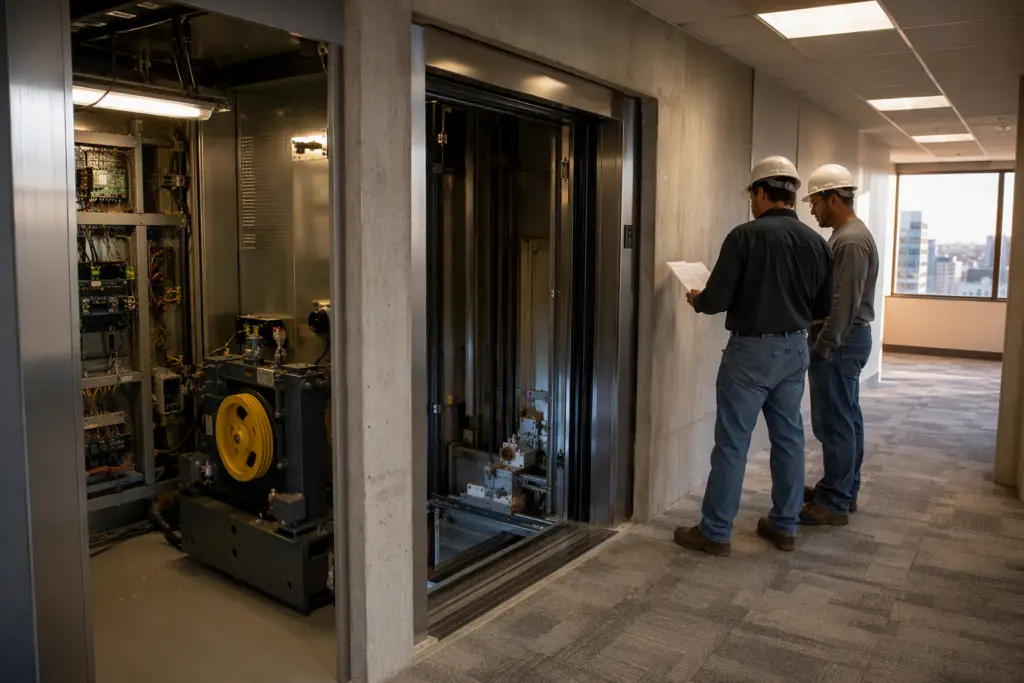
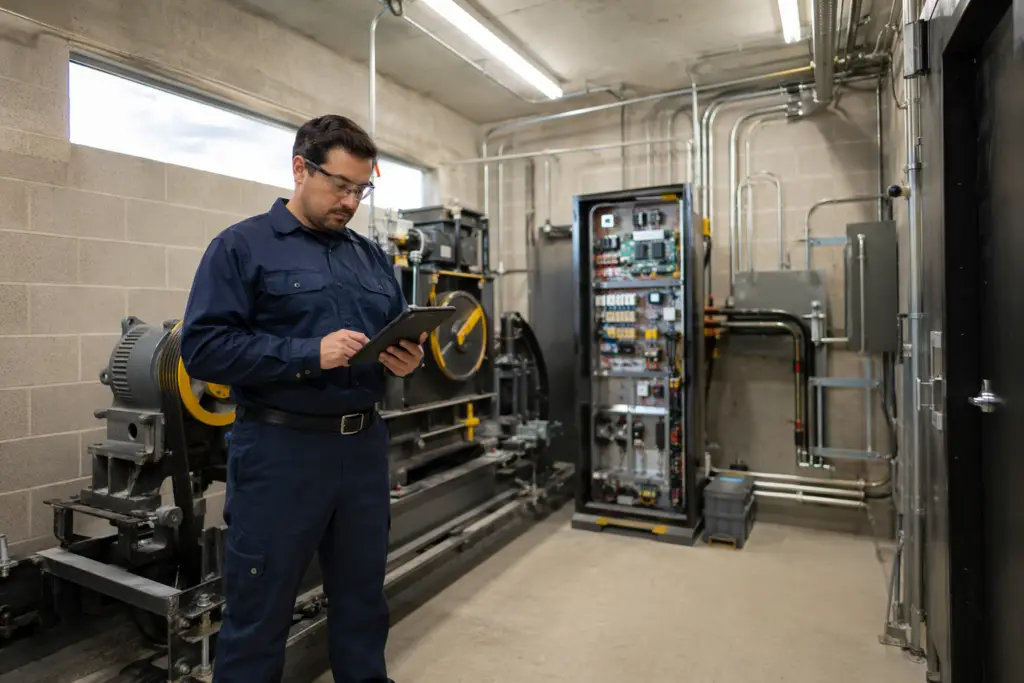
Inspectors review both the physical condition of the equipment and the maintenance documentation. Common pre-inspection maintenance tasks include lubricating guide rails and rollers, testing safety devices (governors, buffers, safeties), verifying door operator alignment and closing force, testing emergency lighting and communications, confirming proper leveling accuracy, and inspecting machine room conditions including temperature, cleanliness, and fire protection. Hydraulic systems require checks for fluid leaks, cylinder condition, and pressure relief settings. Any deferred maintenance or temporary repairs that have not been properly resolved can result in a failed inspection and a delayed CO renewal.
What does a licensed elevator inspector look for during a CO renewal inspection?
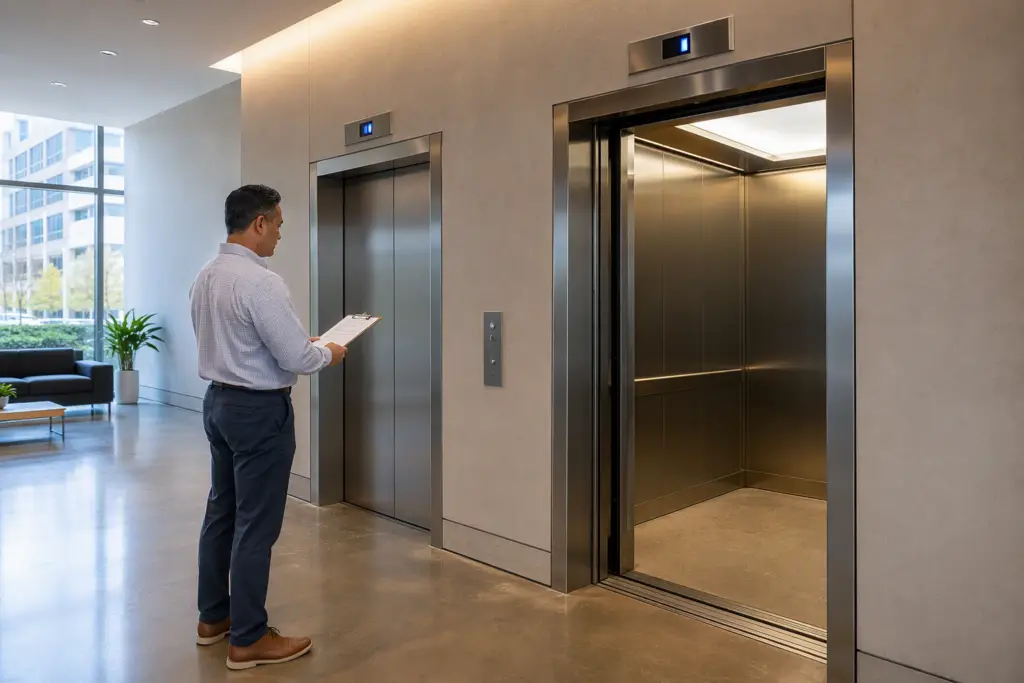
During a CO renewal inspection, a licensed elevator inspector evaluates the elevator’s structural integrity, safety systems, emergency features, door operation, machine room compliance, and overall conformance with the applicable edition of ASME A17.1.
Specific items reviewed typically include: governor and safety system functionality; buffer performance; guide rail and car frame condition; hoistway clearances; pit conditions (lighting, stop switch, ladder, water intrusion); machine room access, lighting, and fire suppression; door closing force and reopening device sensitivity; leveling accuracy; emergency communication systems; firefighter service (Phase I and Phase II operation); car lighting and ventilation; capacity and data plate accuracy; and the physical posting of the prior Certificate of Inspection. In California, seismic shut-off devices are also verified for elevators in applicable seismic zones, which is especially relevant in Los Angeles and San Diego.
What happens if an elevator fails inspection before a CO renewal?
A failed elevator inspection typically results in an order to correct specific deficiencies within a defined timeframe, during which the elevator may be taken out of service, and the CO renewal will be withheld until a passing re-inspection is recorded.
Minor violations — such as missing signage, lighting deficiencies, or documentation gaps — can often be corrected quickly without requiring the elevator to be shut down. Major violations involving safety-critical components, such as a malfunctioning governor, worn brake, or hydraulic leak, will typically result in an order to take the elevator out of service immediately. The building owner must then engage a licensed elevator contractor to perform the necessary repairs before a re-inspection can be scheduled. The CO renewal process cannot advance until a clean inspection certificate is issued. Working with an experienced elevator service provider like AmeriTex Elevator helps building owners identify and resolve these issues before the formal inspection takes place.
Are there ADA accessibility requirements that affect CO renewal for elevators?
Yes — while the Americans with Disabilities Act (ADA) does not directly govern CO issuance, ADA elevator accessibility requirements are enforced through local building department reviews, and non-compliant elevators can trigger barriers to CO approval.
For buildings subject to ADA Title II (state and local governments) or Title III (places of public accommodation and commercial facilities), elevators must meet accessibility standards including minimum cab dimensions, accessible control panel height and button specifications, audible and visual floor indicators, Braille and tactile markings, door timing requirements, and leveling accuracy within a defined tolerance. In Texas cities such as Houston, Dallas, Austin, and San Antonio, as well as in Los Angeles and San Diego, local building officials conducting CO reviews may flag ADA non-compliance as a condition that must be remediated. Building owners undergoing major renovations are particularly at risk, as renovation triggers stricter ADA path-of-travel obligations.
What is the difference between a maintenance contract and a full-service contract, and which do I need?
A maintenance contract typically covers routine lubrication, adjustments, and safety tests, while a full-service (comprehensive) contract also includes parts and labor for most repairs — and the level of coverage directly affects how quickly violations discovered at inspection can be resolved.
For CO renewal purposes, what matters most is that all required inspections and tests have been completed and that the equipment is in serviceable condition. However, buildings operating under a maintenance-only contract may face delays and unexpected costs if the inspection reveals deficiencies requiring parts replacement. A comprehensive service agreement provides broader protection and can accelerate the path from a failed inspection back to compliance. Property managers in high-use commercial buildings in Houston, Dallas, and other major Texas and California markets often benefit from full-service agreements that minimize out-of-pocket repair costs at inspection time.
Who is allowed to inspect elevators in Texas for CO renewal purposes?
In Texas, elevator inspections for CO renewal must be conducted by a Qualified Elevator Inspector (QEI) who is certified by the National Elevator Industry Educational Program (NEIEP) or another TDI-recognized certification body, and who holds a valid Texas elevator inspector license.
The Texas Department of Insurance oversees elevator safety and licensing in the state. Inspectors must be independent of the elevator contractor performing maintenance on the unit being inspected, ensuring an unbiased evaluation. Building owners cannot use an unlicensed individual or an employee of the elevator service company to conduct the official periodic inspection. Some jurisdictions within Texas — including the City of Houston — have historically maintained their own elevator inspection programs in coordination with TDI requirements. Building owners should verify whether their specific municipality has additional requirements beyond the state baseline.
Who is allowed to inspect elevators in California for CO renewal purposes?
In California, elevator inspections must be performed by a Cal/OSHA Certified Competent Conveyance Inspector (CCCI) — either a state Cal/OSHA inspector or an approved third-party inspector authorized to operate under the state’s elevator safety program.
Cal/OSHA’s Elevator Unit issues permits for elevators and licenses inspectors throughout the state. In some California jurisdictions, certified local government inspectors or approved private inspection companies may conduct inspections on behalf of the state program. In Los Angeles and San Diego, property owners should confirm with their local building department or the Cal/OSHA Elevator Unit whether a local inspection program is in place. As in Texas, the inspector must be independent of the maintenance contractor servicing the equipment.
What records and documentation must building owners maintain to support CO renewal?
Building owners must maintain a complete and organized set of elevator records including the current Certificate of Inspection, maintenance logs, test reports, repair records, and any variance or waiver documentation, all of which may be reviewed during a CO renewal process.
Inspectors and local building officials commonly request the following documentation:
- Current Certificate of Inspection (posted in the elevator cab)
- Maintenance logbook with dated service entries
- Test certificates for all periodic tests (five-year tests, firefighter service tests, etc.)
- Records of any repairs, parts replacements, or modifications since the last inspection
- Permits for any alterations or modernizations
- Machine room documentation including wiring diagrams and maintenance manuals
- Violation correction reports for any prior deficiencies
Disorganized or incomplete records are a common source of inspection delays. Elevator service companies such as AmeriTex Elevator typically maintain digital or paper maintenance logs on behalf of building owners, which can be made available quickly when needed for compliance verification.
What is the step-by-step process for preparing an elevator for CO renewal inspection?
Preparing an elevator for CO renewal inspection involves a systematic review of maintenance status, physical condition, documentation, and outstanding violations before the scheduled inspection date.
- Confirm inspection due date: Identify the expiration date on the current Certificate of Inspection and contact the relevant AHJ (TDI in Texas, Cal/OSHA Elevator Unit in California, or local authority) to schedule the inspection well in advance.
- Engage a licensed elevator service contractor: Contact a licensed elevator maintenance provider to perform a pre-inspection audit of all mechanical, electrical, and safety systems.
- Complete all deferred maintenance: Address any known deficiencies, worn components, lubrication needs, and open repair orders before the inspection date.
- Perform required tests: Confirm that all annual and periodic tests (firefighter service, emergency lighting, communication systems) are current and documented.
- Organize documentation: Assemble maintenance logs, prior test certificates, repair records, and the existing Certificate of Inspection for the inspector’s review.
- Verify machine room compliance: Confirm that the machine room is clean, properly lit, at appropriate temperature, free of unauthorized storage, and that fire suppression is functional.
- Confirm cab postings: Verify that the current Certificate of Inspection, capacity plate, and all required signage are properly posted inside the elevator cab.
- Accompany the inspector: Have a knowledgeable representative present during the inspection to answer questions and note any items cited for correction.
- Address violations promptly: If deficiencies are noted, engage the elevator service contractor immediately to complete corrections within the timeframe specified by the inspector or AHJ.
- Obtain and post the new certificate: Once the elevator passes, ensure the new Certificate of Inspection is posted in the cab before submitting the CO renewal application.
Do older or vintage elevators face different requirements for CO renewal?
Yes — older elevators are evaluated against ASME A17.3, the Safety Code for Existing Elevators and Escalators, which establishes minimum safety requirements for equipment that predates the current edition of ASME A17.1, and AHJs may impose retroactive upgrades as a condition of continued operation.
ASME A17.3 is specifically designed to address existing installations by defining the minimum safety improvements that must be made retroactively over time. Both Texas and California have adopted provisions that require older elevators to be brought into compliance with specific A17.3 mandatory upgrades on a defined schedule. Common retroactive requirements include the installation of door restrictors, auxiliary door closing devices, car lighting upgrades, and firefighter emergency service modifications. Buildings with elevators installed before modern code editions — common in older commercial districts of Houston, Dallas, San Antonio, Los Angeles, and San Diego — should have their equipment evaluated against current A17.3 retroactive requirements as part of CO renewal preparation.
What are the consequences of operating an elevator with an expired certificate during a CO renewal period?
Operating an elevator with an expired Certificate of Inspection exposes building owners to significant legal liability, civil penalties, potential insurance coverage issues, and immediate shutdown orders from the AHJ.
Both Texas and California grant their respective elevator safety authorities the power to order the immediate shutdown of any elevator operating without a valid certificate or with documented safety violations. In addition to regulatory penalties, building owners who continue to operate non-compliant elevators may face civil liability if an occupant is injured. Insurance carriers may deny claims arising from incidents on elevators with lapsed certifications. The CO renewal process will be halted, potentially displacing tenants in residential buildings or closing commercial operations. Proactive compliance management — including engaging a service provider to track certificate expiration dates — is the most effective way to avoid these consequences.
Are there special elevator requirements for high-rise buildings in Texas or California that affect CO renewal?
Yes — high-rise buildings in Texas and California are subject to additional elevator requirements beyond standard ASME A17.1 provisions, including enhanced firefighter emergency operation systems, seismic considerations in California, and coordination with local fire codes that must all be in order before a CO renewal is approved.
High-rise elevators in Texas must comply with Texas high-rise fire safety requirements, which include functional Phase I Emergency Recall and Phase II Emergency In-Car Operation, as well as elevator lobby features that coordinate with the building’s fire suppression and alarm systems. In California — particularly in Los Angeles and San Diego, which are in active seismic zones — high-rise elevators must also incorporate seismic shut-off devices that automatically stop elevator operation upon detection of seismic activity above a defined threshold. These seismic provisions are tested during annual inspections. Compliance with both the elevator code and the local fire code is verified during the CO renewal process.
What role does OSHA play in elevator compliance for CO renewal?
The Occupational Safety and Health Administration (OSHA) governs elevator safety primarily in the context of worker safety during construction, maintenance, and installation — and OSHA violations related to elevator work can complicate a CO renewal if they result in stop-work orders or unresolved citations on the property.
OSHA standards applicable to elevators in construction and maintenance settings include requirements for lockout/tagout procedures, fall protection in hoistways, and safe access to machine rooms. While OSHA does not directly regulate the periodic inspection of passenger elevators for building occupancy purposes — that authority rests with TDI in Texas and Cal/OSHA’s Elevator Unit in California — an active OSHA citation or stop-work order affecting elevator equipment on a property can create complications in the CO renewal process. Elevator contractors performing maintenance and repairs in Texas and California must comply with applicable OSHA standards to protect their workers and avoid citations that could affect building operations.
How far in advance should building owners schedule a pre-inspection maintenance visit before CO renewal?
Building owners should schedule a pre-inspection maintenance audit with their elevator service contractor at least sixty to ninety days before the CO renewal deadline to allow adequate time for identifying deficiencies, ordering parts, completing repairs, and scheduling the official inspection.
In major markets such as Houston, Dallas, Los Angeles, and San Diego, licensed inspectors and elevator contractors can experience scheduling backlogs, particularly at peak periods near common lease renewal dates or fiscal year-end compliance cycles. Ordering specialty parts for older elevator systems can add additional lead time. A pre-inspection visit conducted well in advance of the deadline gives building owners a realistic picture of the work required and the time needed to bring the equipment into full compliance. Rushed repairs performed immediately before an inspection increase the risk of inspection failure. AmeriTex Elevator offers pre-inspection assessments to help building owners in Texas and California proactively identify and address compliance gaps before the official inspection date.
What are common reasons elevators fail inspection and delay CO renewal?
The most common reasons elevators fail inspection include door safety device failures, overdue five-year tests, pit deficiencies, missing or expired emergency communication functionality, machine room violations, and incomplete maintenance documentation.
Based on the types of violations most frequently cited in ASME A17.1 compliance contexts, property managers should pay particular attention to the following high-risk areas:
- Door reopening device malfunction or excessive closing force
- Overdue hydraulic pressure tests or traction safety tests
- Pit flooding, inadequate lighting, or missing stop switch
- Non-functional or expired emergency telephone / two-way communication
- Machine room used for storage or with inadequate lighting or ventilation
- Firefighter service (Phase I / Phase II) not operational
- Leveling accuracy outside acceptable tolerance
- Missing, illegible, or expired Certificate of Inspection posted in cab
- Governor or safety device not tested within required interval
- Oil leaks in hydraulic systems without corrective documentation
Can a building owner use any licensed elevator contractor for pre-inspection maintenance, or are there restrictions?
In both Texas and California, pre-inspection maintenance and repair work must be performed by a licensed elevator contractor — in Texas, this means a contractor registered with the Texas Department of Insurance, and in California, a contractor licensed by the California Contractors State License Board under the appropriate elevator contractor classification.
Texas elevator contractors must be registered with TDI, and their technicians must hold valid elevator mechanic licenses or be working under appropriate supervision. In California, elevator contractors must hold a valid C-11 (Elevator) contractor’s license issued by the Contractors State License Board. Engaging an unlicensed contractor to perform elevator work is a violation of state law in both Texas and California and can result in the work being rejected by the inspector, requiring it to be redone by a licensed contractor — adding cost and delay to the CO renewal process. Building owners should verify contractor licensing before authorizing any elevator work. AmeriTex Elevator holds the required contractor licenses to perform elevator maintenance and repair work across its service markets in Texas and California.
What should building owners in Houston, Dallas, Austin, San Antonio, Los Angeles, and San Diego know about local AHJ variations?
Each city’s Authority Having Jurisdiction may impose inspection frequencies, documentation requirements, or local code amendments that go beyond the state baseline, and building owners must verify the specific requirements for their municipality rather than assuming state minimums are sufficient.
For example, the City of Houston has historically operated its own elevator inspection and permitting program. Dallas, Austin, and San Antonio each coordinate with TDI while also applying local building code amendments through their respective building departments. In California, Los Angeles operates one of the largest municipal elevator inspection programs in the country, and San Diego building owners must verify whether their property falls under state Cal/OSHA jurisdiction or a local program. Property managers overseeing portfolios across multiple cities in Texas and California should establish a compliance calendar that accounts for the specific renewal cycle in each jurisdiction. AmeriTex Elevator’s knowledge of local AHJ requirements across Houston, Dallas, Austin, San Antonio, Los Angeles, and San Diego positions the company to help building owners navigate these city-specific variations effectively.
Are there any exemptions from elevator inspection requirements that could affect CO renewal?
Limited exemptions from state elevator inspection programs exist for certain low-use or private-residence elevators, but commercial buildings and multifamily residential buildings subject to CO requirements are almost universally required to maintain current elevator certifications with no practical exemptions available.
In Texas, single-family residential elevators that are strictly private and not accessible to the public may fall outside TDI’s mandatory inspection program. In California, similar limited exclusions may exist for certain private-use installations. However, any elevator in a building that requires a Certificate of Occupancy — including office buildings, retail centers, hotels, hospitals, multifamily residential buildings, and warehouses — is subject to the full inspection and certification regime. Building owners should never assume an exemption applies without confirming with the relevant AHJ. Assuming an exemption and failing to obtain a current certificate is a common and costly error that can result in immediate shutdown orders.
Schedule Your Pre-Inspection Assessment Today
Don’t let an expired elevator certificate delay your Certificate of Occupancy renewal. AmeriTex Elevator provides comprehensive pre-inspection maintenance assessments for commercial and residential buildings across Houston, Dallas, Austin, San Antonio, Los Angeles, and San Diego. Our licensed elevator professionals will evaluate your equipment against current ASME A17.1 and A17.3 requirements, identify compliance gaps, complete required maintenance and testing, and help you build the documentation package your AHJ needs to issue a clean inspection certificate — so your CO renewal moves forward without delays.
Contact AmeriTex Elevator for a free elevator assessment: 866-679-4313