Elevator Accident Statistics in Healthcare Facilities: What Hospital Administrators Need to Know
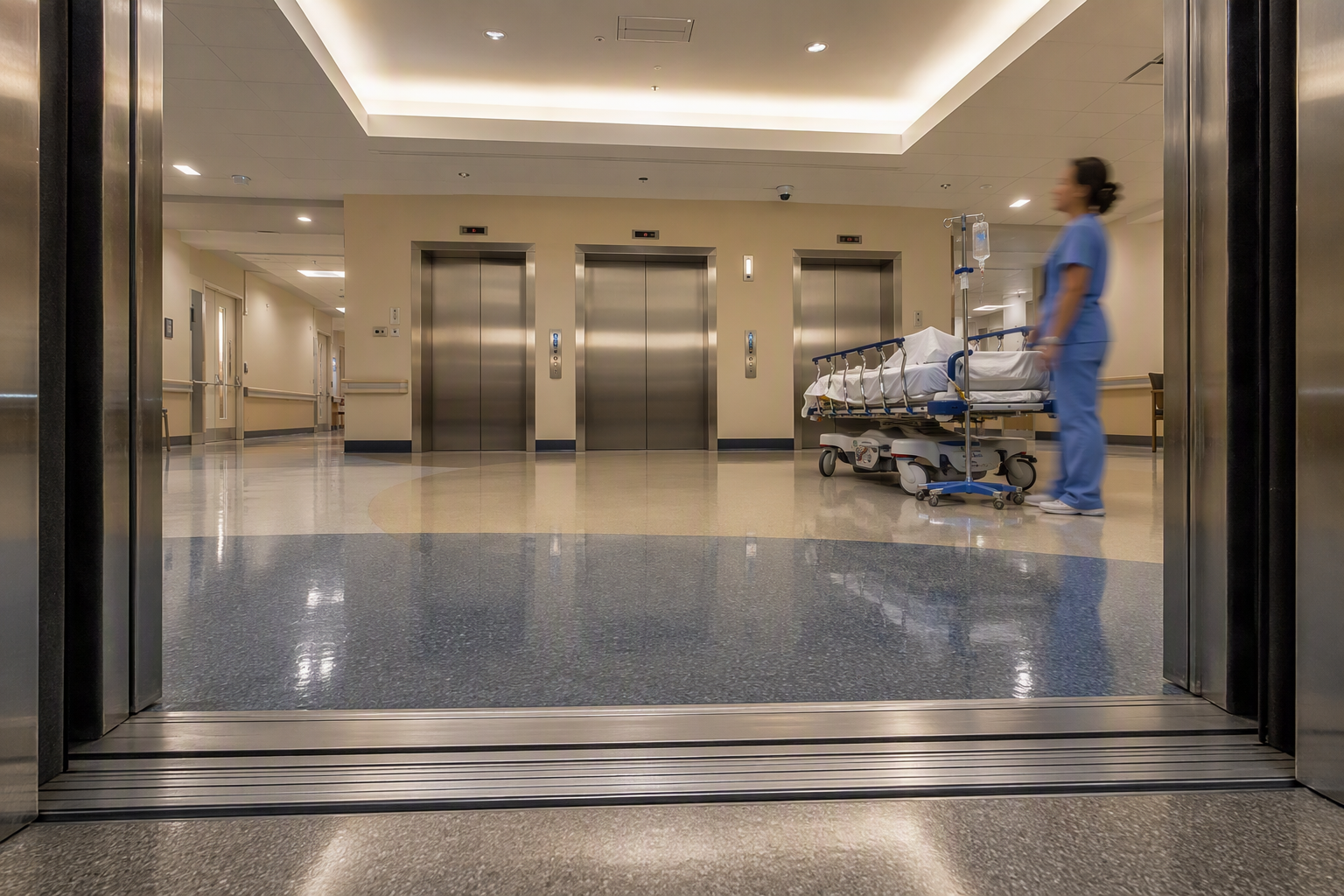
Elevators are the circulatory system of a healthcare facility. Patients in wheelchairs, gurneys, IV poles, and medical equipment move through hospital corridors and elevator banks dozens — sometimes hundreds — of times per day. When an elevator malfunctions or causes an accident in this environment, the consequences can be far more severe than in a commercial office building. Understanding elevator accident risks, applicable compliance standards, and preventive protocols is not optional for healthcare administrators — it is a patient safety imperative.
What Are the Most Common Causes of Elevator Accidents in Healthcare Settings?
Elevator accidents in healthcare facilities most commonly result from a combination of heavy usage, specialized equipment demands, and deferred maintenance. Specific contributing factors include:
- Door malfunctions: Doors that close too quickly or fail to re-open when obstructed pose a serious risk, particularly for patients on stretchers or in wheelchairs.
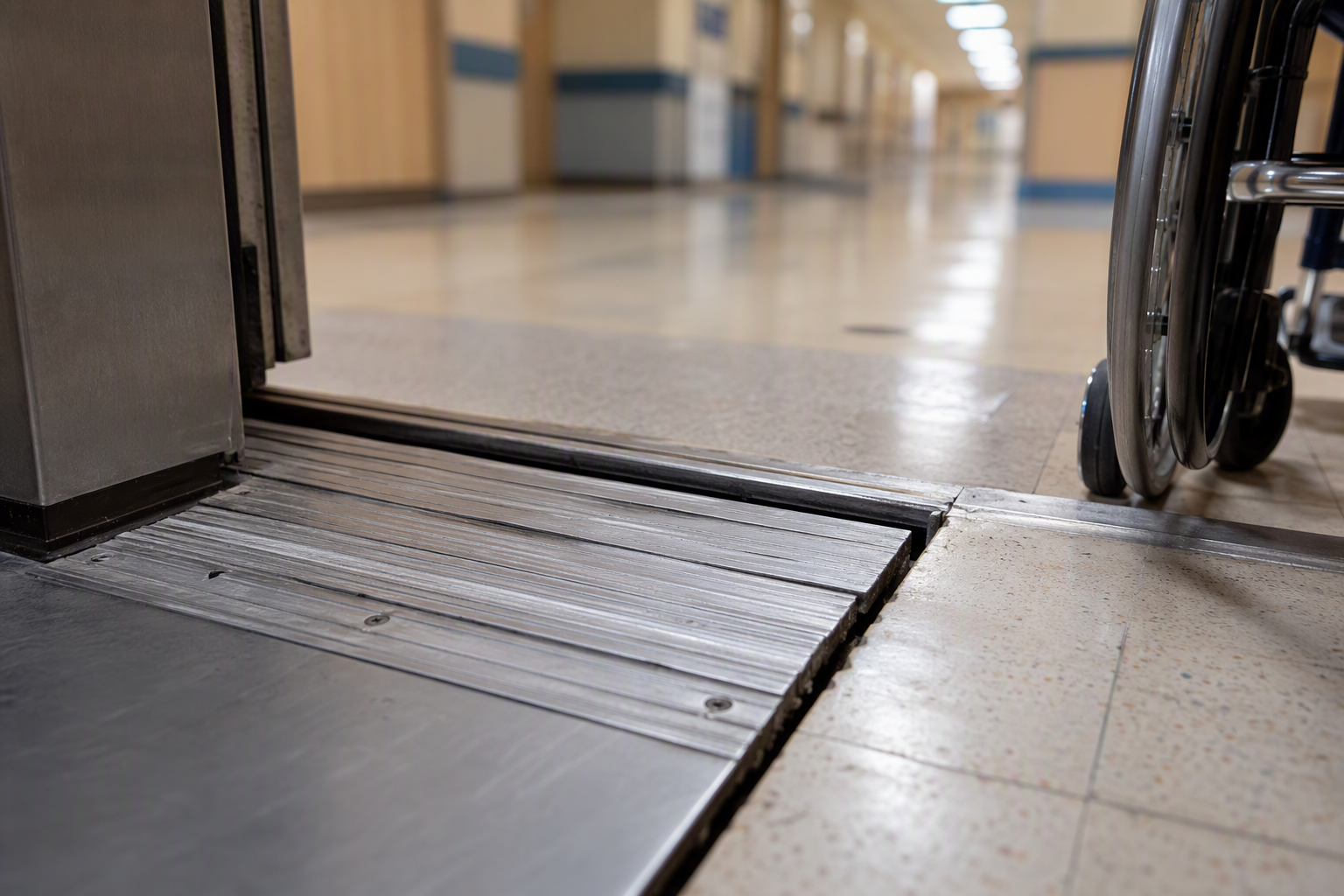
- Leveling failures: When an elevator car does not align precisely with a floor landing, the resulting gap or raised edge creates a trip and fall hazard — especially dangerous for mobility-impaired patients.
- Overloading: Hospital elevators routinely carry heavy medical equipment, beds, and multiple personnel simultaneously. Exceeding rated load capacity accelerates mechanical wear and increases accident risk.
- Entrapment: Power outages, control system failures, and mechanical breakdowns can trap patients, including those dependent on oxygen or other life-critical equipment.
- Hydraulic fluid leaks and contamination: Hydraulic elevators that serve lower-traffic areas of a facility may develop leaks that go undetected without a regular maintenance schedule.
- Worn or damaged sill plates and thresholds: High-traffic healthcare elevators experience accelerated wear on threshold components, creating uneven surfaces that cause falls.
Each of these failure modes is preventable through scheduled preventive maintenance and timely code-compliant repairs.
What Compliance Standards Govern Hospital and Healthcare Elevator Safety?
Healthcare facilities operating elevators in Texas (Houston, Dallas, Austin, San Antonio) and California (Los Angeles, San Diego) are subject to a layered framework of federal, state, and industry codes.
ASME A17.1 Safety Code for Elevators and Escalators
The foundational standard for elevator safety in the United States is the ASME A17.1 Safety Code for Elevators and Escalators. This code establishes minimum requirements for the design, construction, installation, operation, inspection, testing, maintenance, alteration, and repair of elevators. Healthcare facilities must ensure their elevators meet the current edition requirements, which include specific provisions for automatic operation, door reopening devices, and emergency communication systems.
ADA Accessibility Requirements
The Americans with Disabilities Act (ADA) mandates that elevators in multi-story healthcare facilities be fully accessible. This includes minimum cab dimensions, accessible controls positioned at reachable heights, audible and visual signals, and Braille and raised-character signage. For healthcare facilities, ADA compliance is especially critical because a significant percentage of patients and visitors have mobility limitations.
OSHA Workplace Safety Standards
OSHA regulations require that employers — including hospitals and healthcare organizations — provide a workplace free from recognized hazards. Elevator-related hazards fall under OSHA’s general duty clause, and facilities that allow known mechanical deficiencies to go unaddressed may face citations and liability exposure in the event of an accident.
State and Local Inspection Requirements
Texas and California each maintain their own elevator safety programs with mandatory periodic inspections and operating permits. Healthcare facilities are required to maintain current inspection certificates and address any violations noted by state inspectors promptly. Facilities that allow inspection certificates to lapse face both regulatory penalties and increased liability risk.
Healthcare-Specific Codes (NFPA 99 and FGI Guidelines)
Beyond elevator-specific codes, hospitals must comply with NFPA 99 (Health Care Facilities Code) and the Facility Guidelines Institute (FGI) Guidelines for Design and Construction of Hospitals, both of which include provisions for vertical transportation systems in healthcare environments — particularly regarding fire recall operation and emergency power supply for hospital elevators.
Why Are Healthcare Facilities at Higher Risk for Elevator Incidents Than Other Building Types?
Healthcare facilities experience elevator usage patterns that are fundamentally different from office buildings or residential properties. Elevators operate around the clock, seven days a week, carrying loads that frequently approach rated capacity. Patient transport equipment — including powered wheelchairs, bariatric transport chairs, and oversized stretchers — places unusual stress on door systems and cab interiors. Nursing staff and transport personnel often hold elevator doors open manually, which degrades door-closing mechanisms over time. Combined with the critical nature of the passengers being transported, these factors make healthcare elevator maintenance a patient safety issue, not merely a property maintenance issue.
What Should a Hospital Do Immediately After an Elevator Accident?
- Ensure the safety of all individuals involved. Remove passengers from the affected elevator car if it is safe to do so, and provide immediate medical attention as needed.
- Secure the elevator. Take the elevator out of service immediately and place visible “Out of Service” signage on all landings serving that car.
- Notify facility management and risk management. Escalate the incident through established hospital incident reporting protocols.
- Document the scene. Photograph the elevator interior, threshold, door components, and any relevant control panels before any remediation work begins.
- Preserve maintenance records. Gather all recent inspection certificates, maintenance logs, and work orders for the affected elevator.
- Contact your elevator service provider. A qualified elevator service technician must inspect the equipment before it is returned to service. AmeriTex Elevator provides qualified inspection and repair services for healthcare facilities across Houston, Dallas, Austin, San Antonio, Los Angeles, and San Diego.
- File required reports with state elevator safety authorities. Many states require formal reporting of elevator accidents, particularly those resulting in injury. Check with your state elevator safety office for specific reporting timelines.
- Conduct a root cause analysis. Work with your elevator service provider to identify the underlying mechanical or operational cause of the accident and implement corrective actions.
How Often Should Healthcare Facility Elevators Be Inspected?
The ASME A17.1 Safety Code for Elevators and Escalators establishes minimum inspection and testing intervals, including annual inspections and periodic safety tests. However, for healthcare facilities — given the volume of use and the vulnerability of the passenger population — many risk management professionals recommend more frequent preventive maintenance visits than the regulatory minimum. A comprehensive preventive maintenance program conducted by a qualified elevator service company is the most effective strategy for reducing accident risk between mandatory inspections.
What Role Does Preventive Maintenance Play in Reducing Elevator Accidents?
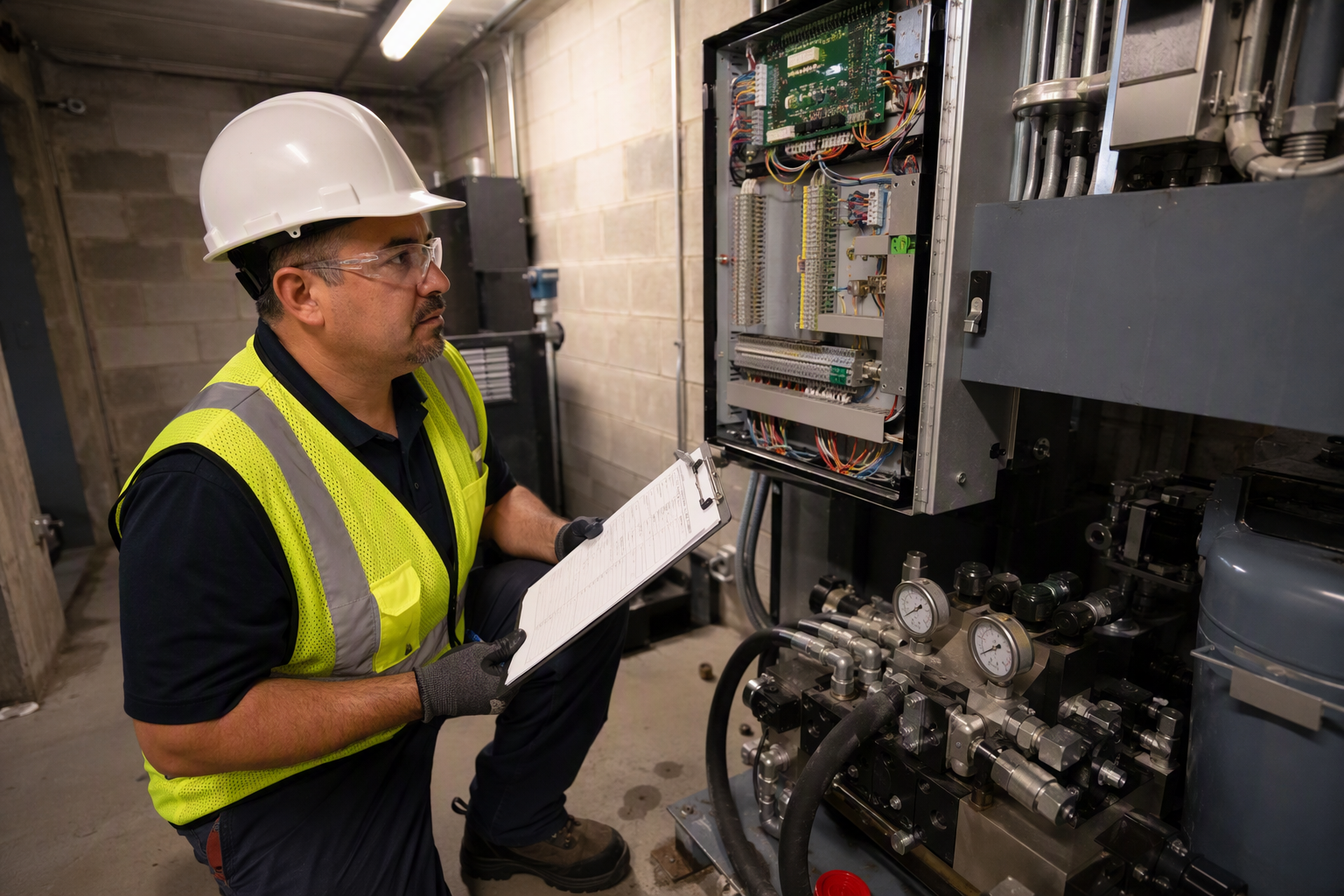
Preventive maintenance is the primary mechanism for catching developing mechanical problems before they result in an accident, an entrapment, or an unplanned equipment failure. A structured preventive maintenance program includes lubrication of moving components, adjustment of door operators and safety edges, testing of governor and safety mechanisms, inspection of ropes or hydraulic cylinders, and verification of emergency lighting and communication systems. For healthcare facilities, unplanned elevator downtime is not merely an inconvenience — it can disrupt patient transport, delay emergency response, and create liability exposure. AmeriTex Elevator offers structured preventive maintenance programs designed to meet the specific demands of healthcare facility elevator systems.
How Does Elevator Safety Affect Hospital Liability and Insurance?
An elevator accident in a healthcare facility can generate significant legal and financial consequences. Negligence claims arising from elevator accidents typically examine whether the facility maintained the equipment in accordance with applicable codes, whether inspection certificates were current, and whether known deficiencies were addressed in a timely manner. Risk managers and general counsel for hospitals should treat elevator maintenance records as risk management documents, not merely operational records. Facilities with documented preventive maintenance programs and current inspection certificates are in a substantially stronger position in the event of a claim than facilities with deferred maintenance histories.
What Are the ADA Requirements Specific to Hospital Elevators?
Under the ADA, hospital elevators must meet specific dimensional and operational requirements. Cab dimensions must accommodate wheelchairs and mobility devices. Call buttons must be positioned within accessible reach ranges. Door open times must be sufficient to allow individuals using mobility aids to enter and exit safely. Visual and audible signals must be provided at each floor. Many older hospital elevators, particularly in facilities built before the ADA’s effective date, have not been fully upgraded to meet current standards — creating both compliance risk and accident risk. AmeriTex Elevator provides ADA compliance assessments and modernization services for healthcare facilities across its service markets.
What Is Elevator Modernization and When Should a Healthcare Facility Consider It?
Elevator modernization involves replacing aging components — control systems, door operators, cab interiors, safety systems, or entire drive systems — with current-generation equipment that meets contemporary code requirements. Healthcare facilities should evaluate modernization when elevators experience recurring mechanical failures, when parts are no longer available for existing equipment, when energy consumption is disproportionately high, or when existing equipment cannot be brought into compliance with current code requirements through repair alone. Modernization is also often the most cost-effective path to ADA compliance for older hospital elevator systems. A qualified elevator service provider can conduct a condition assessment to determine whether repair or modernization is the appropriate solution for a specific installation.
How Do Healthcare Elevators in Texas Compare to California Regulatory Requirements?
Both Texas and California base their elevator safety requirements on the ASME A17.1 framework, but each state administers its own inspection program, permitting process, and enforcement mechanism. California’s Division of Occupational Safety and Health (Cal/OSHA) maintains an active elevator, ride, and tramway unit with its own inspection cadence and code adoption schedule. Texas administers elevator safety through the Texas Department of Insurance. Healthcare facilities operating in both states — or expanding across markets — must ensure that their elevator service provider understands the specific regulatory environment in each jurisdiction. AmeriTex Elevator operates in Houston, Dallas, Austin, San Antonio, Los Angeles, and San Diego, providing healthcare clients with consistent service across both the Texas and California regulatory environments.
Questions Your Inspector Will Ask
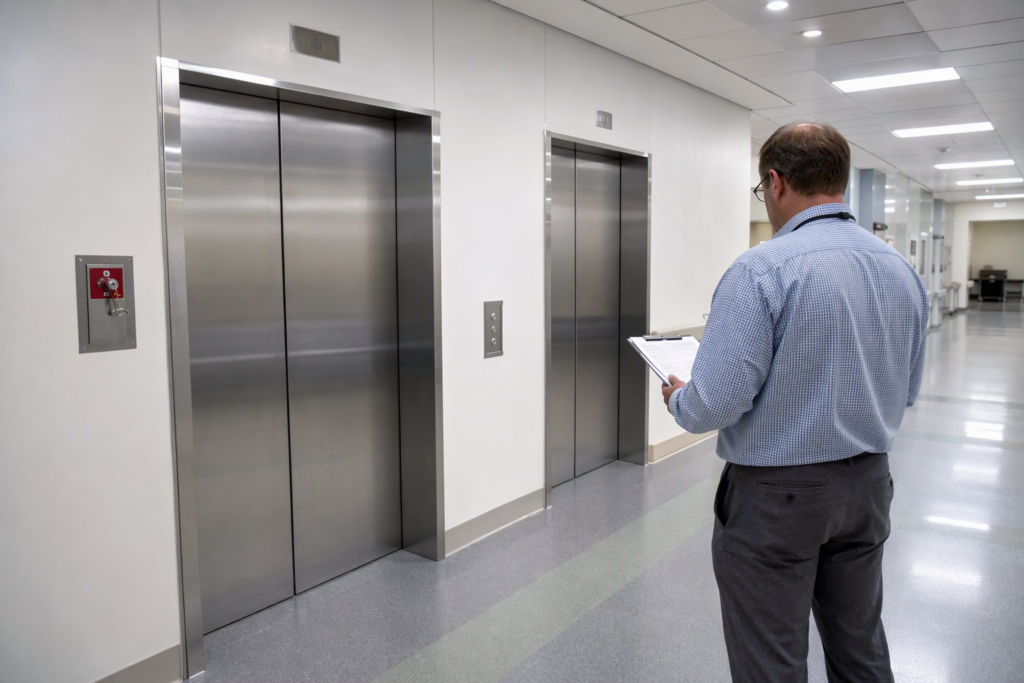
When a state elevator inspector or a healthcare accreditation surveyor (such as The Joint Commission) reviews your facility’s elevator program, expect the following questions and document requests:
- Are current inspection certificates posted in every elevator cab? Certificates must be current and visible to passengers as required by state law.
- Can you produce the maintenance log for each elevator? Inspectors will review the frequency and scope of preventive maintenance visits and any corrective repairs performed.
- Have all violations from the previous inspection been corrected? Open violations from prior inspections are a leading indicator of systemic maintenance deficiencies.
- What is the procedure for taking an elevator out of service after a malfunction? Facilities should have a documented out-of-service protocol available for review.
- How are elevator entrapments managed? Inspectors may ask about emergency communication system testing and staff training for entrapment response.
- Have fire service recall features been tested? ASME A17.1 requires periodic testing of Phase I and Phase II fire service operation, and healthcare facilities have specific fire recall obligations under life safety codes.
- Is there a documented plan for elevator availability during a mass casualty or emergency event? Healthcare accreditation standards increasingly address vertical transportation as part of emergency operations planning.
- Who is your elevator service contractor, and are they qualified to work on this equipment? Inspectors may ask for contractor documentation or licensing verification depending on the state.
What Should Healthcare Administrators Look for When Selecting an Elevator Service Company?
Healthcare facilities should evaluate elevator service providers on the basis of demonstrated experience with hospital and medical facility environments, familiarity with ASME A17.1, ADA, and applicable state code requirements, the ability to service equipment promptly to minimize patient transport disruption, and a documented approach to preventive maintenance that produces comprehensive maintenance records. Facilities operating across multiple markets — such as health systems with campuses in both Texas and California — benefit from working with a service provider that has established operations in each relevant market. AmeriTex Elevator serves healthcare clients across Houston, Dallas, Austin, San Antonio, Los Angeles, and San Diego, providing maintenance, repair, inspection support, and modernization services tailored to the demands of healthcare vertical transportation.
Protect Your Patients, Staff, and Facility — Start With a Free Assessment
Elevator safety in a healthcare setting is a patient safety issue. Deferred maintenance, lapsed inspections, and ADA compliance gaps create real risk for the individuals your facility serves — and real liability exposure for your organization. A proactive maintenance program grounded in current code compliance is the most effective strategy available to healthcare administrators for managing that risk.
Contact AmeriTex Elevator for a free elevator assessment and let a qualified service team evaluate your facility’s current compliance posture, maintenance history, and modernization needs. Serving Houston TX, Dallas TX, Austin TX, San Antonio TX, Los Angeles CA, and San Diego CA.
Call us today: 866-679-4313
Need elevator service you can rely on? AmeriTex Elevator is ready to help.