How to Evaluate and Switch Elevator Service Vendors: The Complete FAQ Guide
Switching elevator service vendors is a significant operational decision that affects building safety, regulatory compliance, equipment longevity, and overall liability exposure. Whether a current vendor is underperforming on maintenance, failing inspections, or simply unresponsive, building owners and facility managers across Texas and California need a clear, step-by-step framework to make the transition safely and confidently. This FAQ hub answers every material question about evaluating your current provider and executing a smooth vendor switch.
What is the most important first step when evaluating whether to switch elevator service vendors?
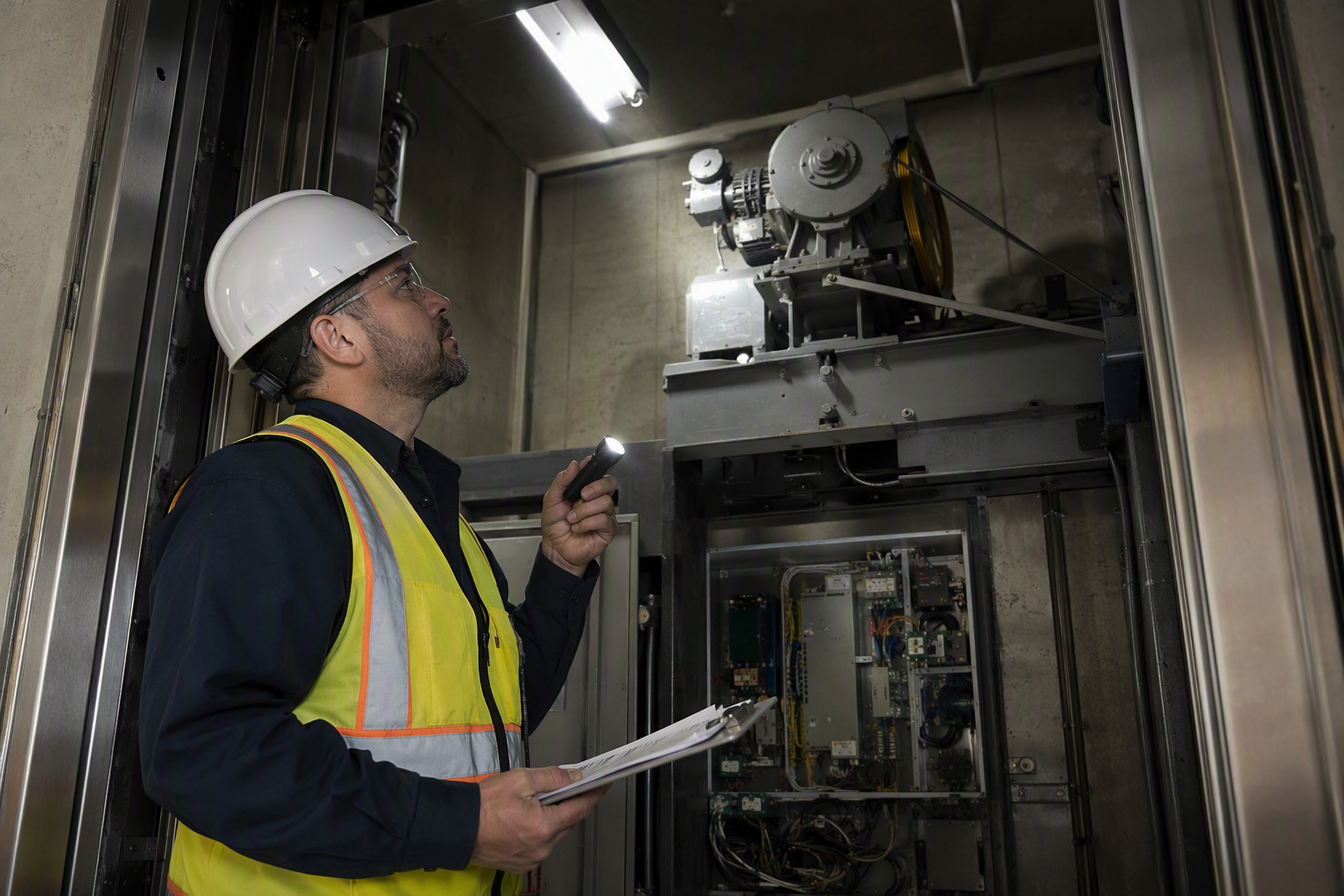
The most important first step is a thorough contract audit combined with an independent mechanical assessment of your elevator equipment.
Before contacting a new vendor or issuing a request for proposals, facility managers should pull the current service agreement and document every obligation, termination clause, auto-renewal window, and notice requirement. Many contracts require 30, 60, or even 90 days of written notice before termination, and missing that window can lock a building into another full service year.
Simultaneously, scheduling an independent elevator inspection — performed by a third-party licensed elevator inspector rather than the incumbent vendor — gives an unbiased baseline of equipment condition. This documentation becomes leverage in vendor negotiations and establishes a legal record of the unit’s state at the time of transition.
How do you know when it is time to switch elevator service vendors?
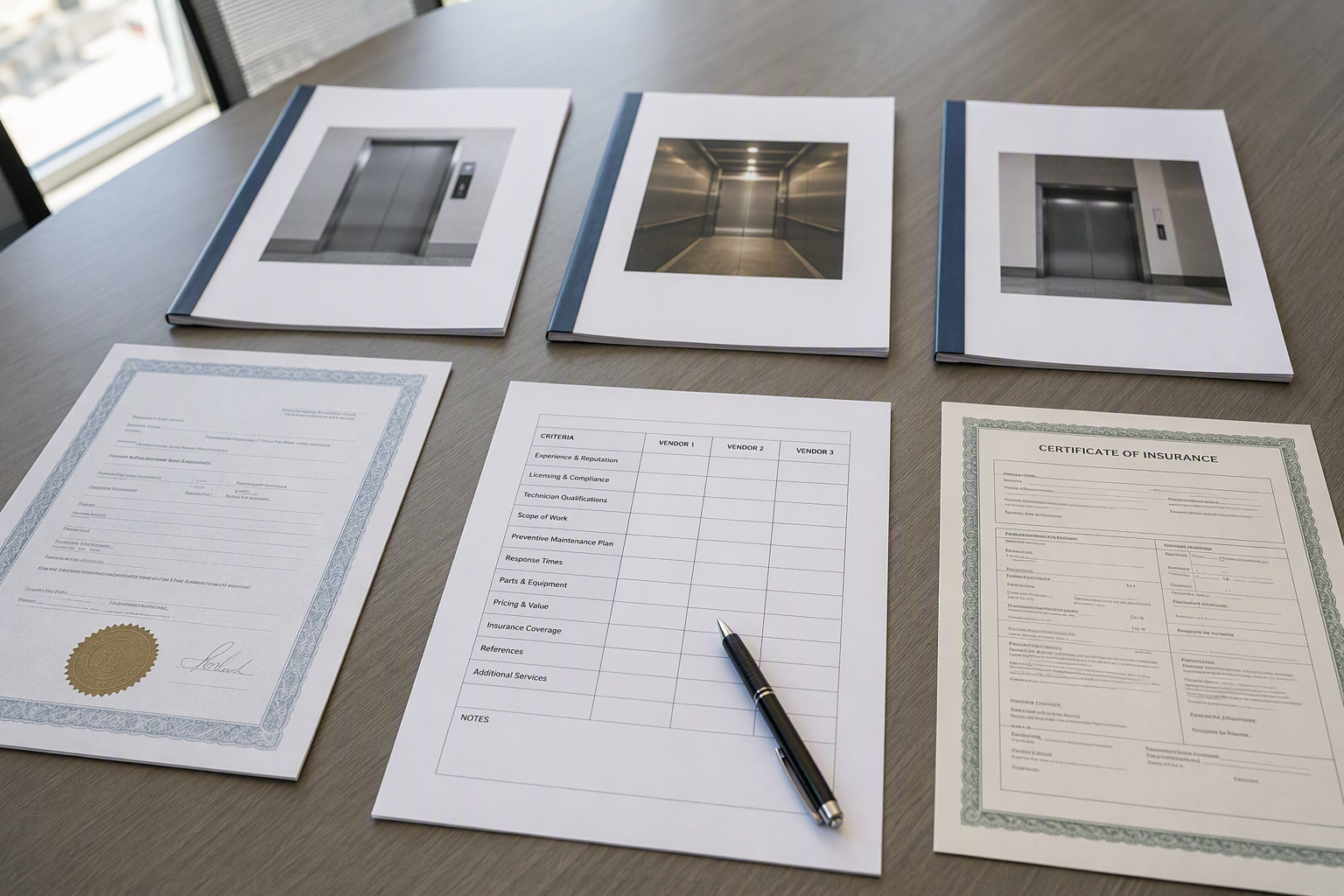
Key indicators include repeated failed inspections, unresolved maintenance callbacks, slow emergency response, poor recordkeeping, and a pattern of deferred repairs that compromise safety compliance.
Regulatory compliance is the clearest benchmark. Under the ASME A17.1 Safety Code for Elevators and Escalators, equipment must be maintained to specific standards, and a vendor who cannot consistently pass state-mandated annual or periodic inspections is a direct liability risk to the building owner.
Beyond compliance, chronic nuisance calls, extended equipment downtime, and technicians who patch rather than correct root causes are operational signals that a service relationship has degraded. Documenting these incidents — with dates, ticket numbers, and resolution times — builds the evidentiary record needed to justify a vendor change to building ownership or a board.
What should a vendor evaluation checklist include?
A thorough vendor evaluation checklist should cover licensing and insurance verification, compliance history, scope of maintenance coverage, parts sourcing practices, technician qualifications, recordkeeping systems, and contractual flexibility.
The checklist items below represent the minimum due diligence standard for any commercial elevator service procurement:
- State elevator contractor license verification (Texas: Texas Department of Insurance; California: DOSH/Cal-OSHA elevator unit)
- Certificate of general liability and workers’ compensation insurance with adequate limits
- Documented history of passing local authority having jurisdiction (AHJ) inspections
- Clear delineation of what is included in routine maintenance versus billable repair
- OEM or equivalent parts sourcing policy
- Compliance with ASME A17.1 maintenance intervals and procedures
- Digital or auditable paper maintenance logs accessible to the building owner
- Contract terms including notice periods, auto-renewal clauses, and exit provisions
- References from comparable building types in your market
How do you compare elevator service contracts side by side?
Compare contracts across five core dimensions: scope of coverage, exclusions, contract term and exit provisions, compliance guarantees, and pricing structure.
The table below provides a benchmark framework for comparing elevator maintenance agreements:
| Evaluation Dimension | What to Look For | Red Flag |
|---|---|---|
| Scope of Coverage | Comprehensive parts and labor included; clear definition of “routine maintenance” | Vague language that excludes most components as “major repairs” |
| Compliance Assurance | Vendor commits in writing to keep equipment inspection-ready per ASME A17.1 and state code | No mention of code compliance; vendor disclaims responsibility for inspection outcomes |
| Contract Term | 12-month initial term with reasonable renewal options | Multi-year auto-renewing contracts with 90+ day cancellation windows |
| Exit Provisions | Clear termination for cause language; buyout provisions are defined and reasonable | No termination for cause clause; early exit penalties are disproportionate |
| Recordkeeping | Owner receives copies of all maintenance logs, inspection certificates, and work orders | Vendor retains all records and provides no copies to building owner |
| Parts Policy | OEM or approved equivalent parts; no proprietary lock-in | Proprietary parts that only the incumbent vendor can source or service |
| ADA Compliance Support | Vendor identifies and documents ADA-related accessibility gaps during routine service | Vendor has no documented ADA compliance protocol |
| References | Verifiable references from comparable building types in your city or region | Vendor cannot or will not provide references |
What are the licensing requirements for elevator service companies in Texas and California?
In Texas, elevator contractors must be licensed through the Texas Department of Insurance Elevator Safety and Accessibility Division; in California, elevator contractors are regulated under Cal-OSHA’s Elevator, Ride, and Tramway Unit under Title 8 of the California Code of Regulations.
Building owners in Houston, Dallas, Austin, and San Antonio should verify that any vendor holds a current Texas Elevator Contractor License before signing a service agreement. The license number should appear on all proposals, contracts, and invoices.
In Los Angeles and San Diego, the applicable regulatory authority is the California Division of Occupational Safety and Health (Cal-OSHA). All elevator mechanics and contractors must hold state-issued certification. Facility managers should request proof of current licensure and confirm the license is in good standing before the service relationship begins. Engaging an unlicensed contractor exposes the building owner to regulatory fines and liability under OSHA guidelines as well as state-specific codes.
How do ASME A17.1 requirements affect vendor selection?
ASME A17.1 is the foundational safety code governing elevator design, installation, operation, and maintenance in North America, and any qualified service vendor must demonstrate working knowledge of its current edition and perform maintenance that meets or exceeds its requirements.
The ASME A17.1 Safety Code for Elevators and Escalators specifies maintenance intervals, inspection procedures, and documentation requirements. A vendor who cannot articulate how their maintenance program aligns with this code — or who cannot produce maintenance logs formatted to its standards — is a compliance risk regardless of price.
During vendor evaluation, request a sample maintenance log and ask the prospective vendor to identify which specific ASME A17.1 sections govern their scheduled maintenance tasks. A technically competent vendor will answer this question without hesitation. The 2025/2026 edition of the code continues to reinforce requirements around machine room access, safety device testing, and modernization triggers that facility managers should be aware of when evaluating aging equipment.
What does a professional elevator equipment audit involve?
A professional elevator equipment audit involves a systematic, documented inspection of all mechanical, electrical, and safety components, benchmarked against ASME A17.1, the applicable local code edition, and the manufacturer’s original specifications.
During a transition between vendors, an independent equipment audit serves two purposes: it protects the incoming vendor from inheriting undisclosed liability, and it gives the building owner a clear picture of deferred maintenance and capital exposure. The audit should cover:
- Controller and drive system condition
- Rope or belt condition and tension (traction elevators) or hydraulic cylinder and fluid integrity (hydraulic elevators)
- Door operator, sill, and interlock condition
- Safety device functionality including buffers, governors, and safeties
- Machine room and pit conditions relative to code requirements
- Current inspection certificate status and any outstanding violations
- ADA compliance status of cab features and signage per ADA Section 4.10 requirements
AmeriTex Elevator provides comprehensive equipment audits for buildings in Houston, Dallas, Austin, San Antonio, Los Angeles, and San Diego as part of its evaluation and onboarding process for new service clients.
How long does it typically take to switch elevator service vendors?
A properly managed vendor transition typically takes between 30 and 90 days from the notice of termination to full execution of a new service agreement, depending on the complexity of the equipment, the number of units, and the contract notice requirements of the incumbent vendor.
The timeline breaks down into three phases. The first phase — contract review and notice delivery — typically requires two to four weeks and must be timed carefully against the incumbent contract’s auto-renewal window. The second phase — vendor evaluation, RFP, and selection — can run concurrently and typically requires three to six weeks for a thorough procurement process. The third phase — equipment audit and onboarding — should occur before or immediately at the start of the new service term and generally requires one to two weeks per property.
Rushing any phase introduces risk. A building that skips the equipment audit at transition may discover deferred maintenance issues that the new vendor inherits without documentation, creating disputes about responsibility and potentially prolonging equipment downtime.
What questions should you ask a prospective elevator service vendor?
The most revealing questions focus on compliance protocols, technician training, parts sourcing, documentation practices, and how the vendor handles inspection failures or emergency situations.
A structured questionnaire for prospective vendors should include the following:
- What is your current Texas (or California) elevator contractor license number, and can you provide a certificate of insurance?
- How does your maintenance program align with the current edition of ASME A17.1?
- What is included in your routine maintenance scope, and what is excluded as a billable repair?
- Do you use OEM parts or approved equivalents, and who sources them?
- How are maintenance logs documented, and does the building owner receive copies?
- What is your process if an elevator fails a state inspection?
- How do you handle emergency entrapments, and what is your protocol for notifying building management?
- What are the termination notice requirements and auto-renewal provisions in your standard contract?
- Can you provide references from buildings with similar elevator types and volumes in our city?
- Do you perform ADA compliance assessments during routine maintenance visits?
How do you negotiate favorable terms when switching elevator service vendors?
Negotiating leverage comes from having competing bids, documented performance failures by the incumbent vendor, a clear understanding of the equipment’s current condition, and a willingness to commit to a reasonable service term in exchange for concessions.
Building owners who bring a completed equipment audit report to vendor negotiations are in a significantly stronger position. The audit removes information asymmetry — the vendor can no longer claim unknown equipment complexity as justification for contract terms that favor the service provider. When multiple vendors are competing for the same account, facilities managers can also negotiate on contract length, auto-renewal notice windows, and the definition of what constitutes a billable repair versus a routine maintenance task.
One particularly important negotiation point is record ownership. Maintenance logs, inspection certificates, and violation records should contractually belong to the building owner, not the service vendor. Vendors who insist on retaining records are creating a switching barrier and should be evaluated accordingly.
What happens to elevator inspection certificates during a vendor transition?
Elevator inspection certificates are issued to the building or equipment, not to the service vendor, so a vendor transition does not automatically invalidate a current certificate — but any outstanding violations must be addressed by the incoming vendor before the next inspection cycle.
In Texas, the Elevator Safety and Accessibility Division issues certificates of compliance that are tied to the specific equipment and the building address. In California, Cal-OSHA’s permit process similarly attaches permits to the equipment rather than the contractor. This means the building owner retains the certificate through a vendor transition.
However, any open violations or required corrections noted in the last inspection report become the responsibility of the building owner and incoming vendor to resolve. The new vendor should review all outstanding inspection findings before executing the service agreement and include a remediation plan in the proposal. Attempting to operate equipment with unresolved violations is a liability exposure regardless of which vendor is in place.
What role does ADA compliance play in elevator vendor evaluation?
ADA compliance is a non-negotiable legal requirement for any public-accommodation elevator, and a qualified service vendor should actively identify and document accessibility gaps during routine maintenance rather than waiting for a complaint or enforcement action.
The Americans with Disabilities Act establishes specific requirements for elevator cab dimensions, door timing, audible and visual signals, Braille and raised character controls, and leveling tolerances. A vendor who lacks familiarity with these requirements — or who defers all ADA questions to the building’s legal counsel — is not providing full-service elevator maintenance.
During vendor evaluation, ask specifically how the prospective vendor incorporates ADA compliance checks into their routine maintenance protocol. The answer should reference specific ADA Standards for Accessible Design criteria and should describe a documentation process that gives the building owner a written record of compliance status.
How should building owners handle proprietary parts or systems when switching vendors?
Proprietary parts or control systems installed by an incumbent vendor can create switching barriers, but these can be managed through equipment audits, parts sourcing research, and — if necessary — targeted modernization to restore open-architecture compatibility.
Some elevator service vendors install proprietary controllers or communication systems that only their technicians are trained or equipped to service. This is a deliberate retention strategy, and building owners should specifically inquire about proprietary components during both contract review and the equipment audit phase.
When proprietary systems are identified, the incoming vendor should assess whether third-party diagnostic tools and parts are available, whether the system can be reprogrammed or replaced as part of a targeted modernization, and what the cost-benefit analysis looks like relative to continuing with the incumbent vendor’s terms. In many cases, a targeted controller modernization — replacing only the proprietary component — can restore full vendor optionality at a fraction of a complete elevator modernization project.
What are the risks of a poorly managed elevator vendor transition?
A poorly managed transition can result in equipment downtime, inspection failures, loss of maintenance history, disputed liability for pre-existing damage, and gaps in coverage that expose the building owner to safety and legal risk.
The most common risks in disorganized vendor transitions include:
- Loss of maintenance records: If the building owner does not hold copies of all maintenance logs, the incoming vendor starts without a history of the equipment, increasing the risk of missed deficiencies.
- Coverage gaps: If the outgoing vendor’s contract lapses before the new agreement is executed, the equipment may operate without a service agreement — a condition that many insurance policies flag as a compliance issue.
- Disputed pre-existing damage: Without an independent equipment audit at transition, new vendors can dispute responsibility for any issues discovered after onboarding, leading to delays and potential cost disputes.
- Inspection timing conflicts: If a state inspection falls during the transition window, it may be unclear which vendor is responsible for addressing violations.
AmeriTex Elevator’s structured onboarding process for new service clients in Houston, Dallas, Austin, San Antonio, Los Angeles, and San Diego is specifically designed to eliminate these transition risks through documented equipment audits and clear contractual handoff protocols.
How many vendors should you evaluate before switching?
A best-practice vendor procurement process involves soliciting proposals from a minimum of three qualified vendors to ensure competitive benchmarking on scope, terms, and service approach.
Evaluating only one alternative to the incumbent vendor limits negotiating leverage and may result in selecting a new provider who offers only marginal improvement. A minimum of three proposals — evaluated against a consistent scoring rubric that weights compliance track record, contractual flexibility, scope of coverage, and technical qualifications — provides the data needed for a defensible decision.
For larger portfolios with multiple units across multiple buildings, a formal Request for Proposals (RFP) process with a defined evaluation rubric is the appropriate procurement method. This approach also creates a documented record of the selection process, which can be valuable if the decision is later reviewed by ownership, a board, or a regulatory authority.
What is the step-by-step process for switching elevator service vendors?
A structured vendor transition follows a defined sequence of steps that protect compliance, preserve equipment history, and eliminate gaps in coverage.
- Audit the current contract. Identify termination notice requirements, auto-renewal dates, exit penalties, and any proprietary equipment clauses.
- Gather all maintenance records. Request complete copies of all maintenance logs, inspection certificates, violation notices, and work orders from the incumbent vendor before providing notice of termination.
- Commission an independent equipment audit. Engage a licensed third-party inspector to document the current condition of all elevator equipment before transition.
- Issue a formal Request for Proposals. Distribute a structured RFP to a minimum of three qualified, licensed elevator service vendors in your market.
- Evaluate proposals against a consistent rubric. Score each proposal on licensing, insurance, compliance approach, scope, contract terms, and references.
- Conduct vendor interviews. Ask the ten structured questions outlined earlier in this guide and verify all claimed credentials independently.
- Negotiate the new service agreement. Prioritize maintenance record ownership, exit provisions, compliance guarantees, and the definition of covered repairs.
- Deliver written termination notice to the incumbent. Send the notice via certified mail or documented electronic method within the required notice window.
- Execute the new service agreement. Ensure the new contract start date aligns with or immediately follows the incumbent contract end date to eliminate coverage gaps.
- Complete the onboarding equipment walkthrough. The new vendor should conduct a documented onsite review of all equipment before assuming full maintenance responsibility.
- Transfer all inspection certificates and records. Confirm all regulatory documents are updated to reflect the new service provider where required by local AHJ.
What should be included in a new elevator service agreement to protect the building owner?
A protective elevator service agreement should include comprehensive maintenance scope definitions, compliance guarantees, record ownership provisions, reasonable termination rights, and clear liability allocation for pre-existing versus newly discovered deficiencies.
Beyond the standard scope-of-work and pricing provisions, facility managers and building owners should specifically negotiate the following protective provisions:
- A written statement that the vendor will maintain equipment in compliance with the current edition of ASME A17.1 and all applicable state and local codes
- A provision that all maintenance records, inspection certificates, and work orders are the property of the building owner and will be provided in full upon contract termination
- A termination for cause provision allowing cancellation without penalty if the vendor fails to correct inspection violations within a defined remediation period
- A clear exclusion carve-out that documents pre-existing conditions identified in the onboarding equipment audit so that liability for those conditions is not improperly assigned to the new vendor later
- An ADA compliance assessment clause requiring the vendor to document accessibility status annually
- An auto-renewal notice window of no more than 30 days to preserve the owner’s ability to re-bid the contract regularly
How do local elevator regulations in Texas and California affect vendor transitions?
Both Texas and California have state-level elevator regulatory frameworks that impose specific requirements on contractors, inspection timelines, and permit transfers that directly affect how a vendor transition must be managed.
In Texas, the Elevator Safety and Accessibility Division under the Texas Department of Insurance requires that elevator contractors maintain current state licensure and that all installations, alterations, and major repairs be performed under a valid permit. A vendor transition that involves any equipment repairs or alterations may trigger permit requirements that the new vendor must fulfill before the work proceeds.
In California, Cal-OSHA’s elevator unit enforces Title 8 regulations and requires that all elevator contractors hold state certification. The permit for each elevator is tied to the equipment, not the contractor, but the incoming vendor must ensure all active permits are in good standing. Building owners in Los Angeles and San Diego should confirm with their incoming vendor that all regulatory notifications required at the time of contractor change are completed promptly to avoid any gap in compliance status.
How does elevator modernization factor into a vendor switch evaluation?
A vendor transition is an ideal time to evaluate whether aging equipment warrants targeted or full modernization, since the incoming vendor’s equipment audit will reveal deferred maintenance that may be more economically addressed through modernization than continued repair.
ASME A17.1 and state codes identify specific equipment age thresholds and technology standards that can trigger modernization requirements, particularly around safety device upgrades and door operator performance. An incoming vendor who reviews the equipment audit and identifies components approaching end of life is providing a valuable capital planning service, not simply selling a larger project.
Building owners should evaluate modernization proposals from the incoming vendor with the same rigor applied to the maintenance contract — including independent review of the scope, compliance basis, and projected equipment life extension. AmeriTex Elevator performs equipment condition assessments across its service markets that include capital planning guidance aligned with current code requirements, giving building owners the information needed to make informed modernization decisions.
What should building owners in Houston, Dallas, Austin, San Antonio, Los Angeles, and San Diego look for in a local elevator service vendor?
Local market presence, verified licensure in the applicable state jurisdiction, demonstrable knowledge of local AHJ inspection practices, and references from comparable properties in the same city are the distinguishing factors for a qualified local elevator service vendor.
National elevator service companies sometimes offer regional coverage through subcontractors or dispatch from distant service centers, which can affect response consistency and local code familiarity. A vendor with an established local presence in the specific market — Houston, Dallas, Austin, San Antonio, Los Angeles, or San Diego — will have direct relationships with the local authority having jurisdiction (AHJ) and current knowledge of that AHJ’s inspection preferences and enforcement patterns.
References should be drawn from the same metropolitan market, not from a different city or state. An elevator service vendor who performs well in Dallas may have a different service depth in San Antonio or Los Angeles. Market-specific references are the most reliable indicator of local service quality.
AmeriTex Elevator operates directly in all six of these markets — Houston, Dallas, Austin, San Antonio, Los Angeles, and San Diego — with service teams familiar with each city’s regulatory environment and inspection authority requirements.
How do you maintain compliance during the period between vendors?
Maintaining compliance during the transition window requires confirming that the incumbent vendor’s obligations remain in force through the contract end date, that no inspection deadlines fall in the gap period, and that any outstanding violations are formally assigned to either the outgoing or incoming vendor before the handoff occurs.
The practical steps for maintaining compliance during transition include:
- Confirm the exact date the incumbent vendor’s service obligations expire and ensure that date aligns with the new vendor’s start date.
- Request the next scheduled inspection date from the local AHJ and ensure either the incumbent or incoming vendor is contractually responsible for that inspection.
- Obtain written confirmation from the incumbent vendor of any outstanding work orders, open violations, or scheduled repairs before the transition date.
- Notify the building’s insurance carrier of the vendor transition and confirm that elevator liability coverage remains continuous.
- Ensure the incoming vendor has all relevant equipment documentation — including the most recent inspection certificate and any violation notices — before assuming service responsibility.
Following these steps eliminates the most common compliance exposure points during an elevator service vendor transition and creates a documented chain of responsibility that protects the building owner in the event of a post-transition dispute.
Need elevator service you can rely on? AmeriTex Elevator is ready to help.