Healthcare Elevator Maintenance Standards: What Hospitals and Medical Facilities Must Know

Elevators in hospitals, outpatient clinics, surgical centers, and long-term care facilities are not optional infrastructure — they are mission-critical systems. When a hospital elevator goes out of service, patient transport is compromised, staff efficiency drops, and regulatory compliance is immediately at risk. Understanding current healthcare elevator maintenance standards in 2026 is essential for facility managers, compliance officers, and healthcare administrators across Texas and California markets including Houston, Dallas, Austin, San Antonio, Los Angeles, and San Diego.
AmeriTex Elevator works with healthcare facilities to develop proactive maintenance programs built around the layered compliance requirements that govern medical environments. The information below covers every dimension of this topic — from code specifics to inspection checklists to vendor selection criteria.
What Are the Core Compliance Requirements for Healthcare Elevator Maintenance?
Healthcare elevator maintenance sits at the intersection of multiple overlapping regulatory frameworks. Each layer adds requirements that go beyond standard commercial elevator codes.
- ASME A17.1 Safety Code for Elevators and Escalators: The foundational national standard governing elevator design, installation, and maintenance. State jurisdictions in Texas and California adopt this code (with local amendments) and require periodic inspections by licensed elevator inspectors.
- Americans with Disabilities Act (ADA): Mandates specific cab dimensions, door timing, control panel heights, and auditory/visual signals to ensure accessibility for patients using wheelchairs, stretchers, or mobility aids.
- The Joint Commission (TJC) Environment of Care Standards: Accredited hospitals must demonstrate that all vertical transportation is included in their preventive maintenance program and that out-of-service events are documented and resolved promptly.
- CMS Conditions of Participation: Medicare- and Medicaid-certified facilities must maintain a safe physical environment, which includes elevator reliability and documentation of service records.
- State and Local Amendments: Texas and California each maintain state-level elevator safety laws administered by the Texas Department of Insurance (TDI) and California’s Division of Occupational Safety and Health (Cal/OSHA), respectively, adding inspection certificate requirements and jurisdiction-specific timelines.
How Often Do Healthcare Elevators Need to Be Inspected?
Under ASME A17.1, elevators in most jurisdictions require a full periodic inspection and a separate safety test on a defined cycle — commonly annual for the inspection and every five years for the full load test (Category 1 and Category 5 tests, as defined in the code). Healthcare environments often trigger more frequent internal maintenance checks because patient safety risk elevates the consequence of any failure.
The Joint Commission’s Environment of Care standards require facilities to document that preventive maintenance is performed at intervals defined in their own maintenance management plan — meaning the facility itself must set a schedule and then prove adherence. Quarterly maintenance visits are a common baseline in hospital settings, though high-use elevators serving emergency departments or surgical floors may warrant monthly inspections.
AmeriTex Elevator helps healthcare clients build maintenance schedules that satisfy both state inspection requirements and internal Joint Commission documentation needs.
What Makes Healthcare Elevator Maintenance Different from Standard Commercial Maintenance?
Several factors make hospital and medical facility elevator maintenance more demanding than typical commercial elevator service:
- Continuous Operation: Healthcare elevators often run around the clock. Equipment wear accumulates faster, and maintenance windows must be planned with extraordinary care to avoid disrupting patient transport.
- Infection Control Protocols: Service technicians working in clinical environments may be required to follow facility-specific infection prevention procedures, including personal protective equipment (PPE) use, equipment cleaning, and restricted access to sterile zones.
- Bariatric and Stretcher Capacity: Medical elevators frequently need to accommodate heavy-duty loads including bariatric patients, hospital beds, and specialized medical equipment. Maintenance must verify rated load capacity remains valid and that all safety devices are calibrated accordingly.
- Emergency Power Integration: Hospital elevators typically connect to emergency generators. Maintenance programs must include testing of the emergency lowering function and integration with the facility’s life-safety system under OSHA and local fire code requirements.
- Documentation Depth: Accreditation surveyors expect granular service records. Every maintenance visit, corrective action, and parts replacement should be logged with date, scope, and technician qualification.
What Are the ADA Requirements Specific to Medical Facility Elevators?
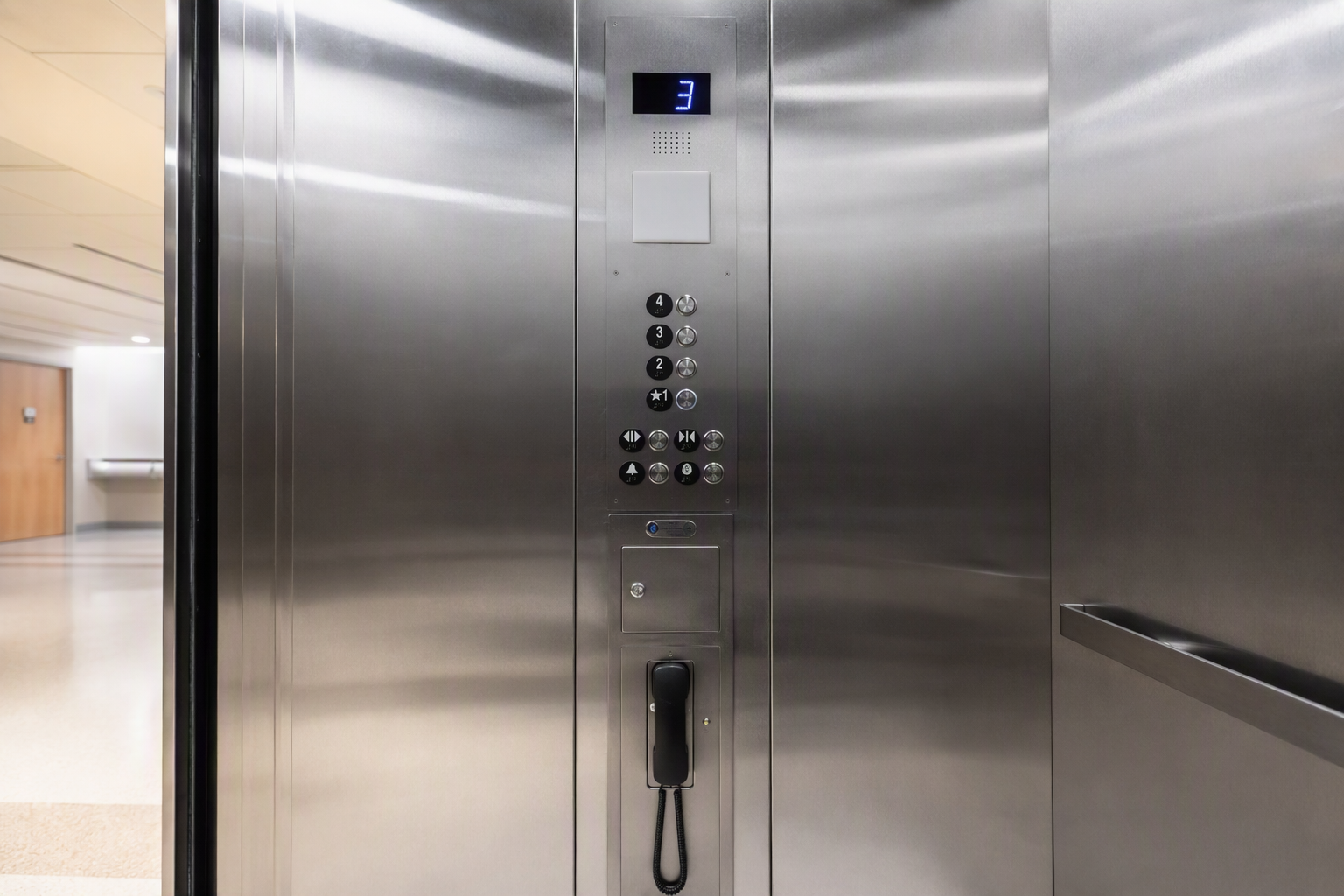
The ADA establishes baseline accessibility standards that apply to all public accommodations and commercial facilities, including healthcare buildings. For elevator cabs in medical settings, key requirements include minimum cab dimensions sufficient to accommodate wheelchairs, door reopening devices that respond to obstructions, audible and visual floor indicators, Braille and raised-character control buttons, and leveling accuracy within a specified tolerance of the landing to allow safe wheelchair and stretcher transfer.
Maintenance failures that cause excessive floor-level misalignment (known as “leveling error”) are among the most common ADA compliance deficiencies found during healthcare facility audits. A routine maintenance program that includes leveling calibration directly reduces this risk.
What Should a Healthcare Elevator Preventive Maintenance Agreement Include?
A preventive maintenance (PM) agreement for a healthcare facility should be substantially more comprehensive than a basic commercial contract. Key elements to require include:
- Defined visit frequency aligned with facility use patterns and Joint Commission documentation expectations
- Full-maintenance coverage (parts and labor) rather than oil-and-grease-only contracts
- Emergency callback provisions with documented prioritization for life-safety environments
- Compliance documentation packages that can be presented directly to TJC surveyors or state inspectors
- Modernization assessments that flag aging components before they cause unplanned downtime
- Infection control compliance protocols for technicians working in clinical spaces
AmeriTex Elevator structures healthcare service agreements to address these requirements across its service markets in Houston, Dallas, Austin, San Antonio, Los Angeles, and San Diego.
What Happens If a Healthcare Facility Fails an Elevator Inspection?
A failed elevator inspection in a healthcare setting triggers a cascade of consequences beyond simple equipment downtime:
- The jurisdiction’s elevator safety authority (TDI in Texas, Cal/OSHA in California) issues a written notice of violation and may require the elevator to be taken out of service immediately.
- The facility must file a corrective action plan within the timeframe specified in the violation notice.
- If the facility is Joint Commission–accredited, the out-of-service event and corrective response must be documented in the Environment of Care program.
- CMS surveyors reviewing the facility’s Conditions of Participation compliance may flag unresolved elevator deficiencies as part of a broader life-safety survey finding.
- Reinspection by the state authority is required before the elevator returns to service, adding additional scheduling complexity.
Proactive maintenance is significantly less disruptive — and less costly in operational terms — than managing a failed inspection event in a patient-care environment.
How Should a Facility Respond Immediately When a Healthcare Elevator Goes Out of Service?
- Post clear out-of-service signage at all affected landings immediately to redirect staff, patients, and visitors.
- Activate the facility’s patient transport contingency plan, routing critical transport through available elevators or alternate pathways.
- Contact the elevator service provider to initiate an emergency service call and document the time of the call.
- Notify the facility’s safety officer and document the outage in the Environment of Care event log.
- If passengers are entrapped, contact emergency services per local protocol and do not attempt manual rescue without trained personnel.
- Upon restoration of service, conduct a documented post-event review to identify root cause and update the preventive maintenance schedule accordingly.
What Are the Elevator Modernization Triggers in a Healthcare Setting?
Elevator modernization — upgrading controls, drive systems, cab interiors, or safety components — is not always optional. In healthcare settings, modernization becomes necessary when:
- Replacement parts for legacy control systems are no longer manufactured, making repairs unreliable
- The elevator cannot reliably meet ADA leveling tolerances due to aging hydraulic or traction systems
- Energy consumption is identified as a facility sustainability target and modern variable-frequency drives offer measurable reduction
- The facility expands or reclassifies space in ways that increase traffic demand beyond the current system’s design capacity
- State inspection authorities identify code compliance gaps that cannot be resolved through maintenance alone
AmeriTex Elevator provides modernization assessments that evaluate whether repair or replacement is the more appropriate path given a facility’s operational requirements and budget constraints.
How Do Texas and California Healthcare Elevator Regulations Differ?
While both states adopt ASME A17.1 as their foundational standard, the administrative frameworks differ meaningfully:
- Texas: The Texas Department of Insurance administers elevator safety through the Elevator Safety and Licensing program. Facilities in Houston, Dallas, Austin, and San Antonio must maintain current certificates of inspection and ensure that inspections are performed by TDI-licensed inspectors.
- California: Cal/OSHA’s Elevator, Ride, and Tramway Unit oversees elevator safety in Los Angeles and San Diego. California also maintains its own Title 8 regulations that supplement ASME requirements, and the permitting and inspection process operates through Cal/OSHA regional offices.
Healthcare facility managers operating across state lines must account for both regulatory environments when designing a unified maintenance program.
What Should Facility Managers Look for When Evaluating an Elevator Service Vendor?
Selecting an elevator maintenance vendor for a healthcare environment requires criteria beyond price. Facility managers should evaluate:
- Demonstrated experience servicing healthcare environments and familiarity with Joint Commission documentation expectations
- State licensure in the applicable jurisdiction (TDI in Texas; Cal/OSHA in California)
- Ability to provide comprehensive maintenance records formatted for accreditation review
- Infection control awareness and willingness to comply with facility-specific protocols
- Transparent contract terms that clearly define what is and is not included in the PM agreement
- Local presence in the facility’s market to support timely emergency response
Questions Your Inspector Will Ask
When a state elevator inspector or Joint Commission surveyor reviews your healthcare facility’s vertical transportation program, the following questions are commonly raised. Facility managers should be prepared with documented answers:
- Can you produce the current certificate of inspection for each elevator in this facility?
- What is the frequency of your preventive maintenance visits, and where is that schedule documented?
- Who is your elevator service contractor, and are they licensed in this state?
- When was the last Category 1 test performed, and where is the test record?
- Have any elevators been out of service in the past 12 months? If so, how was the event documented and resolved?
- How are your elevators integrated with the emergency power system, and when was that integration last tested?
- Has a leveling accuracy check been performed recently, and does it meet ADA tolerances?
- Are there any open corrective action items from prior inspections, and what is the resolution timeline?
Facilities that cannot answer these questions with documentation — not just verbal assurances — face the greatest compliance risk during surveys.
How Can AmeriTex Elevator Support Healthcare Compliance Programs?
AmeriTex Elevator is a certified elevator service company serving healthcare facilities across Houston, Dallas, Austin, San Antonio, Los Angeles, and San Diego. The company’s service programs are designed to address the layered compliance environment that hospital and medical facility operators navigate — from ASME A17.1 and ADA requirements through Joint Commission documentation and state-specific inspection processes.
Healthcare clients who work with AmeriTex Elevator receive maintenance programs structured around their facility’s operational demands, regulatory obligations, and accreditation schedules. Service documentation is organized to support direct presentation to inspectors and surveyors.
Schedule Your Healthcare Elevator Assessment Today
Elevator compliance in a healthcare setting is too consequential to leave to chance. Whether your facility is preparing for a Joint Commission survey, renewing state inspection certificates, or evaluating a aging elevator system for modernization, a thorough assessment is the right starting point.
Contact AmeriTex Elevator for a free elevator assessment: 866-679-4313
Need elevator service you can rely on? AmeriTex Elevator is ready to help.