Elevator Downtime Cost Statistics: What Building Owners Need to Know
When an elevator goes out of service, the financial impact extends far beyond the repair invoice. Building owners, property managers, and facility directors face a layered cost structure that includes lost tenant productivity, emergency service surcharges, regulatory compliance penalties, and reputational damage that can affect occupancy rates for months. Understanding the full scope of elevator downtime costs is essential for making data-driven maintenance and modernization decisions in 2026.
What Is the True Cost of Elevator Downtime?
The cost of elevator downtime is rarely a single line item. It is a compound financial event affecting multiple stakeholders simultaneously. Building owners typically absorb direct costs such as emergency repair fees, parts procurement, and after-hours technician rates. Tenants absorb indirect costs through lost productivity, delayed deliveries, and disrupted operations. In multi-tenant commercial buildings, a single elevator outage in a bank of two or three units can trigger lease clauses, rent abatement demands, or formal ADA complaints — all of which carry their own legal and financial consequences.
Costs generally fall into the following categories:
- Emergency repair premiums: Unplanned service calls — especially after hours or on weekends — command higher labor rates than scheduled maintenance visits. The premium for emergency after-hours elevator service is a well-documented industry reality, though specific multipliers vary by market and contractor.
- Parts sourcing costs: Older elevator equipment may require obsolete or hard-to-source components, which drives up both parts cost and the duration of the outage while parts are located and shipped.
- Tenant productivity loss: In office, medical, or industrial facilities where vertical movement is essential to daily operations, every hour of downtime translates to measurable productivity loss across the building’s workforce.
- ADA compliance liability: When an elevator is the primary means of accessible vertical travel, its extended outage may constitute a violation of the Americans with Disabilities Act (ADA), exposing building owners to complaints, investigations, and civil litigation.
- Occupancy and leasing risk: Persistent elevator reliability issues can factor into tenant renewal decisions, reducing occupancy rates and long-term revenue.
- Emergency firefighter service disruption: Elevator outages can compromise emergency egress and firefighter service features mandated under safety codes, potentially triggering citations from local authorities having jurisdiction (AHJs).
What Data Exists on Elevator Downtime Frequency and Cost?

Rigorous, publicly available statistics specifically quantifying per-incident elevator downtime costs are limited in the open literature. Much of the data is held by equipment manufacturers, large property management firms, and insurance carriers as proprietary benchmarking information. However, several authoritative observations can be drawn from the regulatory and industry landscape:
| Standard / Code | Relevance to Downtime Cost | Source |
|---|---|---|
| ASME A17.1 Safety Code for Elevators and Escalators | Establishes mandatory inspection intervals and safety device testing requirements that, when missed, can force an elevator out of service by the AHJ — generating unplanned downtime | ASME Codes & Standards |
| ADA Title III (Places of Public Accommodation) & Title II (Government Entities) | Requires that elevators serving as the primary accessible route remain operational; extended outages can constitute an ADA violation and trigger civil complaints | ADA.gov |
| OSHA General Duty Clause (Section 5(a)(1)) | Requires employers to provide a workplace free from recognized hazards; elevator mechanical failures in workplaces can trigger OSHA citations if maintenance records reveal known deficiencies | OSHA.gov |
Note: The table above reflects regulatory reference points from authoritative public sources. It does not contain proprietary cost figures or invented statistics.
How Does ADA Compliance Factor Into Elevator Downtime Costs?
Under the Americans with Disabilities Act, elevators that serve as the primary means of accessible vertical transportation must be maintained in working order. When an elevator is out of service for an extended period without an alternative accessible route, building owners risk formal complaints filed with the U.S. Department of Justice or private civil lawsuits under Title III (for places of public accommodation) or Title II (for state and local government buildings).
The financial exposure from ADA-related elevator downtime includes:
- Legal defense costs associated with DOJ investigations or private litigation
- Civil penalties for first and subsequent violations, which are set by statute and subject to periodic adjustment
- Mandatory remediation costs that may go beyond simply repairing the elevator — potentially requiring interim accessibility accommodations or physical modifications
- Reputational damage in markets where accessibility compliance is increasingly scrutinized by tenants and lenders
Building owners should document every elevator outage, communicate proactively with tenants who rely on accessible routes, and work with qualified elevator service providers to minimize outage duration and demonstrate good-faith compliance efforts.
What ASME Codes Govern Elevator Maintenance and Inspection Intervals?
The ASME A17.1 Safety Code for Elevators and Escalators is the foundational standard governing elevator design, installation, inspection, testing, and maintenance across the United States and Canada. Most state and local jurisdictions adopt ASME A17.1 (with or without amendments) as their legally enforceable elevator code.
Key maintenance-related requirements under ASME A17.1 that directly affect downtime risk include:
- Periodic inspections: The code requires periodic inspections by a qualified inspector or inspection authority at intervals specified by the jurisdiction — commonly annual. Failure to maintain current inspection certificates can result in an AHJ ordering an elevator out of service immediately, creating forced downtime that could have been avoided.
- Category testing: Safety devices such as governors, safeties, and buffers must be tested on a schedule defined by the code (Category 1 and Category 5 tests). Deferred testing creates both safety risk and the regulatory risk of forced shutdown.
- Maintenance records: ASME A17.1 requires that maintenance records be kept and made available to inspectors. Gaps in documentation can trigger additional scrutiny and extended out-of-service periods during an inspection cycle.
The cost implication is straightforward: buildings that defer code-required maintenance and testing face a higher probability of both unplanned mechanical failures and regulatory-forced shutdowns — both of which generate downtime costs that dwarf the cost of proactive maintenance.
What Are the Most Common Causes of Unplanned Elevator Downtime?
While specific failure frequency statistics vary by equipment type, age, and maintenance history, the elevator service industry broadly recognizes the following as leading drivers of unplanned outages:
- Hydraulic fluid leaks and pump failures in hydraulic elevators, particularly in aging units with original seals and hydraulic systems
- Door operator failures — including worn rollers, misaligned gibs, and failing door motor drives — which represent one of the most frequently cited causes of nuisance shutdowns and entrapments
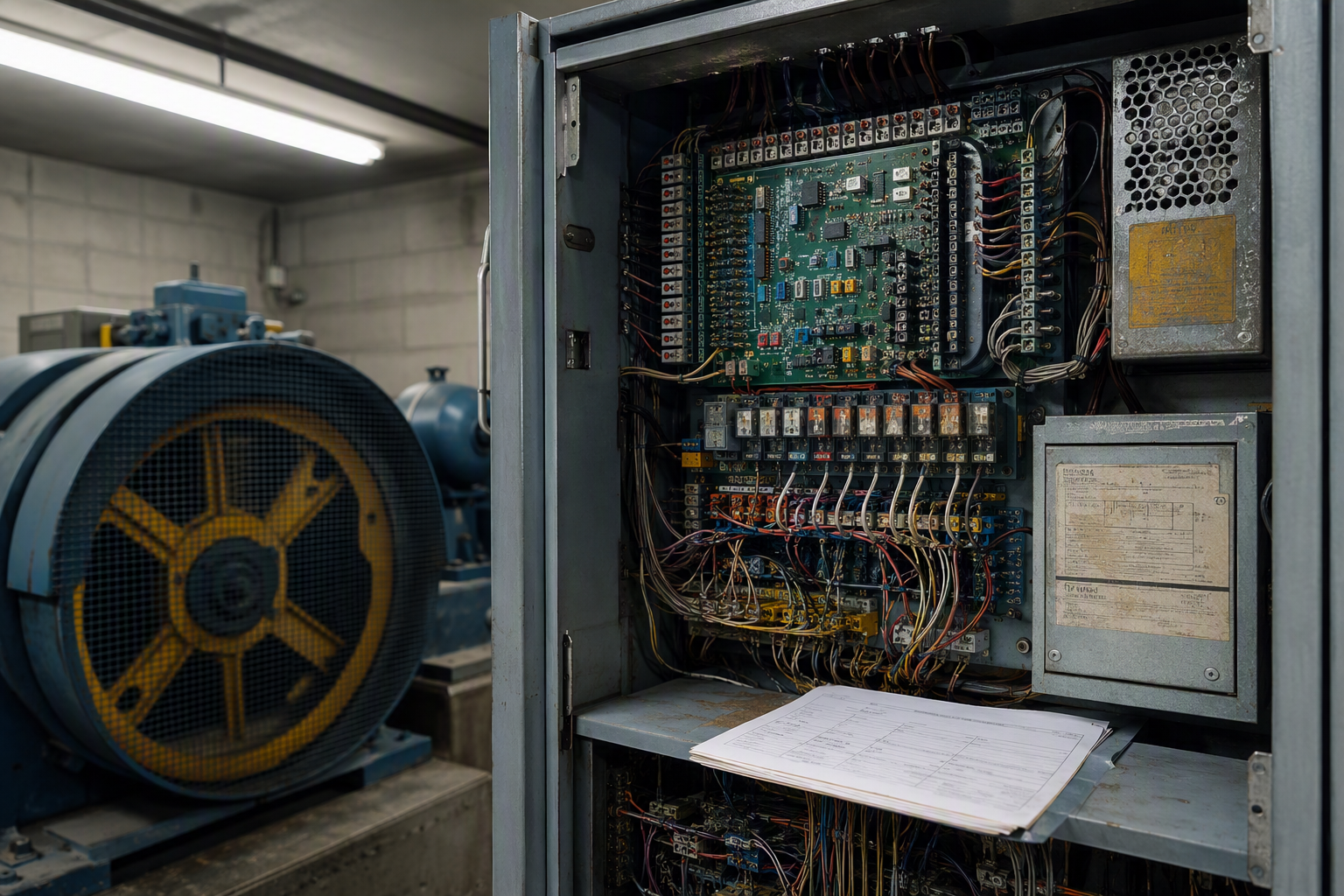
- Controller and circuit board failures in older relay-logic or early solid-state control systems for which replacement parts are scarce
- Rope and sheave wear in traction elevators, which when undetected can result in safety device activation and mandatory shutdown pending inspection
- Brake system degradation that triggers safety circuits before a visual inspection would have flagged a problem
- Power quality issues such as voltage fluctuations that affect drive systems and cause nuisance trips
The common thread across these failure modes is that each one is detectable during routine maintenance before it causes a full outage — making the case that preventive maintenance is the most cost-effective form of downtime cost reduction.
How Does Elevator Age Affect Downtime Risk and Cost?
Elevator equipment age is a primary factor in downtime frequency and repair cost. As elevators age beyond their original design life — often cited in the industry as 20 to 25 years for major components — several compounding cost factors emerge:
- Parts obsolescence: Manufacturers discontinue support for older control systems and mechanical components, forcing service providers to source parts from secondary markets or fabricate replacements, which extends outage duration and increases parts cost.
- Increased failure frequency: Aging components fail more often, converting what might have been a single-incident repair into a pattern of recurring service calls, each carrying its own emergency labor cost.
- Code upgrade requirements: When aging elevators require major repairs, local jurisdictions often require the building owner to bring additional elevator systems into compliance with current ASME A17.1 requirements — a condition sometimes called “triggered alterations” — which can significantly expand the scope and cost of a repair project.
- Insurance implications: Property and liability insurers increasingly scrutinize elevator maintenance records and equipment age, and aging elevators with poor maintenance histories can affect coverage terms.
What Should Building Owners Do Immediately When an Elevator Goes Out of Service?
When an elevator goes out of service unexpectedly, building owners and property managers should follow a structured response protocol to minimize downtime duration, protect tenants, and document the event for regulatory and insurance purposes.
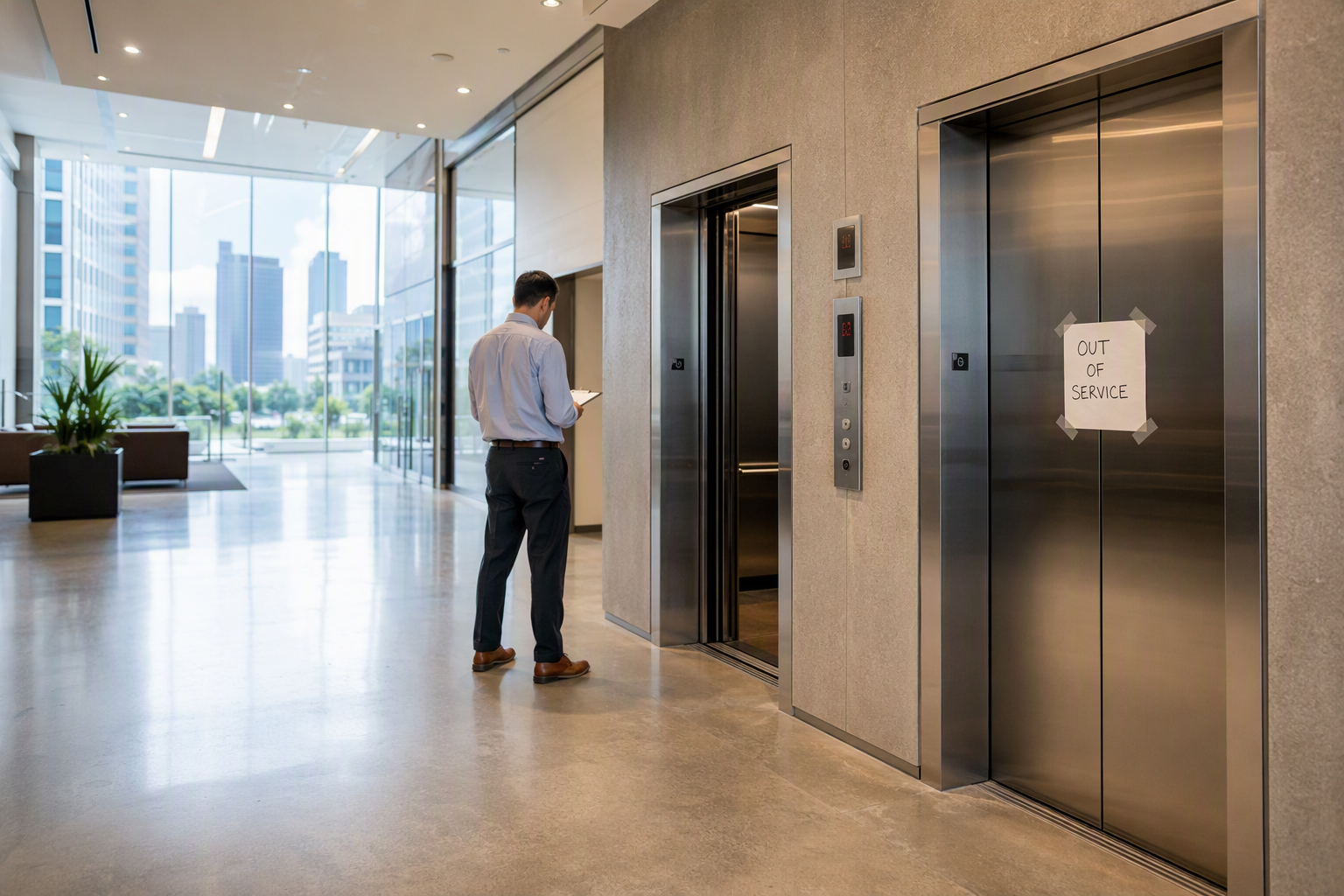
- Secure the elevator immediately. Lock out access to the elevator lobby if the unit is stuck between floors or otherwise unsafe, and place clear out-of-service signage at all landings.
- Verify no occupants are trapped. Communicate with the elevator cab via the emergency phone system and, if an occupant is confirmed trapped, contact emergency services — do not attempt to manually extract an occupant without trained personnel.
- Contact your elevator service contractor. Notify your maintenance provider of the outage and document the time of notification for service records.
- Assess ADA impact immediately. Determine whether the out-of-service elevator is the primary accessible route for any building occupants or visitors. If it is, implement interim accommodation measures and notify affected tenants in writing.
- Notify tenants and building occupants. Provide written or posted notification of the outage, the expected resolution timeline, and any interim accommodations available.
- Document everything. Record the date and time of failure, observed symptoms, all communications with the service provider, and all tenant notifications. This documentation is essential for insurance claims, ADA compliance defense, and code inspection records.
- Review your maintenance agreement. Determine whether your current service contract covers the cause of failure under routine maintenance or whether it will be billed as a repair — this determines your cost exposure and informs future contract negotiation.
- Follow up with a root cause analysis. Once the elevator is restored to service, obtain a written explanation of the failure cause and a recommendation for preventive action to avoid recurrence.
How Do Maintenance Contracts Affect Elevator Downtime Costs?
The structure of an elevator maintenance contract is one of the most consequential financial decisions a building owner makes regarding downtime cost exposure. Maintenance agreements in the elevator industry generally fall into several categories:
- Full-service (comprehensive) contracts cover parts, labor, and emergency calls, transferring significant repair cost risk to the service provider. These agreements typically include defined response time commitments and are priced accordingly.
- Oil and grease (lubrication-only) contracts cover routine lubrication and adjustment but exclude parts and repairs. Under these agreements, building owners bear the full cost of every repair — including emergency call premiums — out of pocket.
- Parts-included contracts fall between these extremes, covering specified parts categories while excluding others. The financial exposure depends heavily on which components are covered and which are excluded.
The key insight for building owners is that the cheapest monthly maintenance contract often produces the highest total annual cost when repair expenses, emergency premiums, and extended downtime events are factored in. A thorough cost-of-ownership analysis — comparing contract premiums against historical repair frequency and average repair costs for the specific equipment type — produces a more accurate picture of true maintenance economics.
What Is the OSHA Relevance to Elevator Downtime Costs?
While elevator safety in public buildings is primarily governed by state elevator codes (based on ASME A17.1), OSHA jurisdiction applies in workplace settings. Under OSHA’s General Duty Clause, employers are required to maintain workplaces free from recognized hazards that are causing or likely to cause serious harm or death. A known elevator mechanical deficiency — particularly one documented in maintenance records but left unaddressed — can constitute a recognized hazard under this standard.
OSHA’s relevance to downtime costs is most acute when:
- An elevator failure results in a worker injury, triggering mandatory OSHA incident reporting and potentially a formal inspection
- Maintenance records reveal that known deficiencies were deferred, which strengthens an OSHA citation case
- A workplace elevator is used to transport materials or equipment in ways that involve specific OSHA material-handling regulations
OSHA citations carry civil monetary penalties, and willful or repeated violations are subject to significantly higher penalty levels. Beyond the penalty itself, an OSHA inspection triggered by an elevator incident can expand into a broader workplace safety audit — compounding the financial impact of a single elevator failure.
How Are Elevator Downtime Costs Trending in 2025–2026?
Several qualitative trends are shaping the cost trajectory of elevator downtime for building owners in 2025 and 2026:
- Aging building stock: A large share of commercial elevators in the United States are operating on aging equipment, and as the installed base gets older, failure frequency and parts costs are broadly expected to increase absent proactive modernization investment.
- Labor market conditions: The skilled trades labor market — including licensed elevator mechanics — remains tight in many markets, which sustains upward pressure on both routine maintenance labor rates and emergency service premiums.
- Parts supply chain complexity: Global supply chain dynamics continue to affect lead times for elevator components, particularly electronic control boards, drive systems, and specialized hydraulic components. Extended lead times convert what might have been a one-day outage into a multi-day or multi-week event.
- Predictive maintenance technology adoption: Building owners and elevator service providers are increasingly deploying IoT-based monitoring systems that track elevator performance data in real time and flag developing failures before they cause outages. While adoption is growing, the technology is not yet universal, and buildings without these systems remain more exposed to unplanned downtime.
- Code update cycles: Regulatory bodies continue to update elevator safety codes, and jurisdictions that adopt newer editions of ASME A17.1 impose additional requirements that aging equipment must meet — creating both compliance cost pressure and, when managed proactively, an opportunity to modernize equipment and reduce long-term downtime risk.
- Tenant expectations: Post-pandemic commercial real estate dynamics have raised tenant expectations for building quality and reliability. Elevator performance is increasingly cited in tenant satisfaction surveys as a factor in lease renewal decisions, raising the reputational and financial stakes of recurring downtime events.
What Is the Difference Between Reactive and Preventive Maintenance in Cost Terms?
The cost difference between reactive (break-fix) and preventive maintenance approaches is one of the most consequential financial distinctions in elevator asset management. Reactive maintenance means waiting for a failure to occur and then dispatching a technician to diagnose and repair the problem. Preventive maintenance means following a structured schedule of inspections, adjustments, lubrication, and component replacement designed to prevent failures before they occur.
Reactive maintenance consistently produces higher total costs for several reasons:
- Emergency service calls carry labor rate premiums above standard scheduled maintenance rates
- Unplanned failures frequently cause collateral damage — a failed component that goes undetected can damage adjacent systems, converting a minor repair into a major one
- Parts ordered on an emergency basis are often purchased at spot prices without volume discount leverage
- Downtime duration is longer because diagnosis must precede repair, whereas preventive maintenance identifies the component before it fails
- Deferred maintenance is a leading predictor of code inspection failures, which can result in forced shutdowns pending corrective action
Preventive maintenance is not simply a cost — it is a cost-offset strategy with a measurable return in reduced emergency repair frequency, extended equipment life, and reduced regulatory exposure.
How Can Building Owners Reduce Elevator Downtime Costs?
Reducing elevator downtime cost is a multi-layer strategy rather than a single decision. The most effective approaches include:
- Investing in a comprehensive maintenance agreement with a qualified elevator service provider that includes regular preventive maintenance, not just reactive repairs
- Scheduling and completing all code-required inspections and tests in accordance with the applicable edition of ASME A17.1 — avoiding the forced downtime that results from inspection failures or lapsed certificates
- Maintaining thorough maintenance records to support regulatory compliance and demonstrate due diligence in any ADA or OSHA enforcement context
- Evaluating modernization for aging equipment where the lifecycle cost of maintaining aging components exceeds the amortized cost of modernization
- Deploying remote monitoring technology where cost-effective, to enable predictive rather than reactive maintenance decision-making
- Establishing emergency response protocols in advance, including clear communication plans for tenant notification and ADA accommodation, to minimize the operational and reputational impact when outages do occur
Why Work With a Data-Driven Elevator Service Provider?
Not all elevator service providers approach maintenance the same way. Building owners who choose a data-driven service partner — one that documents equipment condition, tracks failure trends, and advises on maintenance decisions based on equipment-specific performance data rather than generic schedules — are better positioned to make cost-effective decisions about when to repair, when to modernize, and how to structure maintenance agreements to align with their actual risk exposure.
AmeriTex Elevator approaches elevator service and maintenance with an emphasis on equipment assessment, transparent documentation, and code compliance — giving building owners and property managers the information they need to make informed decisions about their elevator assets. Rather than reacting to failures after they occur, AmeriTex Elevator works with clients to understand the condition and risk profile of their equipment and to structure maintenance programs accordingly.
Frequently Asked Questions About Elevator Downtime Costs
What are the biggest hidden costs of elevator downtime?
Beyond the direct repair invoice, the largest hidden costs of elevator downtime typically include emergency labor rate premiums, ADA compliance liability when the elevator serves as the primary accessible route, tenant productivity loss, and reputational damage that can affect lease renewals. In multi-tenant commercial buildings, elevator outages may also trigger rent abatement clauses in lease agreements, creating direct revenue loss for building owners that dwarfs the cost of the repair itself.
How does deferred elevator maintenance affect long-term costs?
Deferred maintenance consistently produces higher total costs over time. When routine adjustments, lubrication, and component replacements are skipped, components degrade faster, fail more often, and cause collateral damage to adjacent systems. Deferred maintenance also increases the risk of code inspection failures, which can result in AHJ-ordered shutdowns — forced downtime that is both unpredictable and expensive to resolve under time pressure.
Can an elevator outage expose a building owner to ADA liability?
Yes. Under the Americans with Disabilities Act, when an elevator is the primary means of accessible vertical travel, an extended outage without an alternative accessible route may constitute a violation of the ADA’s requirement to maintain accessible features in operable condition. This can result in complaints to the DOJ or private civil litigation, both of which carry legal defense costs and potential civil penalties.
What does ASME A17.1 require for elevator maintenance?
The ASME A17.1 Safety Code for Elevators and Escalators establishes requirements for periodic inspections, category safety device testing (including Category 1 and Category 5 tests), and maintenance record-keeping. Buildings that fail to meet these requirements risk code violations, inspection failures, and AHJ-ordered shutdowns — all of which generate unplanned downtime and associated costs.
How does elevator age affect downtime frequency?
Elevator equipment that is operating beyond its original design life is broadly understood to fail more frequently, require harder-to-source parts, and incur higher per-incident repair costs than newer equipment. As key components age — including control systems, door operators, hydraulic seals, and rope systems — the probability of failure increases and the average duration of outages tends to grow due to parts sourcing challenges.
What is the difference between a full-service and a lubrication-only elevator maintenance contract?
A full-service (comprehensive) maintenance contract covers parts, labor, and emergency calls, transferring significant repair cost risk to the elevator service provider. A lubrication-only contract covers only routine lubrication and adjustment, leaving the building owner fully responsible for all repair costs — including emergency call premiums. The cheapest monthly contract often produces the highest total annual cost when repair expenses are factored in.
How long does a typical unplanned elevator repair take?
Unplanned elevator repair duration varies widely depending on the failure type, parts availability, and technician dispatch time. Simple failures with available parts may be resolved in hours. Failures requiring obsolete or hard-to-source components — common with aging elevator equipment — can extend outages to days or weeks while parts are located and shipped. This variability makes parts availability a critical factor in downtime cost exposure for buildings with older equipment.
Does OSHA regulate elevator maintenance?
OSHA’s primary jurisdiction over elevators in workplace settings derives from the General Duty Clause of the Occupational Safety and Health Act, which requires employers to maintain workplaces free from recognized hazards. OSHA can cite employers when documented elevator deficiencies are left unaddressed and result in worker injury. OSHA citations carry civil monetary penalties that compound the financial impact of an elevator failure event.
What is predictive maintenance and how does it reduce elevator downtime costs?
Predictive maintenance uses real-time equipment monitoring — typically via IoT sensors connected to elevator mechanical systems — to detect developing failures before they cause an outage. By identifying anomalous performance data early, building owners and service providers can schedule targeted repairs during planned maintenance windows rather than responding to unplanned failures during peak building hours. This approach reduces emergency service premiums, minimizes tenant disruption, and can extend component life by enabling early intervention.
When does elevator downtime justify modernization rather than repair?
The decision to modernize rather than continue repairing aging elevator equipment is typically driven by a lifecycle cost analysis comparing the ongoing cost of reactive and preventive maintenance against the amortized cost of modernization. When an elevator is experiencing frequent failures, parts are obsolete or hard to source, and the cumulative cost of repairs is approaching or exceeding modernization cost on a multi-year basis, modernization often produces a better total cost outcome — as well as improved reliability, energy efficiency, and code compliance status.
How should building owners document elevator downtime for insurance and compliance purposes?
Thorough documentation of every elevator outage — including date and time of failure, observed symptoms, service provider notification log, repair description, parts replaced, and tenant communications — creates a defensible record for insurance claims, ADA compliance responses, and code inspection reviews. Documentation also supports trend analysis that can identify recurring failure patterns and inform maintenance strategy adjustments. Buildings with complete, organized maintenance records are better positioned in regulatory and legal proceedings than those with gaps in their service history.
Get a Professional Elevator Assessment From AmeriTex Elevator
Understanding the true cost of elevator downtime starts with knowing the condition of your equipment. AmeriTex Elevator provides data-driven elevator assessments that give building owners and property managers a clear picture of their equipment’s condition, maintenance history, and risk profile — so decisions about maintenance, repair, and modernization are based on facts, not guesswork.
Contact AmeriTex Elevator for a free elevator assessment: 866-679-4313
Need elevator service you can rely on? AmeriTex Elevator is ready to help.