Deciding between repairing an elevator and modernizing it is one of the most consequential choices a building owner or facility manager can make. The wrong call can mean recurring service disruptions, code violations, or a capital expenditure that delivers little long-term value. This guide walks through every factor — cost, compliance, equipment age, performance history, and tenant impact — so the decision is grounded in facts rather than guesswork.
What Is the Difference Between Elevator Repair and Modernization?
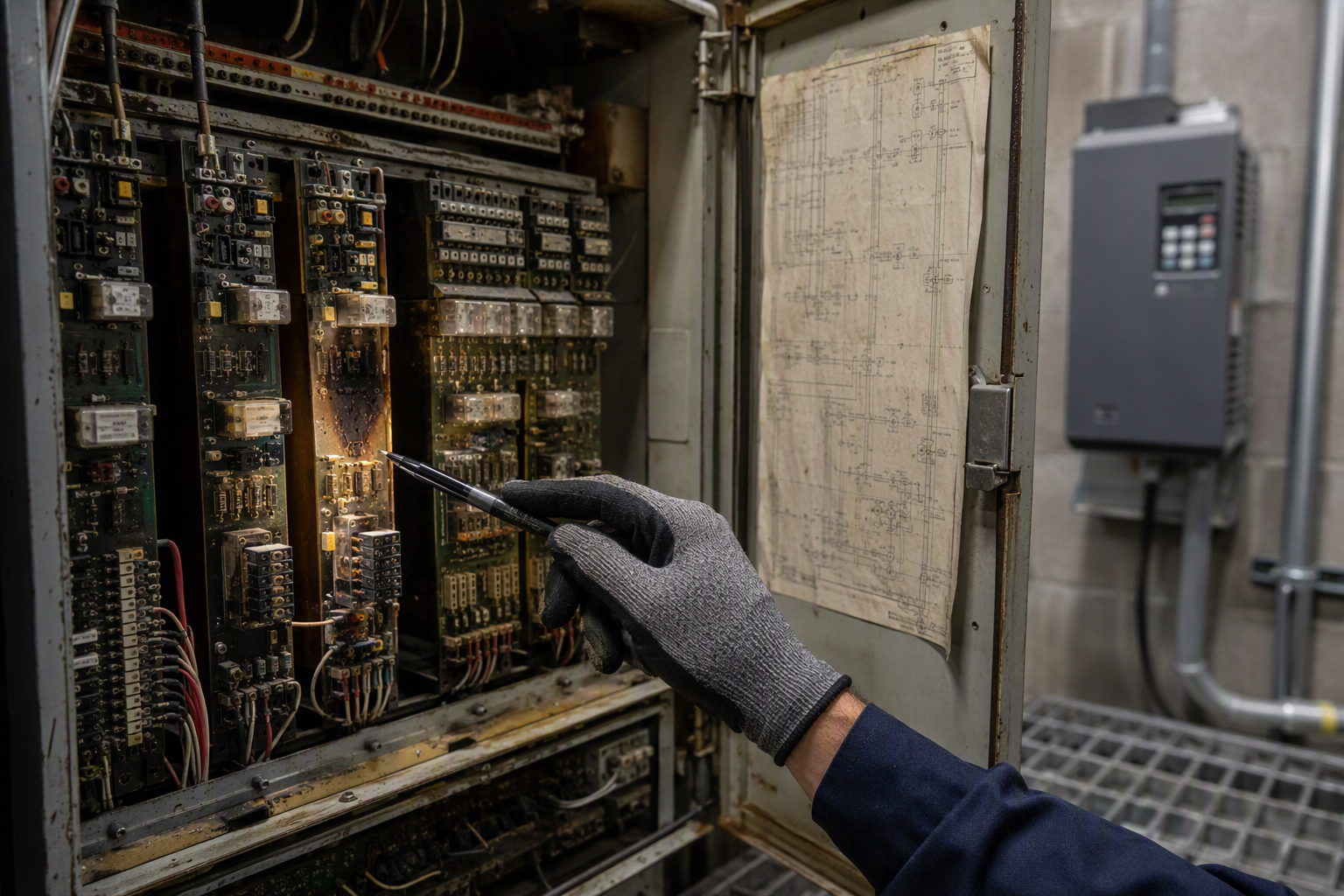
Elevator repair addresses a specific, discrete problem — a failing door operator, a worn brake, a faulty relay — without altering the fundamental design or major components of the system. Repairs restore the elevator to its previous operating condition.
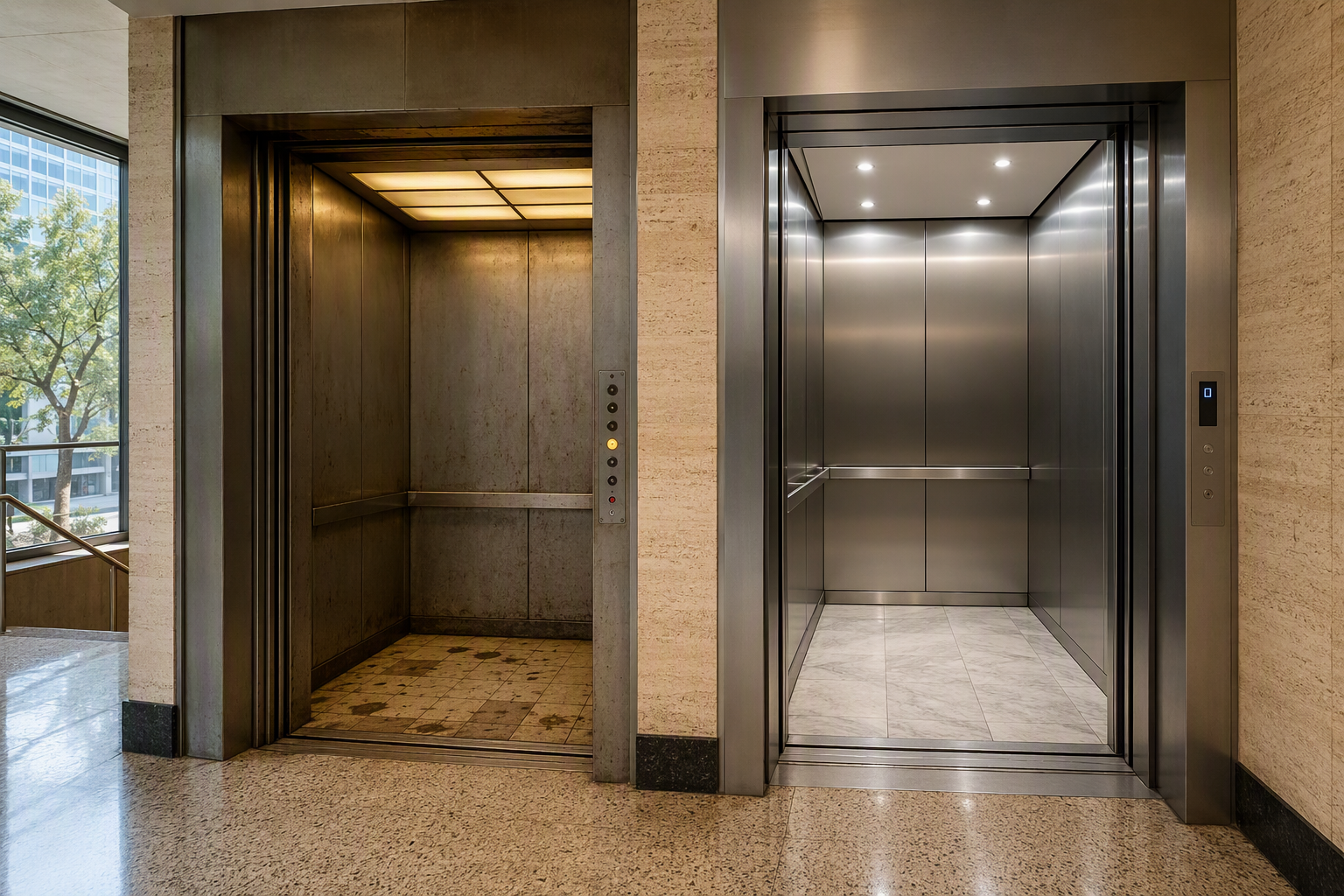
Elevator modernization (sometimes called a “mod” or retrofit) replaces major systems or subsystems — the controller, drive, cab interior, door equipment, or the entire machine — with current-generation technology. A modernization project can be partial (targeting one major system) or comprehensive (a full gut renovation of every component above the pit).
The line between the two blurs when a repair requires replacing a component that is no longer manufactured. At that point, the cost and disruption of sourcing an obsolete part can make a partial modernization the more practical path.
How Do I Know If My Elevator Qualifies for Modernization?

Several observable signals indicate that a unit has crossed from “repair candidate” territory into “modernization candidate” territory:
- Part obsolescence: The manufacturer or aftermarket suppliers no longer stock key components for the existing control system or drive.
- Recurring callback pattern: The unit requires service calls on a frequent, escalating basis rather than after years of reliable operation.
- Code non-compliance: The elevator does not meet current editions of the ASME A17.1 Safety Code for Elevators and Escalators or applicable local amendments in force as of 2026.
- Accessibility gaps: The cab or controls do not conform to ADA accessibility standards, creating liability exposure.
- Energy inefficiency: The existing drive technology (such as a Ward-Leonard or older SCR drive) consumes substantially more power than current variable-frequency drive (VFD) alternatives.
- Ride quality complaints: Persistent leveling problems, rough starts, or excessive noise that repairs have failed to resolve permanently.
- Age of the system: While age alone is not disqualifying, elevators are generally regarded by the industry as approaching end-of-practical-life when major systems have operated well beyond typical service lifespans without significant component replacement.
What Are the Main Factors in the Repair vs. Modernization Decision?
Comparison Table: Elevator Repair vs. Modernization
| Factor | Repair | Modernization |
|---|---|---|
| Scope | Addresses one specific component or failure | Replaces one or more major systems |
| Disruption / Downtime | Hours to a few days for most repairs | Weeks to months depending on scope |
| Upfront Cost | Lower initial outlay | Higher initial capital investment |
| Long-Term Cost | Can accumulate if breakdowns continue | Typically reduces recurring maintenance costs |
| Code Compliance | May not bring unit into full compliance | Triggers code review; must meet current standards per ASME A17.1 |
| Part Availability | Risk of unavailability for older systems | Installs current-generation, supportable components |
| Energy Performance | No improvement to base consumption | Modern drives and motors reduce energy use |
| Ride Quality / Speed | Restored to previous baseline | Can be improved beyond original specification |
| ADA Compliance | Not addressed unless specifically targeted | Opportunity to retrofit cab controls and signage per ADA guidelines |
| Best For | Isolated failures in otherwise sound systems | Aging, non-compliant, or chronically problematic units |
What Does Elevator Modernization Actually Include?
Modernization projects vary widely in scope. Common modernization components include:
- Controller replacement: Swapping relay-logic or older solid-state controls for a microprocessor-based controller with diagnostic capability.
- Drive upgrade: Replacing outdated motor-generator sets or SCR drives with variable-frequency drives (VFDs), which improve efficiency and smoothness.
- Door operator and equipment: New door operators, door controllers, and safety edges or light curtains meeting current standards.
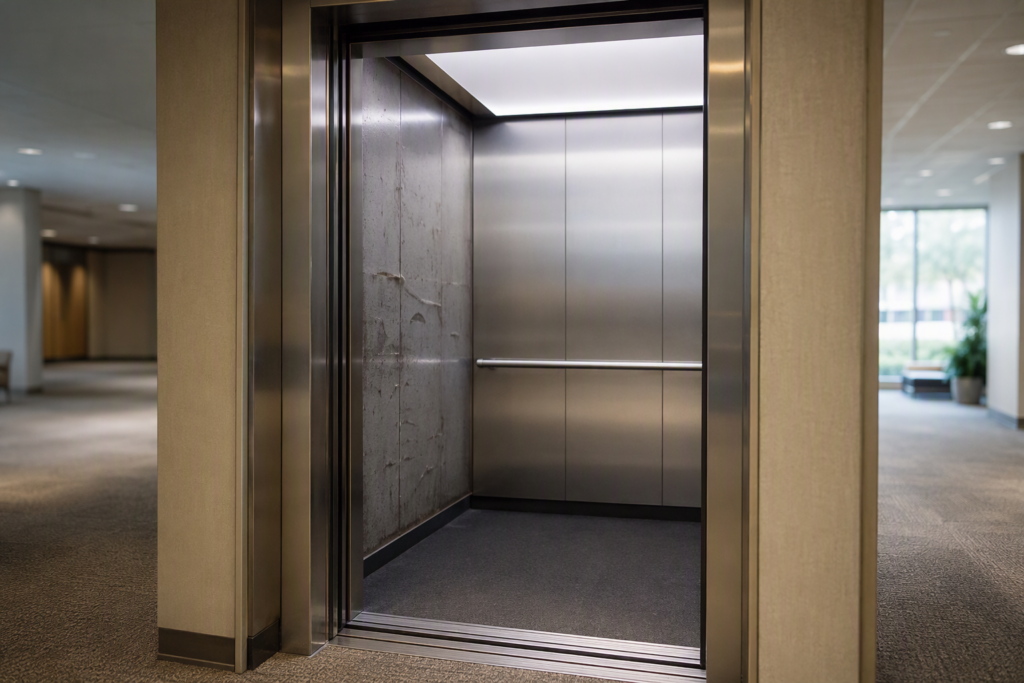
- Cab interior renovation: Updated flooring, walls, ceiling, lighting (often LED), and handrails.
- Signal fixtures: Hall lanterns, position indicators, car operating panels, and emergency communication systems updated for code and ADA compliance.
- Machine replacement: In some cases, replacing the entire hoist machine, including motor and brake.
- Rope or belt replacement: New hoisting ropes or coated steel belts, depending on the system type.
A partial modernization targets one or two systems; a full modernization replaces nearly everything except the hoistway and structural elements. The appropriate scope depends on the condition audit findings and budget constraints.
How Do Safety Codes Affect the Repair vs. Modernization Decision?
This is one of the most critical and frequently misunderstood dimensions of the decision. When a modernization project is undertaken, the work must comply with the current edition of the ASME A17.1 Safety Code for Elevators and Escalators as adopted by the applicable jurisdiction in 2026. Depending on the scope of work, a modernization may also trigger a full code review of the existing installation, potentially requiring upgrades beyond the systems being replaced.
Conversely, a targeted repair typically does not trigger a comprehensive code review — the unit is restored to its prior condition. However, if an elevator is already out of compliance with mandated safety features, a repair does nothing to resolve that liability.
Workplace safety regulations enforced by OSHA also apply to elevator maintenance and service operations, governing the conditions under which technicians work on elevator equipment. Building owners have an obligation to ensure service environments meet these standards.
What Is the Typical Timeline for Each Option?
Timeline planning is essential for occupied buildings where elevator downtime directly affects tenants, residents, or customers.
| Project Type | Typical Duration | Notes |
|---|---|---|
| Emergency repair (single component) | Hours to 1–2 days | Depends on part availability |
| Planned repair (door system, brake, etc.) | 1–5 days | Can often be scheduled during low-traffic periods |
| Partial modernization (controller or drive only) | 2–6 weeks | Varies by system complexity and lead times |
| Full modernization | 4–16 weeks or more | Scope, inspections, and permit timelines drive variance |
Lead times for equipment — particularly microprocessor controllers and custom cab components — can extend timelines significantly. Sourcing parts for an obsolete system slated for repair can introduce comparable delays.
What Are the Pros and Cons of Each Path?
Elevator Repair: Pros and Cons
| Pros | Cons |
|---|---|
| Lower immediate cost | Does not resolve underlying obsolescence |
| Shorter downtime for building occupants | Recurring failures may accumulate cost over time |
| Preserves existing system architecture | No improvement in energy use or ride quality |
| Straightforward scope and permitting | Part scarcity risk for older units |
Elevator Modernization: Pros and Cons
| Pros | Cons |
|---|---|
| Resolves obsolescence and parts scarcity | Higher upfront capital requirement |
| Improves reliability, ride quality, and energy efficiency | Extended downtime during construction |
| Brings unit into current code compliance | May trigger broader code upgrade requirements |
| Enhances property value and tenant experience | Requires detailed planning and permitting |
| Reduces long-term maintenance expenditure | Design and procurement lead times add complexity |
What Should I Do First If I Think My Elevator Needs Attention?
- Document the symptoms. Record the dates, nature, and frequency of every service event, callback, or complaint related to the elevator. This log becomes the foundation of any condition assessment.
- Pull the service history. Request a complete maintenance and repair log from your current service provider. Identify whether the same components are failing repeatedly.
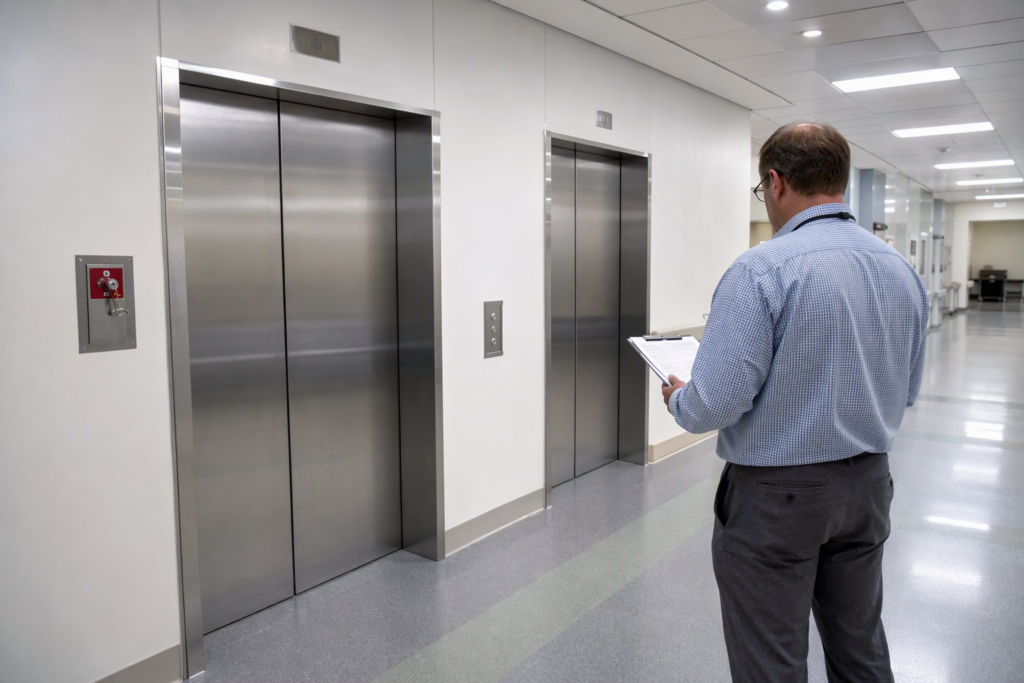
- Schedule a condition assessment. Engage a qualified, independent elevator service company to conduct a thorough inspection of all major systems — controller, drive, machine, ropes, door equipment, cab, and safety devices.
- Review code compliance status. Ask the inspector to note any conditions that do not meet the current ASME A17.1 Safety Code for Elevators and Escalators or local amendments, and whether those deficiencies require immediate correction.
- Check ADA conformance. Verify whether cab controls, door timing, and signage meet ADA accessibility requirements.
- Request itemized proposals for both paths. Obtain repair and modernization proposals separately so costs and scopes can be compared directly rather than assumed.
- Evaluate total cost of ownership, not just upfront cost. Factor in projected maintenance, downtime risk, and energy costs over a five-to-ten-year horizon for each option.
- Make the decision with qualified guidance. Work with an independent service provider — one not tied to a proprietary equipment manufacturer — to ensure the recommendation reflects the building’s actual needs rather than a vendor’s product line.
Does Modernization Increase Property Value?
Elevator condition and reliability are frequently cited by commercial real estate professionals as a material factor in tenant satisfaction and lease renewal decisions, particularly in multi-story residential and commercial buildings. A modernized elevator with updated aesthetics, reliable operation, and current safety compliance can be a meaningful differentiator in competitive rental or sale markets. While specific valuations depend on market conditions and building type, a malfunctioning or visibly outdated elevator is consistently regarded as a liability in building assessments.
Can I Repair Now and Modernize Later?
This is a common and often practical strategy, provided it is executed deliberately rather than reactively. A planned phased approach — stabilizing a unit with targeted repairs while budgeting for a full modernization in a defined future cycle — can be sound capital planning. The risks include:
- Investing in repairs on components that will be discarded during modernization, reducing the net value of the repair expenditure.
- A major failure occurring before the planned modernization, forcing an emergency response under less favorable conditions.
- Code compliance issues that cannot be deferred if a jurisdiction requires correction within a specified timeframe.
A qualified elevator service provider can help structure a phased plan that minimizes waste and preserves budget flexibility.
How Do I Choose Between an Independent Service Provider and an OEM for This Decision?
Original equipment manufacturers (OEMs) offer manufacturer-specific expertise and access to proprietary parts, but their recommendations may be influenced by the availability and profitability of their own product lines. Independent elevator service companies — those not affiliated with a specific manufacturer — are generally positioned to assess the full range of available solutions and recommend the path that best fits the building’s needs and budget.
AmeriTex Elevator is an independent elevator service provider serving building owners and facility managers. Because AmeriTex Elevator is not tied to a single equipment manufacturer, assessments are focused on the building’s operational and compliance requirements rather than on promoting any particular product line. AmeriTex Elevator provides condition assessments, repair services, and modernization project management across a range of elevator types and configurations.
What Questions Should I Ask Any Elevator Service Provider Before Deciding?
- Is the condition assessment based on a full inspection of all major systems, or a visual walkthrough only?
- Are replacement parts for my current system readily available, or are lead times a risk factor?
- Does the proposed repair bring the unit into compliance with current code, or only restore prior operating condition?
- If I choose modernization, what specific code requirements will the project need to satisfy under ASME A17.1 and local amendments?
- What is the realistic downtime for each option, and how will that be managed in my building?
- Are you affiliated with a specific equipment manufacturer, and if so, how does that affect your recommendations?
- What does total cost of ownership look like for each path over a five-to-ten-year horizon?
Summary: Key Decision Factors at a Glance
| Condition or Situation | Likely Recommendation |
|---|---|
| Isolated component failure, otherwise reliable unit | Repair |
| Escalating, recurring service calls | Modernization assessment |
| Parts no longer available from manufacturer or aftermarket | Partial or full modernization |
| Unit does not meet current ASME A17.1 requirements | Modernization (or targeted compliance upgrade) |
| ADA non-compliance creating accessibility liability | Modernization with ADA retrofit |
| Relatively recent installation with isolated fault | Repair |
| Aging drive consuming excessive energy | Drive modernization (partial) |
| Building undergoing renovation or repositioning | Full modernization to align with building upgrade |
Not Sure Which Path Is Right for Your Elevator?
AmeriTex Elevator offers a free elevator assessment to help building owners and facility managers understand the true condition of their equipment, compliance status, and the practical trade-offs between repair and modernization — with no obligation and no manufacturer affiliation influencing the findings.
Contact AmeriTex Elevator for a free elevator assessment: 866-679-4313
Need elevator service you can rely on? AmeriTex Elevator is ready to help.