Hospital Elevator Inspection Frequency, Maintenance Schedules & Compliance Requirements
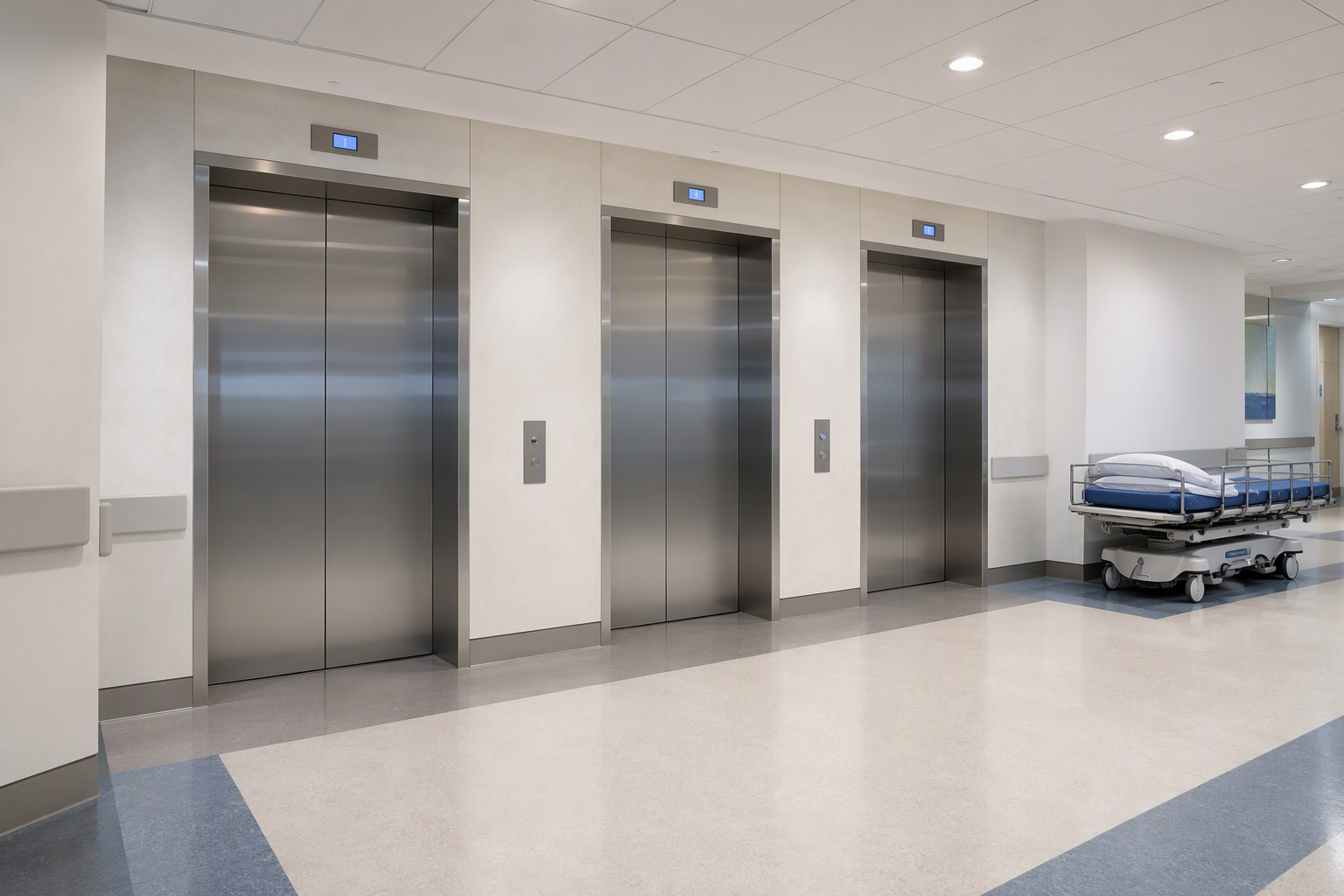
Hospitals depend on elevators around the clock to move patients, staff, medical equipment, and medication. A failure or compliance gap is not simply an inconvenience — it can disrupt patient care, trigger regulatory citations, and expose a facility to serious liability. Understanding the exact inspection intervals, maintenance obligations, and code requirements that apply to healthcare facilities in Texas and California is the starting point for any compliant elevator program.
AmeriTex Elevator works with healthcare clients across Houston, Dallas, Austin, San Antonio, Los Angeles, and San Diego to build maintenance programs that meet state regulatory requirements and align with the demanding operational realities of a hospital environment.
How Often Does a Hospital Elevator Need to Be Inspected?
The baseline inspection frequency is the same for hospitals as for any other commercial building — but the consequences of non-compliance in a healthcare setting are significantly higher.
Texas
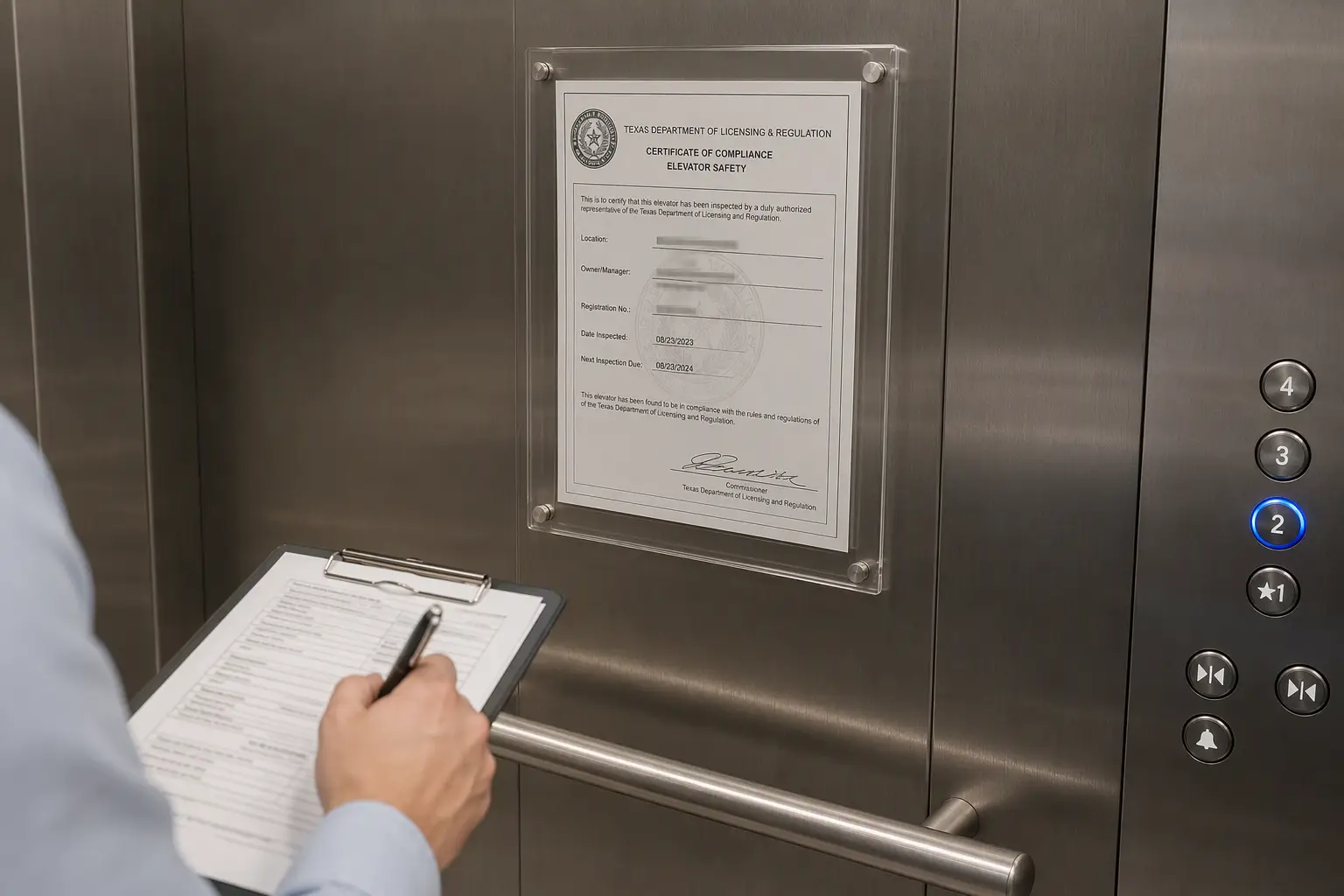
Under Texas Department of Licensing and Regulation (TDLR) rules authorized by Texas Health and Safety Code Chapter 754 and 16 Texas Administrative Code Chapter 74, building owners — including hospital operators — must have every elevator inspected annually by a TDLR-registered elevator inspector. Following a satisfactory inspection, the owner must obtain a TDLR Certificate of Compliance for each unit of equipment. That certificate is valid for one year and must be displayed in a publicly visible area of the building.
Important Houston note: TDLR does not regulate elevators inside Houston city limits. The City of Houston operates its own elevator inspection and compliance program. Houston hospital operators should contact the City of Houston directly to confirm their specific inspection and permitting obligations.
Texas also requires a Category 5 full-load test every five years on electric (traction) elevators — the type most commonly used in multi-story hospital towers.
California
Under California Labor Code Sections 7300–7324.2 and the California Code of Regulations, Title 8, Elevator Safety Orders, the Division of Occupational Safety and Health (Cal/OSHA), Elevator Unit, California Department of Industrial Relations requires every conveyance to be inspected at least once a year. A conveyance found to be in safe condition receives a permit to operate for up to one year. When a hospital elevator is covered by a full maintenance contract with a Cal/OSHA-certified Qualified Conveyance Company (CQCC), Cal/OSHA may issue a permit to operate for up to two years.
In California, arranging the annual reinspection is the elevator owner’s responsibility — not the inspector’s or the maintenance contractor’s. The permit to operate must be posted conspicuously inside the elevator car at all times.
Important Los Angeles note: The City of Los Angeles, Department of Building and Safety (LADBS) runs its own elevator and conveyance inspection program. Los Angeles hospital operators should confirm their obligations directly with LADBS in addition to Cal/OSHA requirements.
What Federal Codes Apply to Hospital Elevators?
Beyond state-level inspection mandates, hospital elevators must comply with federal standards that apply regardless of geography.
- ASME A17.1/CSA B44 Safety Code for Elevators and Escalators: The foundational performance and safety standard covering car dimensions, door performance, emergency lighting, firefighters’ service, and more. Texas has adopted the 2016 edition; California has adopted the 2004 edition, with a proposed update to the 2019 edition currently pending rulemaking as of 2026.
- Americans with Disabilities Act (ADA): Requires that elevators in hospitals serving the public meet accessibility standards, including minimum car dimensions, Braille and tactile controls, audible signals, and door timing requirements that accommodate patients and visitors with disabilities.
- OSHA: Occupational safety regulations apply to hospital workers who use elevators, including requirements related to safe operation during construction, maintenance activities, and emergency scenarios.
What Are the Consequences of a Failed Hospital Elevator Inspection?
A failed inspection carries immediate operational and regulatory consequences for a healthcare facility.
In Texas, building owners must have cited violations corrected — or under contract to be corrected — within 30 days of the inspection, or obtain a waiver or delay from TDLR. Specific safety failures carry immediate removal-from-service obligations. For example, a passenger elevator in Texas without working door restrictors must be removed from service immediately, as must a passenger elevator without functioning Phase One firefighters’ service.
In California, an elevator that does not receive a permit to operate may not legally remain in service. A hospital that continues to operate a non-compliant elevator risks regulatory enforcement and liability exposure.
For hospitals specifically, taking an elevator offline disrupts patient transport, surgical schedules, and medical supply logistics — costs that far exceed the investment in a proactive maintenance program.
What Maintenance Tasks Are Required Between Inspections?
Annual inspections confirm compliance at a point in time, but the condition of a hospital elevator depends on what happens between those inspections. Healthcare environments place unusually heavy demands on elevator systems — high daily trip counts, heavy bed and equipment loads, frequent door cycles, and the need for spotless hygiene.
A structured preventive maintenance program for hospital elevators typically addresses:
- Monthly lubrication of moving components, including guide rails, door operators, and hoist ropes
- Inspection and testing of safety devices, including door restrictors, overspeed governors, and safeties
- Firefighters’ service (Phase I and Phase II) operational testing to confirm hospital staff can rely on it in emergencies
- Emergency lighting and communication system verification
- Door timing and reversal system checks — critical for patients on stretchers or in wheelchairs
- Interior car condition review for cleanliness, wall panel integrity, and flooring safety
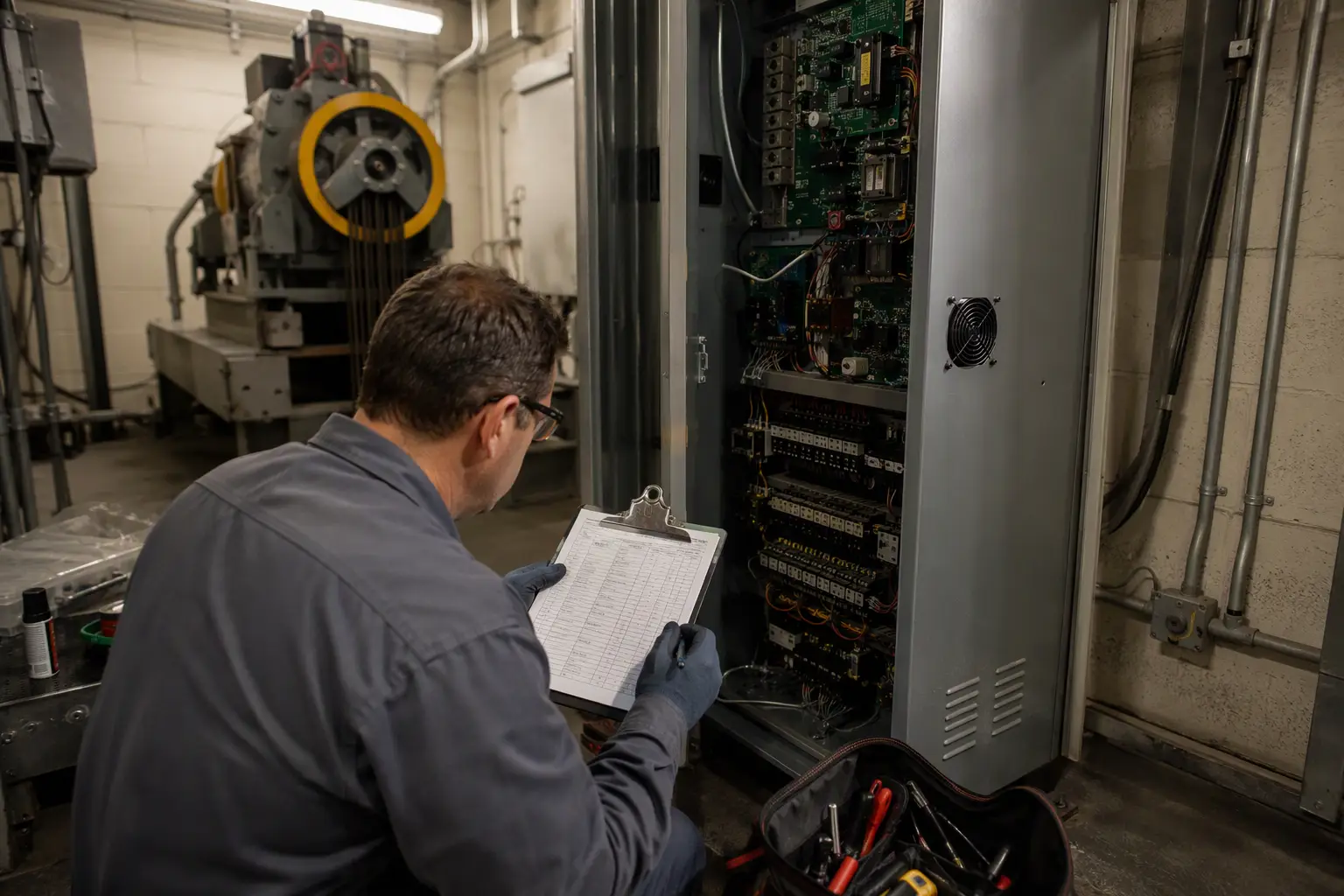
- Review of the machine room environment, including temperature, humidity, and housekeeping
AmeriTex Elevator structures maintenance programs around the operational realities of healthcare facilities, including scheduling work during low-census periods and coordinating with hospital facilities managers to minimize disruption to patient care.
Who Is Authorized to Inspect and Maintain Hospital Elevators in Texas and California?
Only credentialed individuals and registered companies may legally perform elevator work in these states.
In Texas: Inspections must be performed by a TDLR-registered elevator inspector. Maintenance, repair, installation, alteration, and testing work must be performed by a contractor registered with TDLR. Texas elevator contractor registrations expire one year after issuance, and each contractor must carry general liability insurance of at least $1,000,000 per occurrence for bodily injury or death and $500,000 per occurrence for property damage.
In California: Only State of California safety engineers and Certified Competent Conveyance Inspectors (CCCI) may perform elevator inspections. All maintenance, repair, alteration, and testing work must be performed by a Certified Competent Conveyance Mechanic (CCCM) employed by a Cal/OSHA-certified Qualified Conveyance Company (CQCC). Companies must also hold a C-11 Elevator Contractor license issued by the California Contractors State License Board (CSLB). CQCC and CCCM certifications last two years, with renewal requiring continuing education.
AmeriTex Elevator operates as a registered and certified elevator contractor in Texas and California, meeting the specific credentialing requirements of each state.
What Are ADA Compliance Requirements for Hospital Elevators?
The Americans with Disabilities Act sets accessibility standards that are especially consequential in healthcare environments, where patients and visitors with mobility limitations depend on elevators for access to medical services.
ADA-compliant hospital elevators must provide:
- Minimum car interior dimensions sufficient for wheelchair users and mobility devices
- Hall call buttons and car operating panels at accessible heights
- Raised and Braille characters on all controls
- Audible and visible signals indicating car arrival and direction of travel
- Door reopening devices that respond to both passenger presence and obstruction
- Door timing that allows adequate time for patients using assistive devices to enter and exit
- Adequate illumination inside the car
ADA compliance is not a one-time installation matter — components such as audible signals, door sensors, and control button tactile features require ongoing maintenance to remain functional.
What Happens Immediately After a Failed Hospital Elevator Inspection?
- Take the elevator out of service if the violation is a mandatory removal-from-service deficiency (e.g., non-functional door restrictors or firefighters’ service in Texas).
- Notify the facilities director and hospital administration immediately to activate contingency patient-transport protocols.
- Contact a registered elevator contractor to obtain a written repair scope and timeline.
- In Texas, ensure the repair is completed or formally under contract within 30 days of the inspection report, or obtain a waiver or delay from TDLR before that window expires.
- In California, coordinate with the elevator contractor and Cal/OSHA (or LADBS in Los Angeles) to schedule reinspection and obtain a new permit to operate before returning the elevator to service.
- Document all corrective actions — dates, work orders, contractor credentials, and test results — for your compliance file.
- Report any accident involving elevator equipment to TDLR within 24 hours in Texas, as required by law.
What Is a Category 5 Load Test and Does My Hospital Elevator Need One?
A Category 5 test is a full-load safety test required by the ASME A17.1 Safety Code for Elevators and Escalators for traction elevators. It verifies that the car’s safety devices and braking systems can stop and hold a fully loaded car under real-world conditions.
In Texas, the Category 5 test is required every five years on electric (traction) elevators. Multi-story hospitals almost universally use traction elevator systems, making this test a mandatory planning item for hospital facilities managers. The test must be performed by a TDLR-registered contractor and witnessed by a TDLR-registered inspector.
California’s adopted code (ASME A17.1-2004 for installations under the current Elevator Safety Orders) also contains periodic testing requirements. Hospital operators in California should confirm the specific test interval applicable to their equipment with a CQCC-certified contractor.
How Does Firefighters’ Service Compliance Apply in Hospitals?
Firefighters’ service — Phase I (lobby recall) and Phase II (in-car firefighter control) — is required by ASME A17.1 for elevators serving floors above or below a certain height threshold. In hospitals, these systems are critical not only for fire emergencies but also for evacuation of non-ambulatory patients.
In Texas, a passenger elevator without firefighters’ service, or with non-working Phase One firefighters’ service, must be removed from service immediately. This is a zero-tolerance compliance item. Hospital facilities teams should confirm that Phase I and Phase II operations are tested as part of every maintenance visit and documented in the service record.
Questions Your Inspector Will Ask
Whether a hospital elevator is undergoing its annual inspection in Texas or California, the inspector will typically want to verify the following. Facilities managers can use this list to prepare documentation in advance.
- Is the current Certificate of Compliance (Texas) or permit to operate (California) posted and valid?
- Are maintenance records current, and do they reflect work performed by a registered (Texas) or CQCC-certified (California) contractor?
- Have all violations from the prior inspection been corrected and documented?
- Is the machine room secure, clean, and maintained at appropriate temperature and humidity conditions?
- Are emergency lighting and the two-way emergency communication system in working order?
- Are firefighters’ Phase I and Phase II service systems fully operational?
- Are door restrictors present and functioning?
- Is the car’s emergency stop switch operational?
- For traction elevators in Texas: when was the last Category 5 full-load test performed, and is documentation on file?
- Are all car operating panel buttons — including those with raised characters and Braille — legible and functional?
- Is the load capacity signage current and clearly posted inside the car?
- Has any accident involving the elevator been reported to TDLR (Texas) within the required 24-hour window?
What Should Hospital Facilities Managers Look for in an Elevator Service Partner?
Not every elevator contractor has the operational experience to serve a hospital environment. When evaluating a service partner, hospital facilities managers should confirm:
- State registration and certification: TDLR contractor registration in Texas; CQCC certification and C-11 license in California
- Healthcare-specific experience: Familiarity with hospital operational constraints, infection-control protocols, and the documentation standards required for accreditation surveys
- Maintenance contract structure: A full maintenance contract — not a lubrication-only or callback contract — is required in California to qualify for the two-year permit to operate
- Emergency response capability: Hospitals operate around the clock, and an entrapment or mechanical failure at any hour requires a qualified response
- Documentation and record-keeping: Comprehensive service records support accreditation surveys, insurance audits, and compliance verification
AmeriTex Elevator provides structured maintenance programs for healthcare facilities across Houston, Dallas, Austin, San Antonio, Los Angeles, and San Diego, with documentation practices designed to support the compliance and accreditation requirements hospitals face.
How Can a Hospital Prepare for Its Annual Elevator Inspection?
- Review the prior inspection report and confirm all cited violations have been corrected and documented.
- Confirm that current maintenance records are organized and accessible — inspectors will ask for them.
- Verify that the Certificate of Compliance (Texas) or permit to operate (California) is posted and has not expired.
- Test firefighters’ Phase I and Phase II service before the inspection date and document the test results.
- Walk the machine room to confirm it is clean, organized, and free of stored materials that do not belong there.
- Check that the emergency communication device inside each car is operational.
- Confirm with your maintenance contractor that all scheduled Category 5 testing obligations are current.
- In Texas, confirm the identity and current registration status of the TDLR-registered inspector your facility has selected — building owners have the right to select their own inspector.
For hospital operators managing multiple elevators across a complex facility, compliance tracking can quickly become a significant administrative burden. AmeriTex Elevator helps healthcare clients stay ahead of inspection cycles, Category 5 test deadlines, and permit renewals so that compliance gaps do not become operational crises.
Contact AmeriTex Elevator for a free elevator assessment — call 866-679-4313 to speak with a member of the team about your hospital’s elevator compliance program.
Need elevator service you can rely on? AmeriTex Elevator is ready to help.