Hospital Elevator Modernization Cost & Maintaining Access During Construction
Hospitals in California and Texas face a unique challenge when modernizing elevators: the work is not optional, but neither is patient access. Regulatory agencies, accreditation bodies, and the practical realities of healthcare operations all demand that upgrades be planned around continuous service. This page breaks down the cost drivers, the compliance requirements under state and federal codes, and the step-by-step strategies that keep corridors moving while construction is underway.
What Drives the Cost of Modernizing a Hospital Elevator?
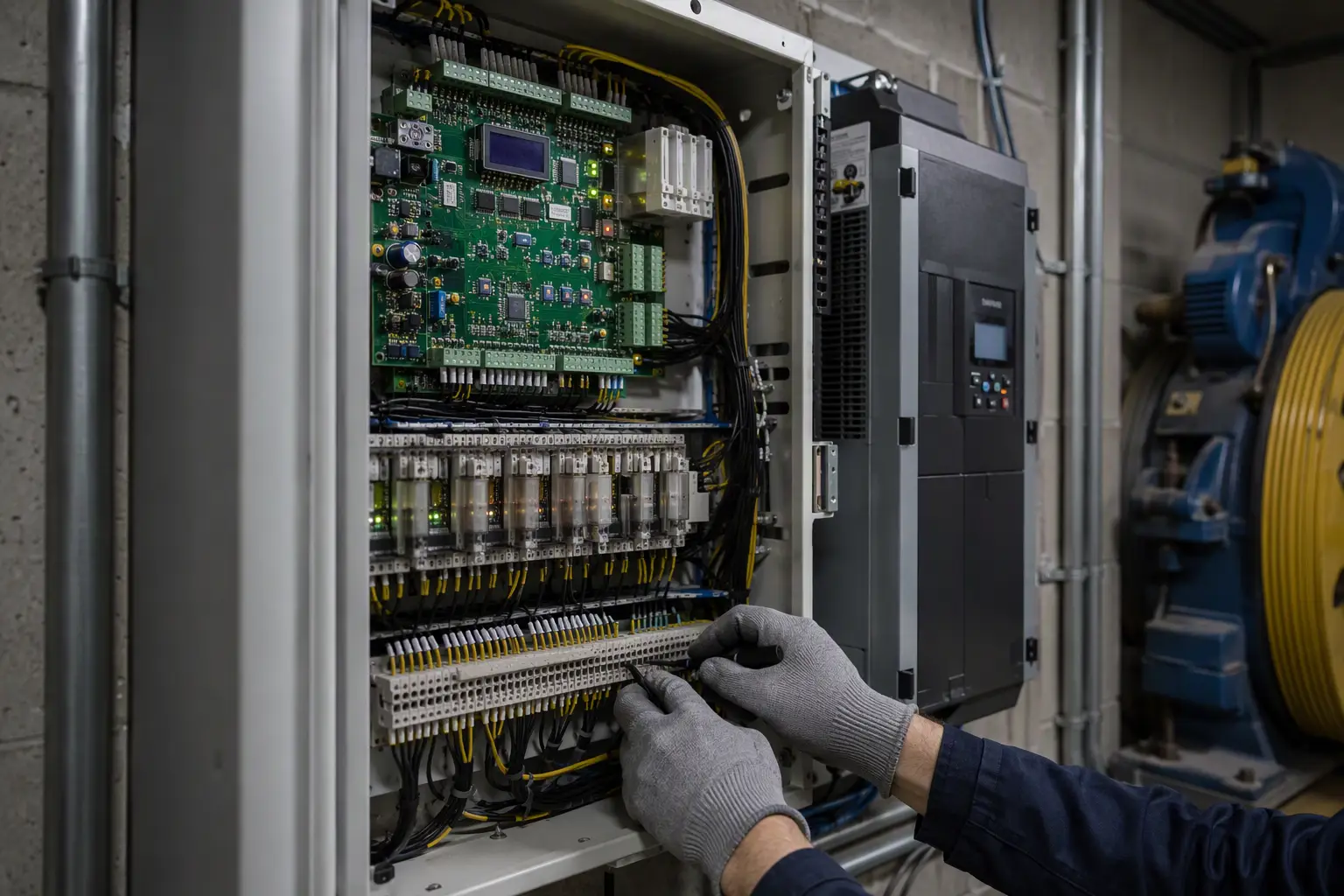
No single price applies universally to hospital elevator modernization because the scope varies dramatically by building age, elevator type, required code upgrades, and hospital-specific operational constraints. The figures cited most often by elevator contractors and facility managers range from the low tens of thousands of dollars for a targeted component upgrade to well over $300,000 for a full cab, machine, and control system replacement on a large-capacity freight or stretcher elevator.
The primary cost categories that drive hospital modernization budgets include:
- Control system replacement: Older relay-logic or analog controllers are the most common modernization trigger. Replacing them with microprocessor-based systems affects dispatching, diagnostics, and code compliance simultaneously.
- Door operator and safety edge upgrades: Hospitals require highly reliable door operations due to constant traffic from beds, gurneys, and wheelchairs. Upgrading to high-speed door operators with multi-beam light curtains is both a safety improvement and a compliance item under the ASME A17.1 Safety Code for Elevators and Escalators.
- Machine and drive upgrades: Traction elevators with worn machines or outdated hydraulic systems may require new permanent magnet gearless machines or variable-voltage, variable-frequency (VVVF) drives for energy efficiency and code compliance.
- Cab interior and fixtures: Hospital cabs endure heavy use. Stainless steel interiors, antimicrobial surfaces, heavy-duty handrails, and oversized thresholds suitable for stretchers add to material costs.
- Accessibility and ADA compliance: Control button height, tactile signage, audible indicators, and door timing all must meet current ADA Standards for Accessible Design. Retrofitting non-compliant cabs in an active hospital adds both material and coordination costs.
- State-specific permitting and inspection fees: In California, a permit from Cal/OSHA’s Elevator Unit is required before a conveyance is materially altered. In Texas, the registered contractor must submit plans to TDLR and obtain approval before installation or alteration work begins. These permitting steps add lead time and associated fees that factor into project budgets.
- Firefighters’ service and emergency communication: Texas requires that a passenger elevator without working firefighters’ service or with non-working Phase One firefighters’ service be removed from service immediately. Bringing emergency service systems into compliance during modernization is therefore a non-negotiable cost item in Texas hospitals.
- Extended work hours and infection control: Hospital environments often require off-hours work, negative-pressure dust barriers, and ICRA (Infection Control Risk Assessment) protocols that increase labor costs compared to commercial office modernization projects.
How Does California Regulate Hospital Elevator Modernization?
In California, elevator modernization in any facility—including hospitals—is governed by Cal/OSHA’s Elevator Unit under California Labor Code Sections 7300–7324.2 and the California Code of Regulations, Title 8, Elevator Safety Orders (Sections 3000–3146). No conveyance may be materially altered without a Cal/OSHA permit. After modernization is complete, a Cal/OSHA safety engineer or Certified Competent Conveyance Inspector (CCCI) must inspect the elevator and issue a new permit to operate before it returns to service.
Only companies certified by Cal/OSHA as a Certified Qualified Conveyance Company (CQCC)—holding a C-11 Elevator Contractor license from the California Contractors State License Board (CSLB)—may perform modernization work. Individual mechanics must be certified as Certified Competent Conveyance Mechanics (CCCM). Hospital procurement teams should verify both credentials before awarding a modernization contract.
Los Angeles hospitals should note that the City of Los Angeles runs its own elevator and conveyance inspection program through the Department of Building and Safety (LADBS), which adds a local layer of coordination alongside Cal/OSHA requirements.
How Does Texas Regulate Hospital Elevator Modernization?
In Texas, hospital elevator modernization falls under TDLR’s Elevator and Escalator Safety program, authorized by Texas Health and Safety Code Chapter 754 and governed by 16 Texas Administrative Code Chapter 74. Texas has adopted the ASME A17.1/CSA B44, 2016 edition, as amended by 16 TAC §74.100(b), effective November 1, 2018.
Before beginning modernization, the registered contractor must submit plans to TDLR for approval. After work is complete, a TDLR-registered elevator inspector—selected by the building owner—must inspect the equipment and the owner must obtain a new Certificate of Compliance, valid for one year, which must be displayed in a publicly visible area of the building.
Texas hospitals that use traction elevators must also account for the Category 5 full-load test required every five years. Scheduling modernization to coincide with a Category 5 test cycle can reduce total downtime. Hospitals within Houston city limits should contact the City of Houston directly, as TDLR does not regulate elevators inside Houston’s city limits; the City of Houston operates its own program.
What Are the Key Cost Differences Between a Partial Upgrade and Full Modernization?
Hospital facility managers typically evaluate three levels of modernization scope:
- Targeted component upgrades: Replacing a controller, door operator, or drive system without touching the machine or cab. This approach addresses the most urgent compliance or reliability failure at lower immediate cost but may require additional phases later as other components age.
- Mid-scope modernization: Replacing the control system, drive, door operators, fixtures, and cab interior while retaining the existing machine if it passes load and condition testing. This is the most common hospital modernization scenario and balances cost against service life extension.
- Full replacement modernization: New machine, controller, roping, cab, and fixtures. This approach is warranted for elevators where the existing machine is obsolete, where parts are no longer available, or where the building’s vertical transportation strategy requires significantly different capacity or speed. Full replacement in a hospital environment carries the highest cost but delivers the longest expected service life and the most complete compliance baseline.
The decision between these scopes should be driven by a documented condition assessment, not solely by budget, because a low-scope upgrade on a mechanically deteriorated elevator may trigger additional required work mid-project—disrupting hospital operations at the worst possible moment.
How Do I Keep Patient and Staff Access During Elevator Modernization?
Maintaining access is an operational, regulatory, and patient-safety obligation. The following protocol reflects industry-standard practice for healthcare facilities undertaking elevator modernization.
- Conduct a vertical transportation audit before issuing any contract. Map every elevator in the building, its designated function (patient transport, service, visitor, code-required accessible route), and its peak-use periods. Identify which units can be temporarily taken out of service without violating ADA accessible route requirements or compromising patient safety.
- Develop a phased shutdown plan with hospital administration. Work with nursing leadership, facilities management, and the infection control team to assign shutdown windows for each elevator. Hospitals typically cannot take more than one elevator bank offline at a time, and patient-transport elevators often require a minimum of one unit in continuous service.
- Schedule work around operational peaks. Off-hours, weekends, and low-census periods (if predictable) reduce the operational impact of a shutdown. Modernization contractors should provide a detailed daily schedule tied to hospital shift changes.
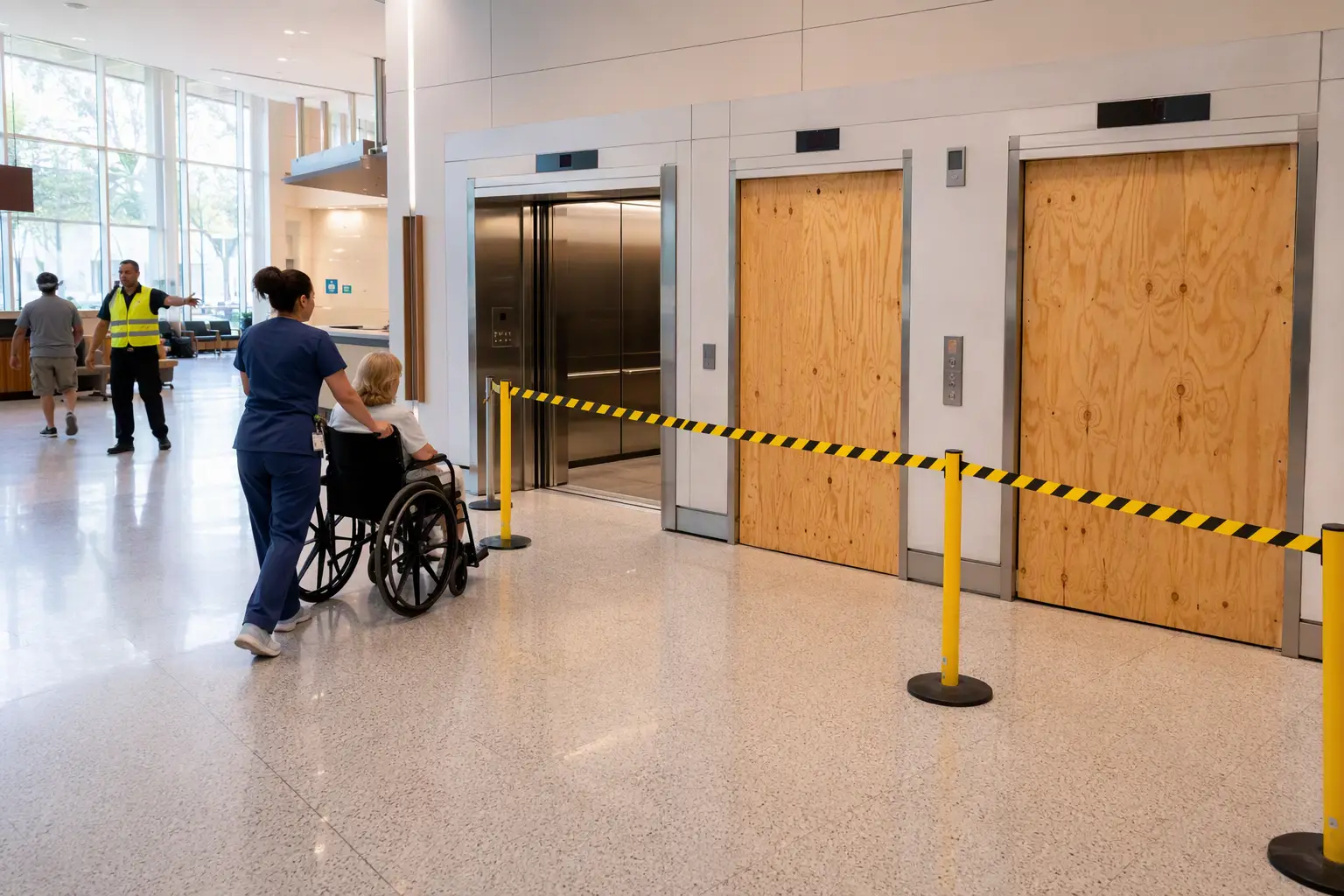
- Establish temporary service alternatives in writing. Document which elevators carry which traffic during construction, and post clear wayfinding signage for patients, visitors, and staff. If stretcher transport requires a detour, communicate the route change to all clinical departments before work begins.
- Implement ICRA-compliant barriers at the elevator entrance. Dust and particulates from modernization work are an infection control risk in a healthcare environment. Negative-pressure enclosures, HEPA-filtered air scrubbers, and sealed hoistway penetrations are standard expectations in Joint Commission–accredited facilities.
- Establish a real-time escalation contact between contractor and hospital. Designate a single point of contact on both sides. If an unexpected equipment condition extends a shutdown window, the hospital must be notified immediately so patient transport can be rerouted without delay.
- Inspect and test before returning to service. In California, a Cal/OSHA-authorized inspection and new permit to operate must be issued before any modernized elevator is placed back in service. In Texas, a TDLR-registered inspector must inspect and the owner must obtain a new Certificate of Compliance. Do not return an elevator to patient use before the regulatory sign-off is complete.
- Conduct a post-modernization operational review. After each elevator is returned to service, monitor door timing, leveling accuracy, and response times for a defined period to catch any commissioning issues before the next unit is taken offline.
Does ADA Compliance Affect the Modernization Scope or Cost?
Yes, and often significantly. Under the Americans with Disabilities Act, alterations to a facility must bring the altered elements—and the path of travel to them—into compliance with current accessibility standards to the extent readily achievable. When a hospital modernizes an elevator, the ADA’s alterations requirements may trigger upgrades to call button placement, cab control panel height, floor designation tactile markings, audible signals, and door open timing. Hospitals that are also undergoing any lobby or corridor renovation connected to the elevator bank face a broader path-of-travel compliance obligation. Legal and accessibility counsel should review the scope before finalizing the modernization contract.
What ASME Standards Apply to Hospital Elevator Modernization?
The ASME A17.1 Safety Code for Elevators and Escalators governs new installations, while ASME A17.3, Safety Code for Existing Elevators and Escalators, applies retroactively to existing equipment. During modernization, the specific edition of A17.1 that applies depends on the state-adopted code and the date the installation or alteration permit is issued. California has adopted the 2004 edition for contracts signed on or after May 1, 2008 (with a proposed Group V update that would incorporate ASME A17.1-2019 in part—no effective date has been posted as of 2026). Texas has adopted the 2016 edition, effective November 1, 2018. Hospital facility managers should confirm with their modernization contractor which edition governs the specific project and what retroactive requirements from A17.3 apply to existing components being retained.
How Long Does Hospital Elevator Modernization Typically Take?
Project duration varies with scope, permitting lead time, equipment lead time, and the hospital’s operational constraints. A targeted control-system-only upgrade on a single elevator may be completed in days of active work, but permitting, equipment procurement, and hospital scheduling coordination often extend the total project timeline to weeks or months. A full modernization of a hospital elevator bank with multiple units, phased for continuous access, routinely spans several months from contract award to final inspection. In both California and Texas, the regulatory permitting and inspection steps at the beginning and end of each unit’s work must be built into the schedule as non-negotiable milestones, not afterthoughts.
What Are the 2025–2026 Trends in Hospital Elevator Modernization?
The hospital vertical transportation market in 2025–2026 reflects several converging pressures. Aging healthcare infrastructure—much of it built during the mid-twentieth century expansion of community hospitals—is reaching the point where piecemeal repairs are no longer cost-effective and full modernization is the more defensible capital decision. Simultaneously, supply chain conditions for elevator components have remained variable, making early procurement planning more important than it was in prior years.
Hospitals are increasingly specifying destination dispatch systems during modernization, which reduce wait times and separate patient, visitor, and service traffic algorithmically rather than through physical separation of elevator banks. Remote monitoring and predictive diagnostics—delivered through internet-connected controllers—are becoming standard specifications rather than premium add-ons, particularly in Joint Commission–accredited facilities where equipment downtime carries direct patient-safety implications.
Energy efficiency is also a growing driver. VVVF drives and regenerative braking systems that return energy to the building’s electrical grid are increasingly favored in hospital settings where sustainability commitments and energy cost management are board-level priorities.
On the regulatory side, California’s proposed Group V Elevator Safety Orders—which would incorporate elements of ASME A17.1-2019—remain in the rulemaking process as of 2026. Hospitals planning major modernizations in California should monitor the California Standards Board for any effective date announcement, as a new code edition would affect the compliance baseline for projects permitted after adoption.
How Should a Hospital Compare Elevator Modernization Contractors?
Hospital procurement teams should evaluate modernization contractors on the following criteria:
- State credentials: In California, verify CQCC certification from Cal/OSHA and a C-11 license from the CSLB. In Texas, verify current registration with TDLR as an elevator contractor. In Houston, verify compliance with the City of Houston’s own program requirements.
- Healthcare-specific experience: Ask for documented examples of modernization projects completed in active, occupied hospitals with phased shutdown plans. General commercial experience does not translate automatically to the infection control, ICRA, and operational coordination demands of a healthcare environment.
- ICRA capability: Confirm that the contractor’s workforce is trained in healthcare infection control construction protocols and that the bid includes compliant barriers, air handling, and waste management.
- Manufacturer relationships: Contractors with established relationships with major equipment manufacturers can provide more reliable lead-time estimates and access to parts for the life of the modernized system.
- References: Request references specifically from hospital facility directors, not general commercial property managers, and contact them before awarding the contract.
What Happens If a Hospital Runs a Non-Compliant Elevator?
The consequences depend on the specific violation and the jurisdiction. In California, operating an elevator without a valid permit to operate issued by Cal/OSHA is a violation of California Labor Code Sections 7300–7324.2 and can result in Cal/OSHA ordering the elevator out of service. In Texas, a passenger elevator without working firefighters’ service—including Phase One firefighters’ service—must be removed from service immediately under TDLR rules. Texas building owners must also have cited violations corrected or under contract to be corrected within 30 days of inspection, or obtain a waiver or delay from TDLR.
Beyond regulatory penalties, a hospital operating non-compliant elevators faces accreditation risk, liability exposure in the event of a patient or staff injury, and potential insurance complications. The cost of proactive modernization is consistently lower than the combined cost of regulatory enforcement, litigation, and reputational damage following a preventable incident.
How Does AmeriTex Elevator Support Hospital Modernization Projects?
AmeriTex Elevator works with hospital facility teams in California and Texas to assess existing elevator equipment, identify compliance gaps under Cal/OSHA or TDLR requirements, and develop phased modernization plans that maintain patient and staff access throughout construction. The assessment process produces a documented scope of work tied to current code requirements—giving hospital administrators and capital planning committees the data they need to make informed modernization decisions. AmeriTex Elevator coordinates permitting with the appropriate regulatory authority before work begins and manages the inspection process at project completion, so hospitals receive compliant, operational elevators without administrative gaps in the regulatory chain.
What Should Be in a Hospital Elevator Modernization RFP?
A well-structured request for proposals for hospital elevator modernization should include:
- A complete equipment inventory with make, model, installation date, and last inspection date for each unit
- A summary of known deficiencies and any open violations or conditions cited by Cal/OSHA or TDLR
- Operational requirements during construction, including minimum units in service by floor zone and time of day
- ICRA classification for the construction area and infection control requirements
- Required state credentials (CQCC/C-11 in California; TDLR registration in Texas)
- Required OSHA compliance documentation and safety plans
- Warranty terms for parts and labor post-modernization
- References from at least two completed hospital modernization projects of comparable scope
- A phased schedule showing which elevator is offline at each project stage and how ADA accessible route continuity is maintained throughout
Including these elements in the RFP reduces scope ambiguity, enables apples-to-apples bid comparison, and surfaces contractor capability gaps before award rather than during construction.
Summary: Key Facts for Hospital Elevator Modernization in California and Texas
| Requirement | California | Texas |
|---|---|---|
| Regulating agency | Cal/OSHA Elevator Unit | TDLR Elevator & Escalator Safety |
| Adopted ASME code edition | ASME A17.1/CSA B44, 2004 (for contracts on or after May 1, 2008) | ASME A17.1/CSA B44, 2016 (effective November 1, 2018) |
| Pre-alteration requirement | Permit from Cal/OSHA required before material alteration | Plans submitted to TDLR; approval required before work begins |
| Contractor credential | CQCC (Cal/OSHA) + C-11 license (CSLB) | Registered elevator contractor (TDLR) |
| Post-modernization inspection | Cal/OSHA safety engineer or CCCI; new permit to operate issued | TDLR-registered inspector; new Certificate of Compliance issued |
| Annual inspection requirement | At least once per year; up to two years with full maintenance contract from CQCC | Annually; Certificate of Compliance valid one year |
| Special local program | City of Los Angeles (LADBS) runs its own program | City of Houston runs its own program; TDLR does not regulate Houston |
Sources: California Department of Industrial Relations, Cal/OSHA Elevator Unit; Texas Department of Licensing and Regulation, Elevator and Escalator Safety; ASME Codes & Standards.
Contact AmeriTex Elevator for a free elevator assessment at 844-646-9660.
Need elevator service you can rely on? AmeriTex Elevator is ready to help.