Elevator Emergency Phone Number: Complete Guide to Requirements, Compliance & What to Do in a Crisis
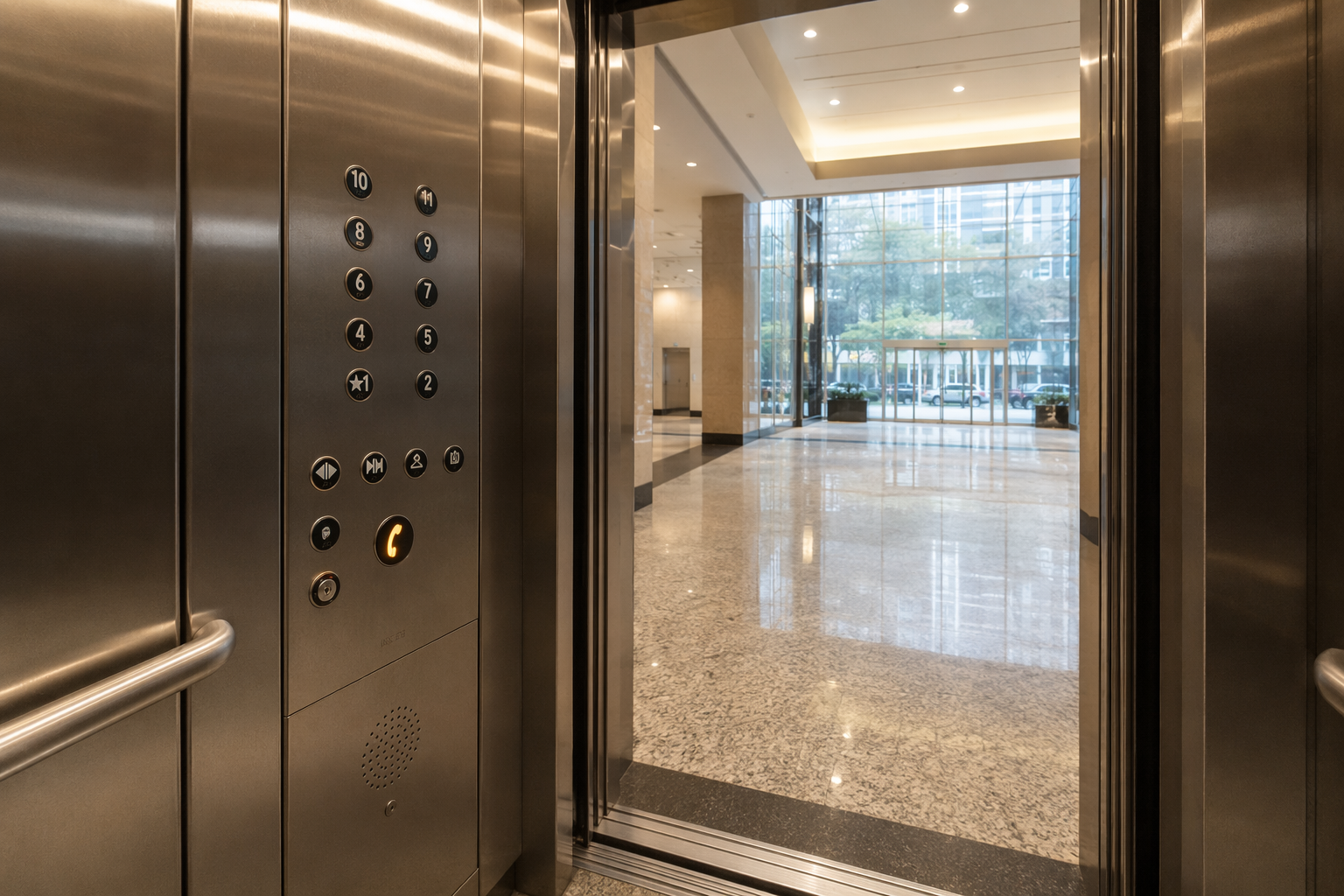
After more than 15 years servicing elevators across Texas and California, I’ve responded to hundreds of entrapment calls. The single most important piece of equipment separating a manageable emergency from a dangerous one is a properly installed, fully operational emergency phone. This guide covers everything building owners, property managers, and tenants need to know — from federal code requirements to what actually happens when someone presses that button.
What exactly is an elevator emergency phone number and why is it required?
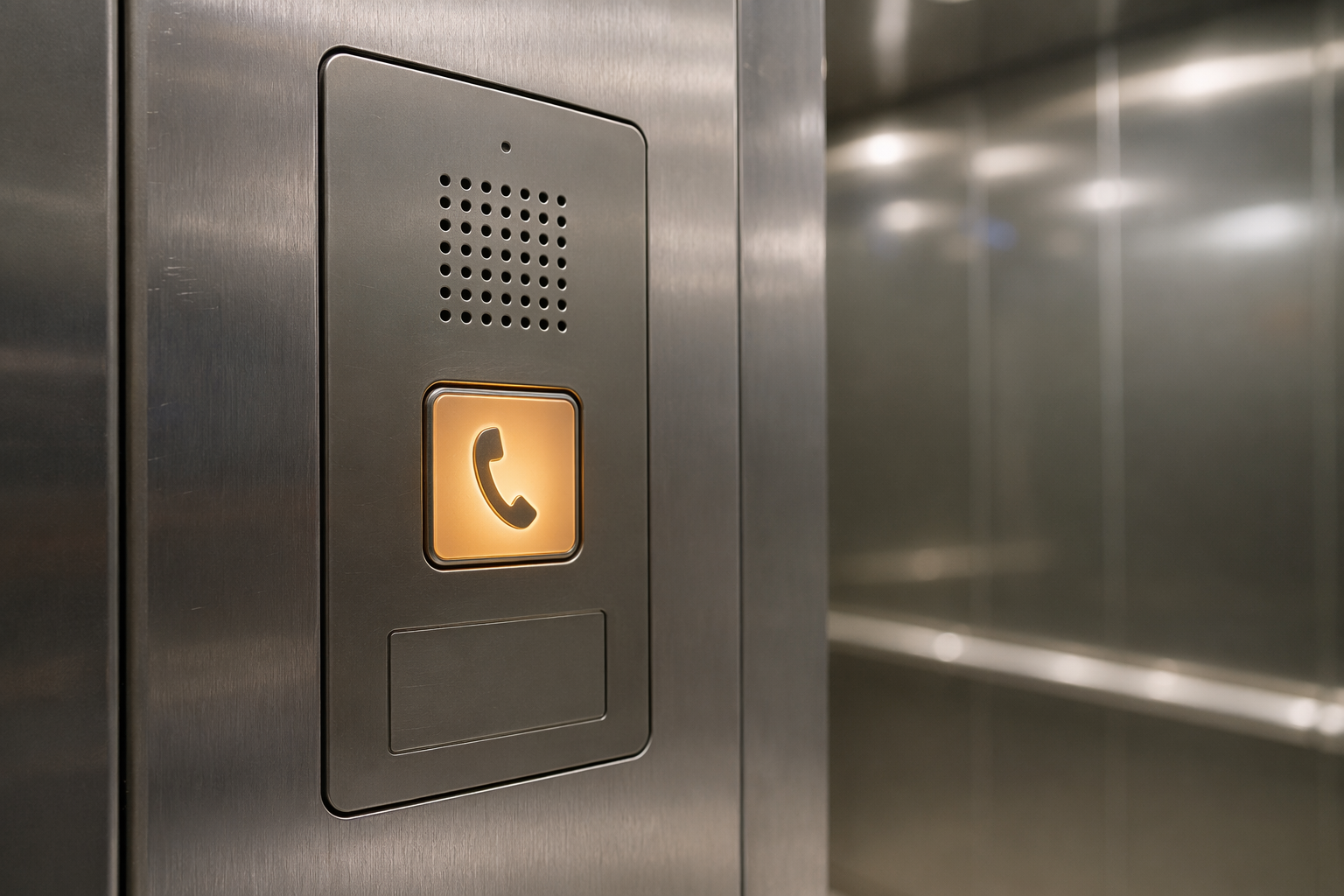
An elevator emergency phone number is a dedicated two-way voice communication line installed inside an elevator cab that connects trapped passengers to a live answering service, building security, or emergency dispatch — required by law under ASME A17.1-2022 and the Americans with Disabilities Act.
This isn’t optional equipment. Under ASME A17.1, the Safety Code for Elevators and Escalators, every passenger elevator must be equipped with a means of two-way communication between the elevator cab and a location staffed by authorized personnel capable of summoning emergency assistance. The 2022 edition of the code (which remains the enforced baseline in 2026) is explicit: the system must operate independently of elevator power and must not require a person to hold a button to communicate.
The underlying reason is straightforward — elevator entrapments happen. In the United States, approximately 10,000 elevator entrapments are reported each year. Without a functioning emergency phone, passengers — particularly elderly individuals, people with medical conditions, or those with disabilities — face serious risk of injury or death from panic, dehydration, or cardiac events.
What are the ASME A17.1 requirements for elevator emergency phones in 2026?
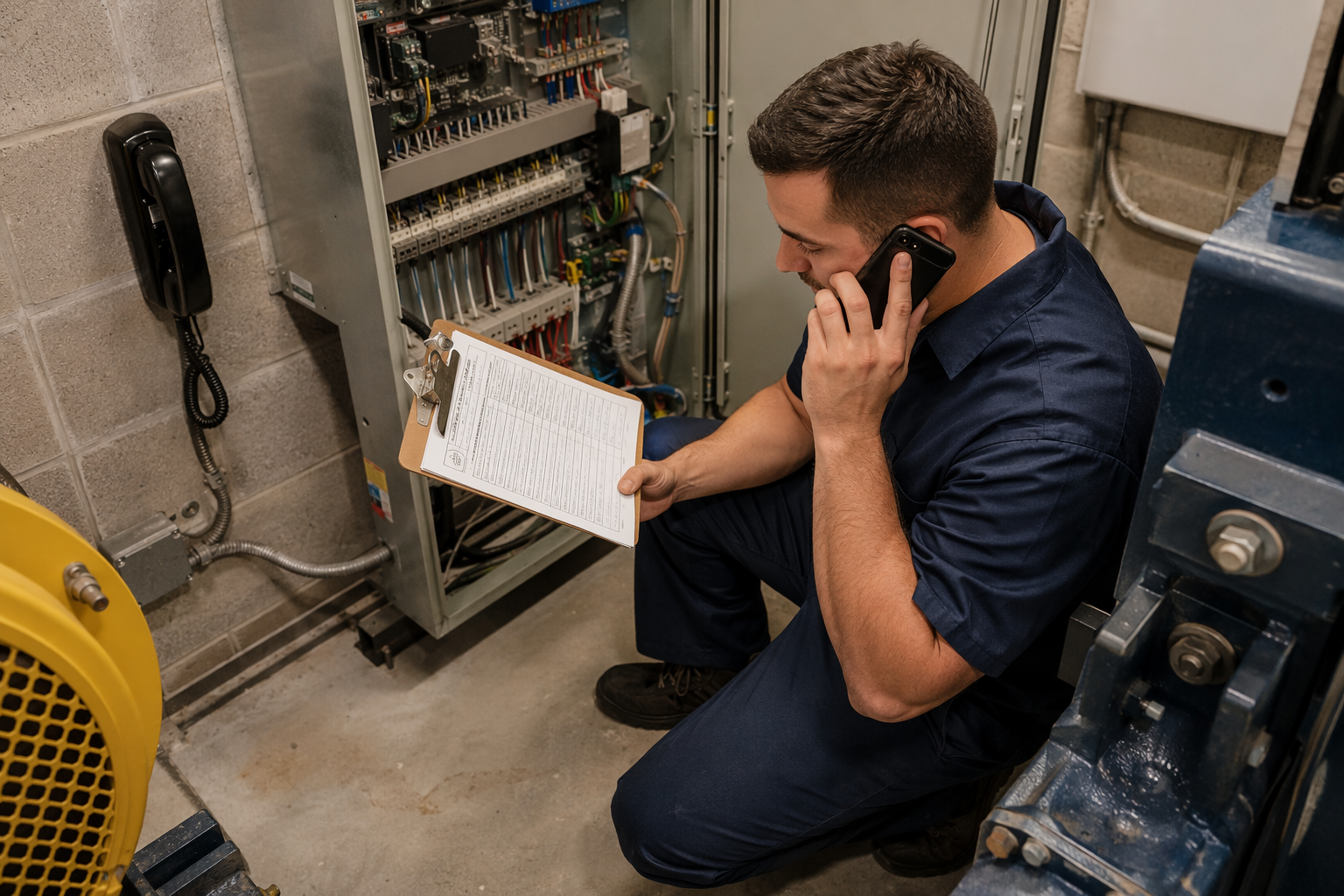
ASME A17.1-2022 Section 2.27.1.1 mandates that elevator emergency phones must provide hands-free two-way voice communication, auto-dial to a monitored location without requiring the passenger to know any phone number, and must function on a dedicated phone line or cellular backup independent of the building’s primary power.
Key compliance points from the code that I verify on every service call include:
- The phone must automatically dial a predetermined number when activated — passengers cannot be expected to dial manually.
- Communication must be hands-free so passengers with mobility limitations or injuries can use it without holding a handset.
- The emergency phone must be identified with a visible symbol (the telephone handset icon) and must be illuminated or in a location with adequate lighting.
- The system must include a means of identifying the specific elevator and building location to the monitoring station.
- Backup power (typically a battery) must sustain operation for a minimum of 4 hours after primary power loss.
- Testing must be performed at regular intervals — typically monthly — and documented.
In California, the elevator emergency phone requirements are additionally governed by Title 8 of the California Code of Regulations and enforced by the Division of Occupational Safety and Health (Cal/OSHA). In Texas, the Texas Department of Insurance (TDI) enforces elevator safety under the Texas Elevator Safety Act. Both states reference ASME A17.1 as the foundational code but layer additional inspection and testing requirements on top of it.
What does ADA say about elevator emergency communication systems?
The Americans with Disabilities Act requires elevator emergency communication devices to be usable by people who are deaf, hard of hearing, or have speech impairments — meaning a voice-only phone is not sufficient to achieve full ADA compliance in many contexts.
ADA Standards for Accessible Design, Section 407.4.9, specifically requires two-way communication systems in elevators to comply with ICC A117.1 standards for accessible design. In practice, this means:
- Controls must be within reach range (15 to 48 inches above the floor for side reach; up to 54 inches for forward reach).
- The emergency phone button must be identified by the international TTY symbol or include visual signaling capabilities for users who cannot hear a verbal response.
- Some jurisdictions now require the system to support text-based communication (SMS or TTY) in addition to voice.
In 2026, ADA enforcement has become more aggressive, particularly in Los Angeles and San Diego, where DOJ settlement agreements with several commercial building owners have included elevator communication compliance as a specific line item. Building owners in those markets should treat this as a priority.
What is the difference between an elevator emergency phone and a standard intercom?
An elevator emergency phone is a code-compliant auto-dialing two-way communication device designed specifically for life-safety situations, whereas a standard intercom connects only to a building-specific location that may not be staffed 24/7 — making intercoms alone insufficient for ASME A17.1 compliance.
This distinction matters enormously in real-world emergencies. I’ve been called to properties where building management believed their intercom system satisfied the emergency phone requirement — it does not. An emergency phone must dial out to a monitored 24-hour answering location. If a building’s front desk closes at 6:00 PM and the intercom only rings there, passengers entrapped after hours have no effective means of rescue communication.
Dedicated elevator emergency phone systems also include location identification data transmitted with the call, allowing dispatch to know which building and which elevator car is involved without relying on the passenger to communicate that information — critical when passengers are panicked, injured, or non-English speaking.
What should a passenger do immediately when trapped in an elevator?
When trapped in an elevator, a passenger should immediately press the emergency phone button or alarm bell, stay calm, and wait for emergency services — never attempt to force open doors or climb out of a stopped cab.
- Press the emergency phone button. It is typically marked with a telephone handset icon and located on the elevator control panel. Hold it briefly — most auto-dial systems connect within 10 to 30 seconds.
- Communicate your location clearly. When connected, state the building address, floor you believe you stopped near, and how many people are in the cab. Many modern systems transmit this automatically, but verbally confirming it speeds response.
- Press the alarm bell button. This is distinct from the emergency phone and alerts anyone nearby in the building. Use both.
- Stay calm and stay in the cab. Elevator entrapments are rarely dangerous if passengers remain inside and avoid forcing the doors.
- Do not attempt to pry open doors or climb through the ceiling hatch. The space between the cab floor and landing can be unpredictable — injuries and fatalities have resulted from passengers self-evacuating.
- If there is a medical emergency, communicate it immediately. Inform the monitoring center so they can escalate to 911 dispatch.
- Wait for a certified elevator technician or emergency responder to release you. Legitimate rescue typically takes 15 to 60 minutes depending on location and time of day.
Who answers when an elevator emergency phone is called?
When an elevator emergency phone is activated, it connects to either a building-contracted 24-hour elevator monitoring service, the building’s own security desk (if staffed around the clock), or in some configurations directly to a local 911 dispatch center.
The quality of response depends entirely on who is on the other end of that line. Premium elevator monitoring services employ dispatchers trained specifically in elevator emergencies who can simultaneously contact an elevator service company and local fire department if needed. Budget monitoring arrangements sometimes route calls to general answering services with no elevator-specific training.
When AmeriTex Elevator configures or inspects emergency phone systems for buildings in Houston, Dallas, Austin, San Antonio, Los Angeles, and San Diego, we verify that the phone is programmed to a monitoring center with documented 24/7 coverage and elevator-specific dispatch protocols — not just any answering service.
How often must elevator emergency phones be tested and documented?
Elevator emergency phones must be tested monthly at minimum under ASME A17.1 maintenance requirements, with documented results kept on file for inspection — and annual full-system tests are required as part of the comprehensive elevator inspection process in both Texas and California.
Here is what a compliant testing schedule looks like:
| Test Type | Frequency | Who Performs It | Documentation Required |
|---|---|---|---|
| Basic phone connectivity check | Monthly | Building maintenance or elevator contractor | Logbook entry with date, tester name, result |
| Two-way audio quality test | Monthly | Elevator contractor | Service ticket or maintenance log |
| Backup battery load test | Every 6 months | Elevator contractor | Battery test report with voltage readings |
| Full system compliance inspection | Annually | State-licensed elevator inspector | Inspection certificate filed with state authority |
| 5-Year full load test (CA only) | Every 5 years | DOSH-certified inspector (California) | Cal/OSHA Form 31 or equivalent |
Failure to maintain these testing records can result in significant fines. In California, Cal/OSHA elevator violation penalties can reach $25,000 per incident for willful violations as of 2026. In Texas, TDI can issue notices of violation and require immediate shutdown of non-compliant elevators.
What happens if an elevator emergency phone is not working?
A non-functioning elevator emergency phone is a serious code violation that can result in mandatory elevator shutdown, state fines, and significant liability exposure for the building owner — the elevator must be taken out of service until the communication system is repaired and verified.
Under ASME A17.1, an inoperative emergency communication device is classified as a hazardous condition. This is not a deficiency to be scheduled at next convenience — it requires immediate correction. I’ve seen property managers try to place a paper sign on the cab saying “emergency phone temporarily out of service” as a workaround. That provides no legal protection and does nothing for a trapped passenger.
The liability exposure here is substantial. Personal injury lawsuits stemming from elevator entrapments where the emergency phone was documented as non-functional prior to the incident have resulted in multi-million dollar settlements in multiple cases across Texas and California in recent years.
What are the specific elevator emergency phone requirements in Texas?
In Texas, elevator emergency phone requirements are enforced by the Texas Department of Insurance under the Texas Elevator Safety Act (Texas Occupations Code, Chapter 754), which adopts ASME A17.1 as the baseline standard and requires annual inspections by a TDI-licensed elevator inspector with results filed electronically through the TDI portal.
Texas-specific notes that affect emergency phone compliance:
- All elevators in Texas must display a current inspection certificate issued by TDI — visible to passengers, typically posted inside or near the cab.
- Emergency phone lines in Texas must connect to a live person within 60 seconds of activation, per TDI enforcement guidance updated in 2024.
- Houston, Dallas, Austin, and San Antonio each have local fire codes that supplement state requirements — specifically around elevator recall and emergency responder communication during fire events.
- Texas does not currently mandate TTY/text capability for elevator emergency phones, but ADA federal standards still apply to buildings covered under Title II and Title III of the ADA.
What are the elevator emergency phone requirements in California?
California elevator emergency phone requirements are enforced by Cal/OSHA’s Elevator, Ride, and Tramway Unit under Title 8 of the California Code of Regulations, which incorporates ASME A17.1 with California-specific amendments and requires permits, annual inspections, and certified inspectors for every elevator in the state.
California-specific requirements relevant to emergency phones:
- California requires the elevator permit number to be identifiable to the monitoring center when an emergency call is placed — systems must include automatic building and cab identification transmission.
- Los Angeles Department of Building and Safety (LADBS) conducts additional spot inspections and has issued specific guidance on cellular backup requirements given the seismic risk environment.
- San Diego County enforces elevator safety through coordination between Cal/OSHA and local building departments — emergency phone deficiencies found during inspections trigger mandatory correction timelines.
- As of 2026, California’s emergency phone rules increasingly require cellular LTE backup as landline infrastructure in some areas has become unreliable — this is not yet codified in ASME but is being adopted by progressive AHJs (Authorities Having Jurisdiction).
Can a cell phone or VoIP line be used as an elevator emergency phone?
A cellular or VoIP-based elevator emergency phone system can be code-compliant if it meets all ASME A17.1 performance requirements — including automatic location identification, hands-free operation, and reliable 4-hour backup power — but standard consumer cell phones left in a cab do not satisfy these requirements.
Dedicated cellular elevator emergency phone units are widely available and are increasingly the preferred solution in buildings where running a traditional POTS (Plain Old Telephone Service) copper line is cost-prohibitive or where landline service has been discontinued by carriers. These units use LTE or 5G networks and include SIM cards on dedicated M2M (machine-to-machine) data plans designed for reliability.
VoIP-based systems are acceptable in many jurisdictions but require careful vetting — they must maintain function during internet outages, which typically requires a cellular fallback built into the unit. VoIP-only systems with no cellular backup have failed during the building power outages that often accompany elevator mechanical failures.
The cost of a properly certified cellular elevator emergency phone unit ranges from $300 to $800 for the hardware, plus monitoring service fees of $15 to $40 per month depending on the monitoring provider and contract terms as of 2026.
How much does elevator emergency phone installation and monitoring cost?
Elevator emergency phone installation costs range from $400 to $1,200 per cab depending on system type and building infrastructure, with ongoing monitoring costs of $15 to $50 per month — a cost that pales against the liability exposure of a non-compliant or non-functioning system.
| Cost Component | Low Estimate | High Estimate | Notes |
|---|---|---|---|
| Hardware (POTS-based phone unit) | $150 | $400 | Requires active phone line |
| Hardware (cellular/LTE unit) | $300 | $800 | No landline needed |
| Installation labor | $150 | $400 | 1–3 hours typical |
| Monthly monitoring (basic) | $15/month | $25/month | May use general answering service |
| Monthly monitoring (elevator-specific) | $30/month | $50/month | Trained elevator dispatchers, recommended |
| Annual compliance testing | $75 | $150 | Part of full elevator inspection |
What is the difference between the elevator alarm bell and the emergency phone?
The elevator alarm bell is an audible alert device that signals people nearby that the elevator has stopped unexpectedly, while the emergency phone is a two-way voice communication system that connects passengers to a remote monitoring center — both are required by code, and neither can substitute for the other.
ASME A17.1 Section 2.27.1.2 requires an audible signaling device (alarm bell) in addition to the two-way communication system. The alarm bell serves passengers when the building is occupied and someone may hear it — a maintenance worker in a nearby corridor, for example. The emergency phone serves passengers in all other situations, including late-night entrapments when no one is within earshot.
In practice, the most effective emergency response comes from both being activated simultaneously. Modern elevator control panels consolidate these into adjacent or combined buttons, but the underlying circuits remain separate. Testing one does not confirm the other is functional.
What should building owners do to ensure their elevator emergency phone is always compliant?
Building owners should establish a documented monthly testing protocol, contract with a licensed elevator maintenance company for regular service, verify that the monitoring center is available 24/7 with elevator-specific dispatchers, and ensure the emergency phone number and monitoring contract are updated whenever building management or contact information changes.
The single most common failure I find on service calls is not hardware failure — it’s an outdated phone number programmed into the auto-dial. A building changes its security desk number, or a monitoring contract lapses, and the emergency phone is now calling a disconnected line or a voicemail box. The phone looks functional. The test button lights up. But it calls no one.
A comprehensive compliance checklist for building owners includes:
- Verify the programmed auto-dial number connects to a live person at every monthly test.
- Confirm the monitoring center can correctly identify the building and cab when called.
- Ensure backup battery is tested under load every 6 months and replaced on the manufacturer’s recommended cycle (typically every 3 to 5 years).
- Keep a physical logbook or digital record of every test with date, tester identity, and outcome.
- Review the monitoring contract annually to confirm 24/7 live coverage is still in place.
- Update all programming immediately after any change to building contact information, security staffing, or monitoring vendors.
How do elevator emergency phones handle calls from passengers who speak languages other than English?
Premium elevator monitoring services offer multilingual dispatch capability, and building owners in diverse urban markets like Los Angeles, Houston, and San Antonio should specifically require documented multilingual support in their monitoring contracts to ensure all passengers can communicate effectively in an emergency.
This is a compliance gap that exists in many buildings and is rarely audited but carries genuine safety and liability consequences. In markets like Los Angeles and Houston, where Spanish, Mandarin, Vietnamese, and other languages are widely spoken, a monitoring service that can only communicate in English provides inadequate safety coverage for a significant portion of the building’s users.
When evaluating monitoring services, building owners should ask specifically: What languages do your dispatchers speak? What is your protocol when a caller speaks a language your dispatcher does not? Is a translation service available on demand? These questions should be answered in writing in the service contract.
What is the elevator emergency phone number format — do passengers dial a number or just press a button?
Passengers do not dial any number — they press a single designated button on the elevator control panel and the system automatically connects to the monitoring center without requiring the passenger to know or enter any phone number.
This auto-dial design is the core safety feature of a compliant elevator emergency phone. The number programmed into the system is not typically displayed in the cab, though some systems show the monitoring center’s name. What passengers need to know is simple: press the button with the telephone icon, wait for connection (typically 10 to 30 seconds), and speak. The system handles everything else.
Some modern elevator emergency phone systems also send a simultaneous SMS or email alert to building management when activated, providing an additional notification layer without adding complexity for the trapped passenger.
Are elevator emergency phones required in all elevator types, including hydraulic and home elevators?
Emergency communication requirements under ASME A17.1 apply to all commercial passenger elevators including traction and hydraulic systems, but private residence elevators are governed by ASME A17.1 Section 5.3 with somewhat different requirements that may not mandate a full auto-dialing monitoring system depending on jurisdiction.
For commercial buildings — which represent the vast majority of elevators serviced by AmeriTex Elevator in Houston, Dallas, Austin, San Antonio, Los Angeles, and San Diego — the full emergency phone requirements apply regardless of whether the elevator is traction, hydraulic, or MRL (machine room less) design. The type of elevator drive system does not affect communication requirements.
Limited-use/limited-application (LU/LA) elevators, which are often found in smaller commercial buildings and are designed to serve a maximum of three floors, are governed by ASME A17.1 Part XII — and yes, they too require emergency communication devices meeting the same fundamental standards.
Freight elevators that are never intended to carry passengers are sometimes exempted from these requirements, but this is a narrow exception. If a freight elevator is used by workers for any purpose, emergency communication requirements typically apply.
What should a property manager do when they discover their elevator emergency phone is not working?
When a property manager discovers a non-functioning elevator emergency phone, they must immediately take the elevator out of service, contact a licensed elevator maintenance company for emergency repair, and document the discovery and corrective action — continuing to operate the elevator with a known non-functional emergency phone is a code violation and a serious liability risk.
- Take the elevator out of service immediately. Post clear signage on all floor landings and lock out the cab if possible.
- Document the discovery. Record the date, time, who discovered the deficiency, and what specifically is not functioning. This documentation protects you.
- Contact your licensed elevator maintenance company. This should be treated as an emergency service call, not a routine work order. Most licensed companies including AmeriTex Elevator offer emergency response service.
- Notify building ownership and legal counsel. The liability exposure from operating an elevator with a known defective emergency phone is significant — ownership needs to know.
- Do not return the elevator to service until the emergency phone is verified functional by a qualified technician. A written service report confirming the repair and successful phone test should be obtained before reopening.
- Review your maintenance contract. If this failure was not caught by your scheduled maintenance program, it’s time to evaluate whether your current service provider is meeting their obligations.
How do I find a reputable elevator emergency phone monitoring service?
A reputable elevator emergency phone monitoring service should be available 24 hours a day 365 days a year, employ dispatchers specifically trained in elevator emergency protocols, provide automatic location identification capability, and offer documented response time guarantees — your elevator maintenance company should be able to recommend vetted monitoring providers.
When evaluating monitoring providers, ask for references from buildings in your specific city, ask to see their average speed-to-answer data, and ask how they handle simultaneous calls from multiple buildings. During a major storm or power event, many elevators in a market may experience entrapments simultaneously — a small monitoring service may not have adequate staff to handle surge demand.
The major national elevator monitoring providers include companies that specialize exclusively in elevator emergency communication. Your elevator service contractor — and AmeriTex Elevator specifically includes this as part of our client advisory services — can help you evaluate options appropriate for your building size, occupancy type, and budget.
What new technologies are changing elevator emergency phone systems in 2026?
In 2026, elevator emergency phone technology is rapidly evolving toward IP-based two-way video communication, integrated IoT monitoring that can detect entrapments automatically without passenger activation, and AI-assisted dispatch systems that pre-identify building and cab information before a human dispatcher answers — improving response speed and accuracy significantly.
Several trends worth knowing:
- Two-way video communication: Some newer elevator emergency phone systems include a camera and screen, allowing the monitoring dispatcher to visually assess the situation — particularly valuable when a passenger is injured, unconscious, or unable to communicate verbally.
- Automatic entrapment detection: IoT sensors integrated with elevator control systems can detect door open failures, prolonged stops between floors, and other entrapment indicators — automatically initiating an emergency call without requiring passenger action. This is critical for passengers who may be incapacitated.
- LTE Cat-M and NB-IoT cellular: These low-power cellular standards designed for IoT devices are becoming the preferred connectivity for elevator emergency phones, offering better building penetration than standard LTE and longer battery life for backup power applications.
- Unified building safety platforms: Some building management systems now integrate elevator emergency phone monitoring with fire alarm, access control, and security camera systems — giving a single operations center full situational awareness during an elevator emergency.
These technologies are not yet universally required by code, but the 2025 ASME A17.1 revision cycle includes working group discussions on automatic entrapment detection that may result in new requirements in the next code cycle. Building owners investing in new equipment now should consider systems that will meet anticipated future requirements.
Contact AmeriTex Elevator for a Free Elevator Assessment
If you manage a commercial building in Houston, Dallas, Austin, San Antonio, Los Angeles, or San Diego and have any question about whether your elevator emergency phone system is fully compliant with ASME A17.1, ADA standards, Texas TDI requirements, or California Cal/OSHA regulations — do not wait for an inspection failure or, worse, an entrapment incident to find out.
AmeriTex Elevator provides free elevator safety assessments that include a comprehensive evaluation of your emergency communication system, backup power status, monitoring contract adequacy, and compliance documentation. Our IUEC-certified technicians bring current knowledge of both Texas and California enforcement environments and can identify gaps before they become violations or liabilities.
Call AmeriTex Elevator today: 866-679-4313
Or request your free assessment online. Our team is available for emergency service calls 24 hours a day, 7 days a week across all markets we serve. Don’t leave elevator safety to chance — the life it protects may belong to one of your tenants, your employees, or your guests.
Need elevator service you can rely on? AmeriTex Elevator is ready to help.