Signs Your Elevator Maintenance Contract Is Not Covering What It Should: 20 Expert FAQs
Most building owners and property managers sign an elevator maintenance contract and assume everything is handled — until an unexpected shutdown, a failed inspection, or an ADA complaint reveals serious gaps. Knowing the specific warning signs of an underperforming vendor can protect you from liability, fines, and costly emergency repairs. The 20 questions below cover every angle of this topic, from contract language to Texas and California code requirements, helping you evaluate your current vendor with confidence.
What are the most common signs that my elevator maintenance contract is not covering what it should?
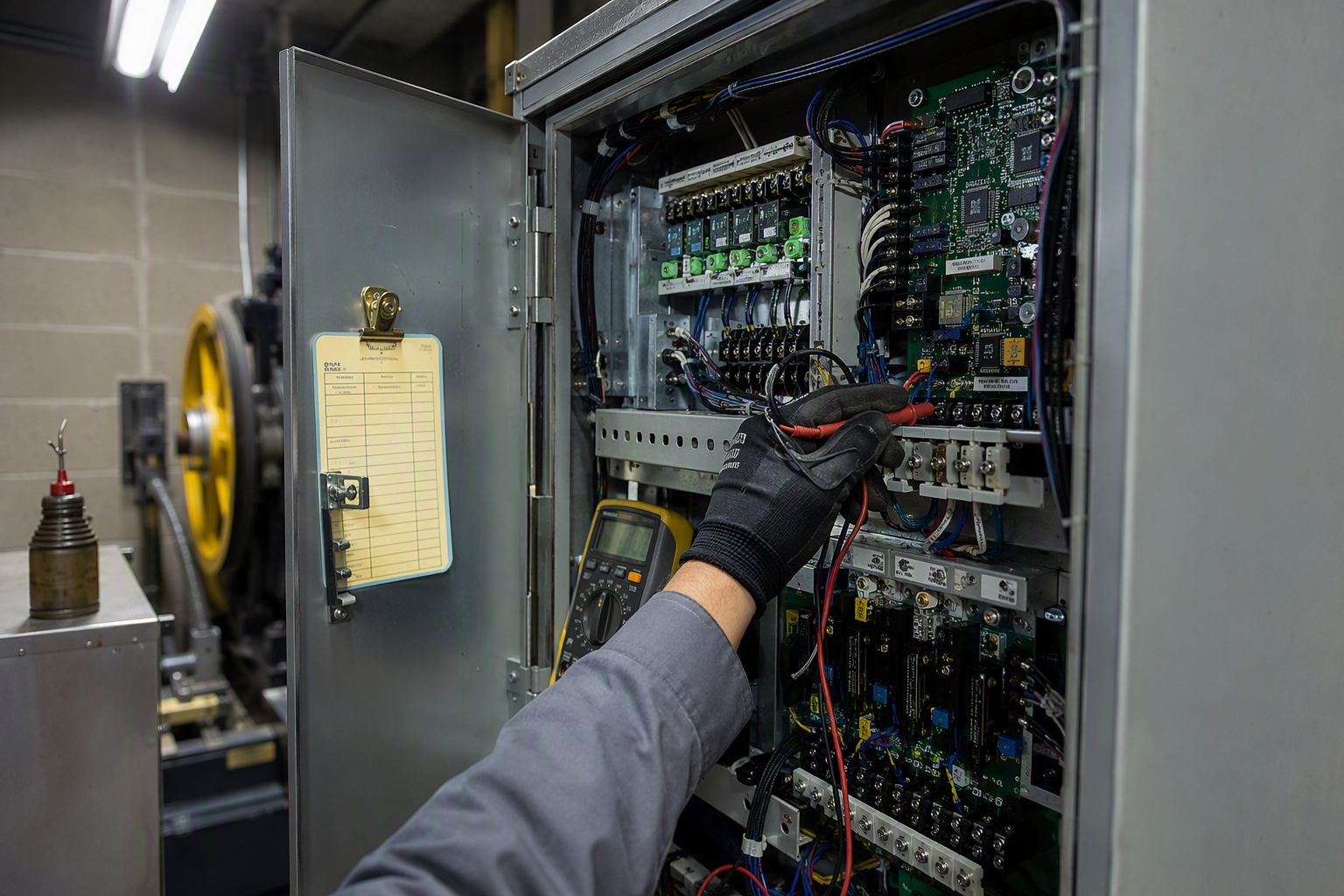
The clearest signs are missed or undocumented inspections, recurring equipment problems that never fully resolve, verbal-only service updates with no written reports, and contract language that excludes critical parts or safety tests required by applicable codes.
Beyond those headline indicators, watch for technicians who arrive without service history on hand, invoices that list only labor with no parts detail, and a vendor who cannot quickly produce your state inspection certificates on request. In Texas and California — where state agencies actively enforce elevator safety — a vendor who cannot show documented compliance with ASME A17.1 Safety Code for Elevators and Escalators is a significant liability risk for the building owner.
What should a comprehensive elevator maintenance contract actually include?
A comprehensive contract must clearly define inspection frequency, parts coverage, lubrication, safety device testing, callback response, written reporting, and code-compliance responsibility — leaving none of these items as implied or verbal agreements.
Contracts generally fall into three categories: oil-and-grease (most limited), parts and labor (mid-tier), and full-maintenance (most comprehensive). A full-maintenance agreement typically covers all adjustments, all parts except those damaged by vandalism or misuse, all required safety tests, and all costs associated with passing scheduled government inspections. If your contract does not specify which category it falls into, or uses vague language like “routine maintenance as deemed necessary,” that ambiguity almost always benefits the vendor rather than the building owner.
How often should elevator inspections and safety tests occur under a proper maintenance contract?
Under ASME A17.1 Safety Code for Elevators and Escalators, periodic inspections and tests are required at defined intervals, and both Texas and California adopt and enforce these standards through their respective state authorities.
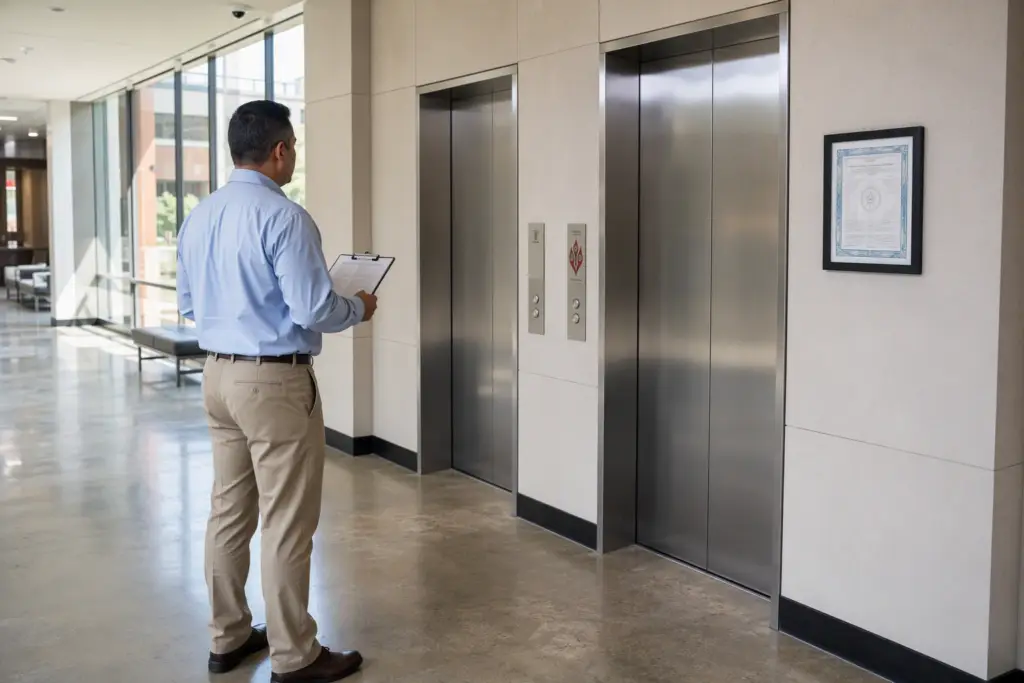
In Texas, the Texas Department of Insurance (TDI) oversees elevator inspections and requires annual inspections as a baseline for most elevator types, with additional periodic tests — such as the five-year Category 5 full-load safety test — required on a longer cycle. California enforces elevator safety through the Division of Occupational Safety and Health (Cal/OSHA Elevator Unit) with comparable annual inspection requirements. A vendor who cannot show that your unit’s inspection history aligns with these mandatory cycles is failing a core contractual obligation. Ask your vendor to provide copies of the state inspection certificate for every year the contract has been in force.
What does “callback response” mean in an elevator contract, and why does it matter?
Callback response refers to how quickly and thoroughly a vendor addresses a reported malfunction or entrapment after the initial service call — a poorly defined or unfulfilled callback clause is one of the most common ways building owners are underserved.
A callback clause should specify the conditions under which a return visit is provided at no additional charge, which categories of problems qualify, and what documentation results from that visit. If your contract simply states “callbacks available” without any further definition, a vendor can charge for repeat visits or close tickets without confirming the root cause was resolved. Repeated callbacks on the same equipment failure — door operators, leveling issues, motor overheating — almost always indicate that preventive maintenance is being deferred rather than performed.
What contract language should immediately raise a red flag?
Phrases such as “parts at our discretion,” “reasonable maintenance,” “excludes modernization items,” and “inspections subject to technician availability” are common contract clauses that legally allow a vendor to deliver far less than a building owner expects.
Additional red-flag language includes exclusions for proprietary components, exclusions for any part with a list price above a certain dollar threshold, and clauses that transfer all regulatory-fine liability to the building owner even when the vendor failed to schedule a required inspection. Before renewing or signing any agreement, have your facilities director or legal counsel mark every undefined term and every exclusion, then ask the vendor to clarify each one in writing as a contract addendum.
How can I tell if my elevator technician is performing real preventive maintenance or just responding to breakdowns?
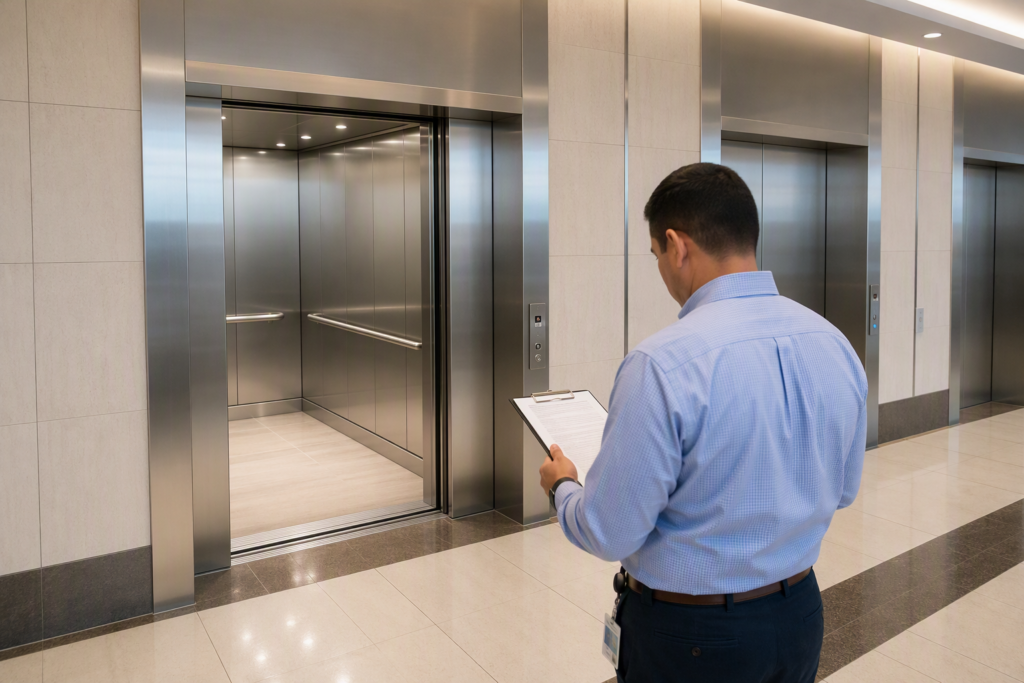
Genuine preventive maintenance produces written checklists that document specific measurements, adjustments, and lubrication points on each visit — reactive-only vendors typically produce vague visit logs that record only the complaint and closure, with no underlying equipment data.
A well-maintained elevator should have documented records showing periodic checks of brake adjustment, governor rope tension, door timing, buffer condition, oil levels in the machine room, and safety device functionality. If your service reports show visit dates and a one-line note like “unit running normal,” the technician may be conducting a quick visual sweep rather than a structured preventive maintenance procedure. Ask your vendor to provide blank copies of the inspection checklist they use on your unit — if one does not exist, that is a serious deficiency.
What specific safety tests are required by code that my contract should guarantee?
Both Texas and California enforce ASME A17.1 safety test categories that include annual no-load safety tests, periodic full-load governor and safety device tests, and — for hydraulic elevators — periodic pressure vessel and pressure-relief valve tests.
Category 1 tests (typically annual) require a no-load test of the safety and governor. Category 3 tests apply to hydraulic units and test the pressure-relief valve. Category 5 tests — required on a longer periodic cycle — require a full-load, full-speed safety test with a witnessing inspector present. A contract that is silent on which test categories are included, or that lists only “annual inspection” without specifying the test category, may leave you responsible for scheduling and paying for required periodic tests separately.
Am I responsible for ADA compliance on my elevator even if I have a maintenance contract?
Yes — under the Americans with Disabilities Act (ADA), building owners retain ultimate legal responsibility for elevator accessibility, regardless of what a maintenance contract does or does not cover.
ADA elevator requirements include operational car controls at the correct mounting heights, audible and visible floor indicators, adequate door timing and reopening sensitivity, and functioning Braille signage. A maintenance contract does not automatically include ADA compliance audits or remediation unless that language appears explicitly. Building owners in Houston, Dallas, Austin, San Antonio, Los Angeles, and San Diego should periodically request an ADA-focused walkthrough from their vendor to confirm that aging equipment has not drifted out of compliance as components wear.
What is the difference between an oil-and-grease contract, a parts-and-labor contract, and a full-maintenance contract?
These three tiers define how much of the elevator’s upkeep — and its associated costs — the vendor absorbs versus passes back to the building owner as separate invoices.
| Contract Type | What Is Covered | What Is Typically Excluded | Best Suited For |
|---|---|---|---|
| Oil & Grease (Basic) | Lubrication, minor adjustments, visual inspection | Parts, labor for repairs, safety tests, callbacks | Very new equipment under manufacturer warranty |
| Parts & Labor (Mid-Tier) | Most labor, many parts, callbacks | Major components (motors, controllers, ropes), modernization items | Mid-age equipment in stable condition |
| Full Maintenance (Comprehensive) | All adjustments, all standard parts, safety tests, inspection support, callbacks | Vandalism, cosmetic items, code upgrades due to new construction | Older equipment, high-traffic units, risk-averse owners |
If you are currently paying for a full-maintenance contract but experiencing frequent out-of-contract invoices for parts or repairs, your vendor may be improperly reclassifying standard wear items as excluded categories — a practice that warrants a written contract dispute.
How should a proper elevator service report look, and what should it contain?
A proper service report is a written or digital document produced after every visit — whether routine maintenance or a callback — that records the unit ID, date, technician actions, parts used or inspected, measurements taken, and any deficiencies found along with a recommended resolution timeline.
Reports that simply list “elevator serviced” or “unit running at time of departure” provide no operational baseline and cannot support a liability defense if an accident occurs. Over time, properly detailed reports create a maintenance history that allows both the vendor and the building owner to identify trends — such as a door operator that requires adjustment on every visit — and make informed decisions about repair versus replacement. If your vendor cannot produce organized service reports for the past 12 months on request, that is a contractual and operational deficiency.
What happens to my legal liability if my elevator fails inspection due to vendor neglect?
In both Texas and California, the building owner — not the maintenance vendor — is the party of record with the state inspection authority, meaning fines, shutdown orders, and correction notices are issued to the property owner even when the root cause is vendor negligence.
This legal structure makes it essential that any maintenance contract include explicit language about which party is responsible for scheduling government inspections, providing access, completing deficiency corrections, and covering costs associated with a failed inspection. Without that language, a vendor can allow a unit to fall out of compliance and leave the building owner holding the regulatory and financial consequences. Consulting with legal counsel before signing or renewing a contract is advisable, particularly for multi-elevator facilities in Houston, Dallas, Los Angeles, or San Diego where inspection calendars are complex.
How do I know if my vendor is qualified and properly licensed to work on elevators in Texas or California?
In Texas, elevator contractors and mechanics must hold licenses issued by the Texas Department of Insurance, which oversees the Elevator Safety Program and requires that all persons performing elevator work meet defined competency standards. In California, elevator mechanics must hold a Certified Competent Conveyance Mechanic (C-11) certification, and contractors must be registered with the state.
A vendor who cannot immediately produce current license numbers for their company and the technicians assigned to your unit is operating outside the legal framework in either state. Building owners should verify license status directly with TDI (Texas) or the relevant California authority rather than relying solely on the vendor’s representation. AmeriTex Elevator operates within the regulatory frameworks of both Texas and California and serves building owners in Houston, Dallas, Austin, San Antonio, Los Angeles, and San Diego.
What are the signs that my elevator vendor is prioritizing their profit margin over my equipment’s health?
Profit-driven underservice typically appears as shortened visit durations, deferred lubrication and adjustment tasks, repeated recommendations to replace parts that were recently replaced, and a pattern of blaming equipment age for problems that preventive maintenance could have prevented.
Another indicator is a vendor who consistently recommends full modernization or major component replacement without providing a documented failure analysis or getting a second opinion. While modernization is sometimes genuinely necessary — particularly as components age beyond the service life defined in ASME A17.3 Safety Code for Existing Elevators and Escalators — a reputable vendor will present the building owner with a written condition assessment that distinguishes between safety-critical replacements and performance improvements.
What questions should I ask a new elevator maintenance vendor before signing a contract?
Before signing, ask about the specific ASME test categories included, the parts exclusion list, the written reporting format, the process for scheduling state inspections, and who bears responsibility for correction costs after a failed inspection.
Additional critical questions include: Are proprietary parts and controller components covered? What is the escalation process for recurring problems that are not resolved after two callbacks? Will the contract rate change if the scope of work increases? Is the contract auto-renewing, and what is the termination notice period? Getting clear, written answers to each of these questions before signing prevents the most common sources of vendor disputes.
What should I do immediately if I suspect my current elevator vendor is underserving me?
If underservice is suspected, the building owner should take a structured set of actions to document the situation, protect their compliance status, and evaluate alternatives without creating unnecessary equipment risk.
- Gather all service reports, inspection certificates, and invoices from the current contract period and organize them chronologically.
- Compare the visit frequency and documented tasks against the inspection intervals required by ASME A17.1 and your state’s authority having jurisdiction (AHJ).
- Review the contract document itself and highlight every exclusion, undefined term, and performance obligation.
- Contact your state elevator inspection authority — TDI in Texas, the Cal/OSHA Elevator Unit in California — to confirm whether your current inspection certificate is valid and whether any open violations exist on record.
- Request a written explanation from your current vendor for any inspection gaps, unresolved callbacks, or undocumented visits.
- Obtain an independent assessment from a second qualified elevator service company to establish an objective equipment condition baseline.
- Contact AmeriTex Elevator at 866-679-4313 to schedule a no-obligation elevator assessment at your facility.
How does equipment age affect what my maintenance contract should cover?
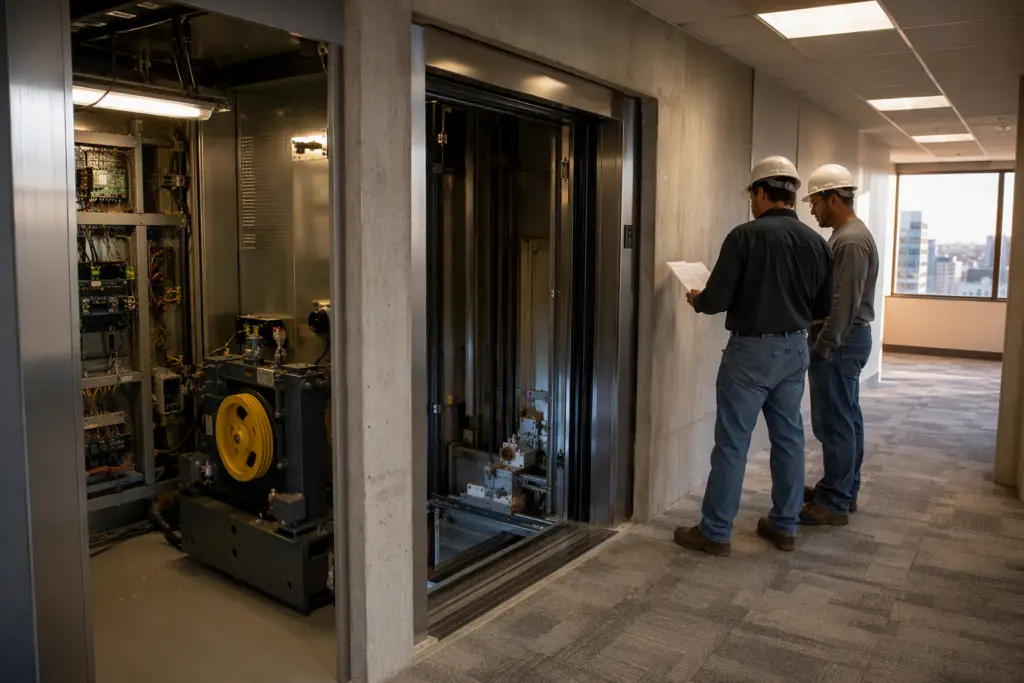
Older equipment requires more comprehensive contract coverage — not less — because aging components such as controllers, rope assemblies, door operators, and hydraulic cylinders are more likely to fail between visits and require more frequent adjustment and lubrication.
ASME A17.3 Safety Code for Existing Elevators and Escalators specifically addresses the requirements applicable to equipment that was installed before current editions of A17.1 took effect, and compliance with A17.3 can require retrofits or upgrades that a basic oil-and-grease contract would not cover. Building owners with elevators that are more than 15 to 20 years old should evaluate whether their current contract tier matches the actual maintenance demands of aging equipment.
Can I switch elevator maintenance vendors mid-contract, and what should I know before doing so?
Most elevator maintenance contracts are legally terminable under specified conditions — typically with 30 to 90 days written notice — but the contract language governs, and some agreements include liquidated damages, equipment lock-out clauses, or proprietary controller restrictions that complicate the transition.
Proprietary controller lock-out is a particularly important issue: some original equipment manufacturers (OEMs) program controllers that only respond to their own diagnostic tools, effectively preventing independent vendors from performing full maintenance. Before switching vendors, confirm whether your equipment has proprietary controller restrictions and whether the prospective vendor has the tools and access codes to service it fully. AmeriTex Elevator has experience evaluating equipment across a wide range of manufacturers in Houston, Dallas, Austin, San Antonio, Los Angeles, and San Diego, and can advise building owners on transition logistics as part of a free assessment.
What role does OSHA play in elevator maintenance obligations?
The Occupational Safety and Health Administration (OSHA) governs the safety of elevator maintenance workers — including requirements for lockout/tagout procedures, working in machine rooms, and personal protective equipment — which means a vendor’s internal safety practices directly affect both technician safety and your facility’s liability exposure.
Building owners are not directly responsible for a contractor’s OSHA compliance, but a vendor who operates with inadequate safety protocols creates accident risk on your property. When evaluating a vendor, ask whether their technicians follow documented OSHA lockout/tagout procedures and whether the company has a recordable incident history. A vendor’s internal safety culture is often a reliable indicator of how rigorously they approach equipment maintenance as well.
How should a maintenance contract address emergency entrapment situations?
A contract should define entrapment response as a separately prioritized obligation — distinct from routine callbacks — with a clear protocol that ensures passenger safety is addressed before equipment repair begins.
Entrapment situations require that the responding technician is trained in safe passenger release procedures that do not expose occupants to additional risk. The contract should also specify that entrapment response is available at all hours your building is occupied. If your current contract treats an entrapment call the same as a door-adjustment callback with no prioritization language, that is a serious gap — both from a safety standpoint and from the perspective of your duty of care as a building owner.
How can AmeriTex Elevator help me determine whether I am being underserved by my current vendor?
AmeriTex Elevator offers building owners in Houston, Dallas, Austin, San Antonio, Los Angeles, and San Diego a free, no-obligation elevator assessment that evaluates equipment condition, reviews existing service documentation, and compares current maintenance practices against applicable ASME and state code requirements.
The assessment is designed to give property managers and building owners an objective, documented picture of where their elevator program stands — without pressure to switch vendors if the current situation is genuinely adequate. Where gaps are found, AmeriTex Elevator provides a written findings summary that can be used either to negotiate improvements with the current vendor or to make an informed decision about alternative service arrangements. The goal is always code-compliant, fully documented elevator maintenance that protects both passengers and the building owner’s legal standing under Texas and California law.
Find Out If Your Elevator Contract Is Truly Protecting You
If any of the warning signs described above sound familiar — missed inspections, vague service reports, recurring equipment problems, or contract language you cannot interpret — the next step is a professional, independent assessment. AmeriTex Elevator serves building owners and property managers throughout Houston TX, Dallas TX, Austin TX, San Antonio TX, Los Angeles CA, and San Diego CA with comprehensive elevator maintenance, compliance consulting, and full-maintenance contract services built around ASME A17.1 Safety Code for Elevators and Escalators and applicable state requirements.
Contact AmeriTex Elevator for a free elevator assessment: 866-679-4313
Need elevator service you can rely on? AmeriTex Elevator is ready to help.