Elevator Code Violation Penalties: The Complete FAQ for Building Owners and Facility Managers
Elevator code violations carry real financial and legal consequences for property owners across Texas and California. Whether a building is in Houston, Dallas, Austin, San Antonio, Los Angeles, or San Diego, the enforcement framework combines federal standards, state regulations, and local authority oversight. This FAQ covers every dimension of elevator code violation penalties — from how fines are calculated to what happens when an elevator is shut down — so building owners and facility managers can make informed compliance decisions in 2026.
What Are the Most Common Types of Elevator Code Violations?
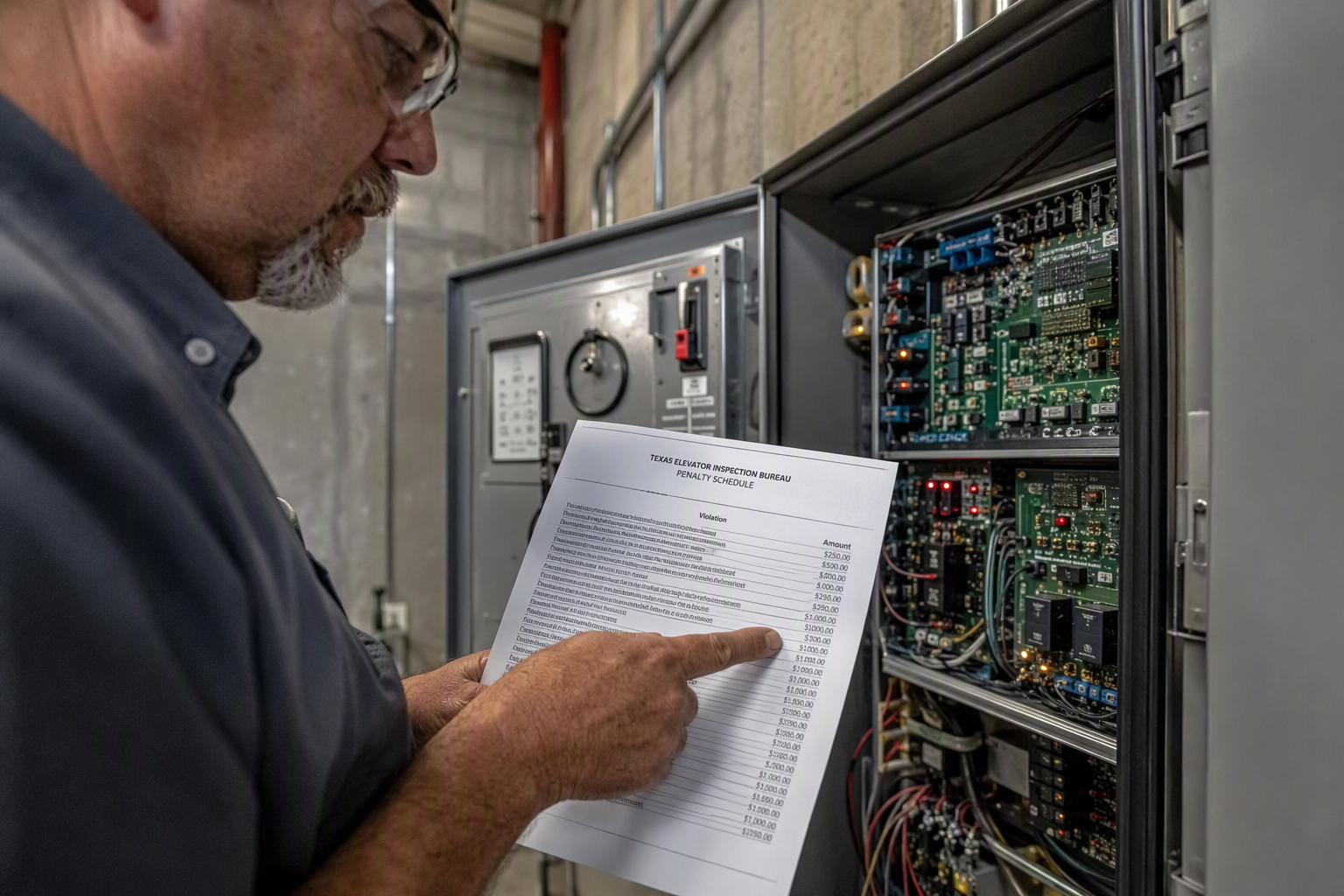
The most common elevator code violations involve expired inspection certificates, missing or faulty safety devices, inadequate lighting, door-reversal mechanism failures, and non-compliance with ADA accessibility requirements.
Inspectors evaluating elevators against the ASME A17.1 Safety Code for Elevators and Escalators routinely cite deficiencies in door-closing force limits, emergency lighting systems, governor and safety device testing records, and pit conditions. ADA violations are a separate enforcement track and can include inadequate cab dimensions, non-compliant control panel height, missing Braille signage, and inaccessible lobby call buttons. Both categories can be cited in the same inspection, compounding the compliance burden on the property owner.
How Are Elevator Code Violation Penalties Calculated?
Penalty amounts are determined by the type of violation, its risk classification, the number of times it has been cited previously, and the discretion of the enforcing authority — whether that is a state elevator safety bureau, a city building department, or a federal agency.
In Texas, the Texas Department of Insurance (TDI) Elevator Safety Program administers elevator inspections and can issue administrative penalties for non-compliance. In California, the Division of Occupational Safety and Health (Cal/OSHA) enforces elevator safety under Title 8 of the California Code of Regulations, and penalty schedules follow a tiered structure based on violation severity — serious, willful, or repeat classifications each carry escalating financial consequences. Generally across both states, uncorrected violations accrue additional penalties for each day the hazardous condition persists, meaning that delay dramatically increases total exposure.
What Is the Difference Between a Minor and a Serious Elevator Violation?
A minor violation typically involves documentation gaps or low-risk maintenance deficiencies, while a serious violation involves conditions that present a substantial probability of injury or death and triggers mandatory corrective action timelines and higher penalties.
Regulatory frameworks generally classify violations based on the likelihood and severity of harm. Expired inspection certificates, missing signage, or lighting deficiencies are often categorized as non-imminent-hazard violations that allow a defined correction window. By contrast, a failed door-reversal device, a defective governor, unguarded hoistway openings, or a cab that is not leveling correctly are treated as serious or imminent-hazard violations. Under OSHA standards applicable to workplaces, willful or repeat violations carry the highest penalty tiers, and a documented failure to act on prior citations is strong evidence of willful conduct.
Can a Building Owner Be Ordered to Shut Down an Elevator for a Code Violation?
Yes — inspectors in both Texas and California have authority to issue an out-of-service order immediately when an elevator presents an imminent hazard, regardless of the financial or operational impact on the building owner.
An out-of-service tag or seal means the elevator cannot legally operate until the violation is corrected and the unit passes a follow-up inspection. For multi-tenant commercial buildings, retail centers, or healthcare facilities, an unexpected elevator shutdown can trigger lease disputes, ADA accommodation obligations, and loss of business income. This is one of the most significant indirect costs of non-compliance — costs that dwarf what a proactive maintenance program would have required. Working with a qualified elevator service provider to resolve violations quickly is critical to minimizing downtime.
What Are the ADA-Specific Penalties for Elevator Violations?
ADA elevator violations can result in civil lawsuits, Department of Justice investigations, and court-ordered injunctive relief requiring immediate remediation, with courts able to award attorney’s fees and litigation costs to prevailing plaintiffs.
Under Title III of the ADA, places of public accommodation — which includes most commercial buildings — must maintain accessible features in operable condition. An elevator that is out of service without an adequate accessible alternative, or one that does not meet dimensional, signage, or control requirements, creates ADA exposure. Unlike some building codes where only government agencies can levy fines, ADA violations in public accommodations can be pursued by private litigants. In California, state civil rights law under the Unruh Civil Rights Act provides additional remedies, including statutory damages per incident, creating a layered liability environment for property owners in Los Angeles and San Diego.
How Do Elevator Violation Penalties Differ Between Texas and California?
| Factor | Texas (TDI Elevator Safety Program) | California (Cal/OSHA Title 8) |
|---|---|---|
| Primary enforcement authority | Texas Department of Insurance | Cal/OSHA Division of Occupational Safety & Health |
| Governing safety code | ASME A17.1 (adopted by TDI rule) | ASME A17.1 / California-specific Title 8 amendments |
| Inspection frequency (typical) | Annually (varies by equipment type) | Annually (permits renewed annually) |
| ADA overlay enforcement | Federal ADA + Texas Accessibility Standards (TAS) | Federal ADA + California Building Code (CBC) / Unruh Act |
| Out-of-service authority | Yes — TDI inspector or authorized third party | Yes — Cal/OSHA Elevator, Ride, and Tramway Unit |
| Repeat/willful violation escalation | Yes — administrative penalty multipliers apply | Yes — Cal/OSHA repeat/willful tiers significantly higher |
| Private right of action (ADA) | Federal ADA; no Texas-specific elevator private action | Federal ADA + Unruh Act statutory damages per incident |
What Should a Building Owner Do Immediately After Receiving a Violation Notice?
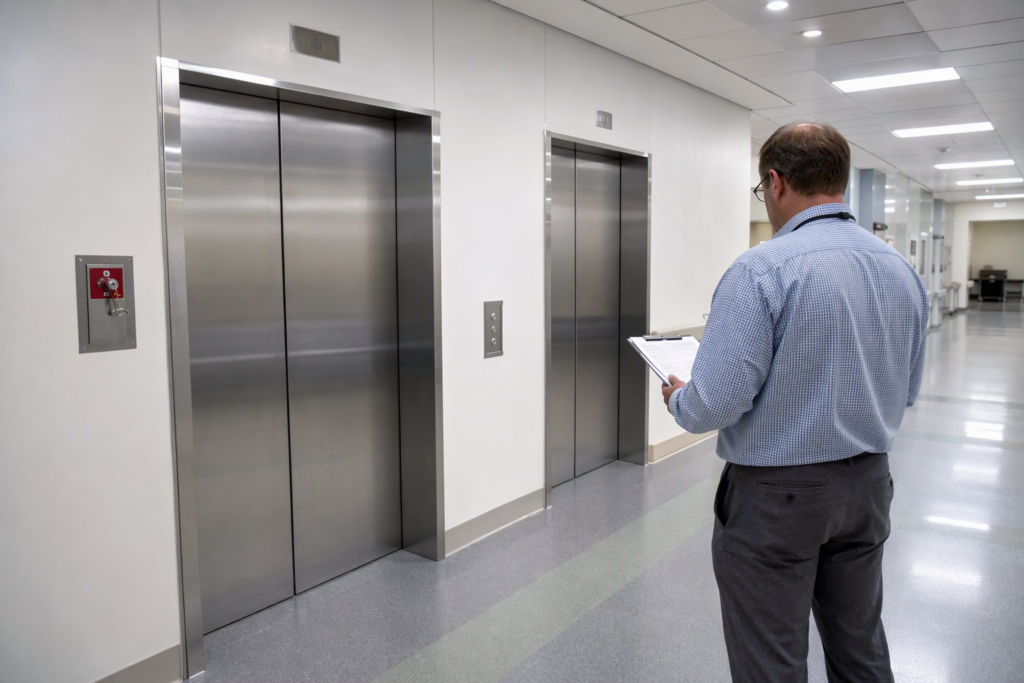
Upon receiving a violation notice, a building owner should act immediately and systematically to document, respond, and remediate before the correction deadline passes.
- Read the notice in full. Identify whether the violation is classified as imminent hazard, serious, or non-serious, and note the exact correction deadline.
- Take the elevator out of service if required. If the inspector has already tagged the unit, do not operate it. If the violation is imminent-hazard, voluntarily removing the elevator from service demonstrates good faith and can limit additional penalties.
- Contact a licensed elevator service contractor. A qualified technician must diagnose the cited deficiency and provide a documented corrective action plan. AmeriTex Elevator serves building owners across Houston, Dallas, Austin, San Antonio, Los Angeles, and San Diego and can assist with violation-driven repair needs.
- Document all communications. Keep copies of the notice, your response, work orders, parts procurement records, and any correspondence with the enforcing authority.
- Respond to the enforcement agency in writing. Acknowledge receipt, confirm your plan of action, and provide a realistic but prompt corrective timeline. Proactive communication routinely results in more favorable enforcement outcomes.
- Schedule the follow-up inspection. Once repairs are complete, request reinspection promptly. Certificates of compliance or operating permits cannot be reinstated until the follow-up inspection passes.
- Review your broader compliance program. Use the incident as a trigger to audit all elevator equipment in the building, not just the unit that was cited.
How Long Does a Building Owner Have to Correct an Elevator Violation?
Correction timelines vary by jurisdiction and violation classification — imminent hazards typically require immediate action or same-day shutdown, while lower-risk violations may allow correction windows of thirty to ninety days or longer at the inspector’s discretion.
In Texas, the TDI elevator safety rules provide for different abatement periods based on risk level, and enforcement staff have discretion to grant extensions when a building owner demonstrates good-faith progress. In California, Cal/OSHA citation timelines follow its standard enforcement procedures, with similar discretion available when good-faith remediation is documented. The critical point is that penalties continue to accrue on a per-day basis in most jurisdictions when an uncorrected violation persists past its correction deadline — making prompt action a direct financial priority.
What Happens If an Elevator Violation Is Ignored?
Ignoring an elevator violation can result in compounding daily penalties, forced shutdown orders, civil litigation, and in cases involving injury, significant tort liability exposure for the property owner.
Beyond the direct regulatory penalties, an uncorrected violation that contributes to a passenger injury creates a near-certain basis for negligence claims. Courts in both Texas and California regularly allow plaintiffs to introduce evidence of known, uncorrected code violations as evidence of negligence per se — meaning the violation itself can establish the duty-and-breach elements of a negligence claim. In cases involving serious injury, the damages can vastly exceed any reasonable estimate of what the repair would have cost. Property owners should view elevator code compliance not only as a regulatory obligation but as essential risk management.
Does a Violation History Affect Insurance Premiums or Coverage?
Yes — a documented record of elevator code violations, especially uncorrected or repeat violations, can affect property and liability insurance premiums, coverage terms, and in some cases insurability for specific risks.
Commercial property insurers and general liability carriers underwriting buildings with elevators routinely evaluate maintenance and inspection histories during renewal and claims adjustment. A building with a pattern of uncorrected violations may face higher premiums, exclusions for elevator-related claims, or requirements to remediate conditions before coverage continues. Property owners who proactively maintain inspection records, comply promptly with violation notices, and contract with a qualified elevator service provider are better positioned during underwriting reviews.
What Is the Role of ASME A17.1 in Elevator Code Enforcement?
The ASME A17.1 Safety Code for Elevators and Escalators is the foundational national standard that both Texas and California have adopted — either directly or with state-specific amendments — as the technical benchmark against which elevator equipment and maintenance practices are evaluated during inspections.
ASME A17.1 establishes requirements for design, installation, operation, inspection, testing, maintenance, and repair of elevators and escalators. When an inspector cites a violation, the specific code section of ASME A17.1 (or its California-modified equivalent under Title 8) is typically referenced in the notice, enabling the building owner and their service contractor to identify the exact technical standard that must be met. Understanding the code is therefore a prerequisite to effectively contesting a violation or designing a corrective action plan. AmeriTex Elevator’s technicians work within the ASME A17.1 framework across all markets served.
Can Building Owners Contest or Appeal Elevator Code Violation Penalties?
Yes — both Texas and California provide formal administrative appeal processes through which building owners can contest the validity of a violation, the penalty amount, or the correction timeline.
In Texas, TDI administrative proceedings allow for contested case hearings. In California, Cal/OSHA citations can be appealed to the Occupational Safety and Health Appeals Board within the statutory period stated on the citation. Building owners should be aware that appealing a violation does not automatically extend the correction deadline — continued operation of an unsafe elevator during appeal proceedings can increase liability exposure. Legal counsel familiar with elevator regulatory enforcement is advisable when contesting serious or willful violation classifications. Simultaneously, beginning remediation while pursuing an appeal demonstrates good faith and can support penalty reduction arguments.
How Do Elevator Violations Affect Multi-Tenant Commercial Buildings Differently Than Single-Tenant Properties?
Multi-tenant commercial buildings face compounded compliance risk because elevator outages simultaneously affect multiple parties, trigger lease obligations, and may implicate ADA requirements for accessible paths of travel that the landlord has a non-delegable duty to maintain.
Many commercial leases include provisions requiring the landlord to maintain building systems in compliance with applicable law. A code violation that results in an elevator shutdown can be treated by tenants as a breach of the lease’s covenant of quiet enjoyment or the landlord’s maintenance obligation, depending on lease language and jurisdiction. In buildings where the elevator is the only accessible means of vertical travel, an ADA-compliant temporary accommodation plan may be required under ADA Title III during any outage period. These downstream contractual and accessibility obligations make rapid violation remediation a high priority for property managers and owners of multi-tenant assets in Houston, Dallas, Austin, San Antonio, Los Angeles, and San Diego.
What Are the Consequences of Operating an Elevator Without a Valid Inspection Certificate?
Operating an elevator without a valid, posted inspection certificate is itself a violation in both Texas and California, independent of whether any other safety deficiency exists, and can result in immediate shutdown orders and associated penalties.
Texas law requires that a current certificate of inspection be posted in the elevator cab. California similarly requires an annual permit. Allowing these documents to lapse — even when the equipment is mechanically sound — creates a compliance gap that inspectors will cite on routine or complaint-driven inspections. Building owners should calendar certificate expiration dates and initiate renewal inspections well in advance of expiration. A qualified elevator maintenance contractor can manage inspection scheduling as part of an ongoing service agreement, removing this administrative burden from facility management teams.
How Can a Preventive Maintenance Contract Reduce Elevator Violation Risk?
A comprehensive preventive maintenance contract addresses the most common causes of cited violations before inspections occur, creating documented evidence of due diligence that supports favorable enforcement outcomes and reduces the frequency and severity of violations over time.
Routine maintenance visits performed against an ASME A17.1-aligned checklist generate work records that demonstrate a proactive compliance posture. When a violation is still cited despite an active maintenance program, those records can support arguments for reduced penalties or extended correction timelines, because they show the property owner did not willfully neglect the equipment. Conversely, buildings with no maintenance records face an uphill battle in penalty mitigation proceedings. AmeriTex Elevator provides preventive maintenance programs for building owners across its service markets and can tailor service agreements to the inspection cycle requirements of each jurisdiction.
What Are the Elevator Code Compliance Requirements Specific to Houston and Dallas?
In Houston and Dallas, elevator compliance is governed by the Texas TDI Elevator Safety Program at the state level, with local building departments and fire marshals potentially exercising overlapping authority for code compliance in existing buildings during construction permit or certificate of occupancy processes.
Texas has a statewide elevator safety law that preempts local ordinances from establishing conflicting elevator safety standards, which provides a degree of regulatory consistency across Houston, Dallas, Austin, and San Antonio. However, local building departments in each city may require elevator compliance as a condition of commercial building permits, change-of-use approvals, and certificate of occupancy renewals. Property owners undertaking renovations in Texas markets should consult with both TDI and their local building department to ensure that all applicable compliance triggers are identified. For ongoing operations, TDI-mandated inspection intervals and certificate requirements remain the primary compliance framework.
What Are the Elevator Code Compliance Requirements Specific to Los Angeles and San Diego?
In Los Angeles and San Diego, elevator compliance is enforced by Cal/OSHA’s Elevator, Ride, and Tramway Unit under California Title 8 regulations, with additional ADA and California Building Code accessibility requirements administered through local plan check and inspection processes.
California’s regulatory environment for elevators is widely regarded as among the most stringent in the United States, with Cal/OSHA maintaining active field inspection programs and a penalty structure that escalates sharply for repeat or willful violations. Los Angeles County and the City of San Diego also have local building departments that review elevator installations and alterations as part of permit processes. California-specific modifications to ASME A17.1 are incorporated into Title 8, meaning that a technician familiar only with base ASME requirements may miss California-specific obligations. Building owners in Los Angeles and San Diego benefit from working with service providers who understand both the national standard and California’s regulatory overlay. AmeriTex Elevator operates across both California markets with knowledge of the applicable state requirements.
How Does an Elevator Injury Incident Relate to Prior Code Violations?
When a passenger is injured in an elevator, any prior code violations — whether corrected or uncorrected — become discoverable evidence in litigation, and an uncorrected violation directly related to the injury mechanism is among the most damaging facts a plaintiff’s attorney can present to a jury.
Courts in Texas and California have consistently allowed plaintiffs to use violation records to establish that a building owner had notice of a hazardous condition. Prior inspection reports, violation notices, and service records are routinely subpoenaed in elevator injury litigation. The practical implication is that every cited violation should be treated as a documented notice of a known hazard — and failure to correct it is documented evidence of knowing inaction. This relationship between the regulatory enforcement record and civil liability is one of the strongest arguments for maintaining a rigorous, documented compliance program.
What Should Property Owners Know About Elevator Code Updates in 2026?
Code editions are periodically updated, and property owners should be aware that ASME A17.1 undergoes regular revision cycles, with states adopting updated editions on their own schedules — meaning the specific edition in effect in Texas may differ from the edition currently enforced in California.
As of 2026, building owners should confirm with their state’s enforcement authority — TDI in Texas or Cal/OSHA in California — which edition of ASME A17.1 is currently adopted. New code editions can introduce requirements for additional safety devices, updated testing protocols, or revised inspection intervals. For existing installations, code adoption sometimes triggers a requirement to bring equipment into conformance with certain provisions of the newer edition, particularly when alterations or repairs are performed. A qualified elevator service contractor will be familiar with the current adopted edition and can advise building owners on any compliance gaps that new requirements create.
How Can Building Owners Choose the Right Elevator Service Company to Manage Compliance?
Building owners should select an elevator service company with demonstrated familiarity with both ASME A17.1 and the specific state regulations in their jurisdiction, a transparent maintenance documentation process, and the operational capacity to respond to violation-driven repair needs promptly.
Key evaluation criteria include whether the contractor maintains records in a format that can be produced during enforcement proceedings, whether their technicians are familiar with state-specific code requirements beyond the base ASME standard, and whether the company serves the specific market where the property is located. For property owners with assets in multiple Texas or California cities, a service provider with multi-market presence simplifies contract management and ensures consistent compliance standards across a portfolio. AmeriTex Elevator serves commercial and residential property owners across Houston, Dallas, Austin, San Antonio, Los Angeles, and San Diego, providing elevator maintenance, inspection support, and violation remediation services across all of these markets.
Don’t Wait for a Violation Notice — Get Ahead of Compliance
Elevator code violation penalties are avoidable with the right maintenance program and inspection management. Building owners across Houston, Dallas, Austin, San Antonio, Los Angeles, and San Diego rely on AmeriTex Elevator to keep their equipment compliant, their certificates current, and their violation risk minimized. Whether you have received a violation notice and need rapid remediation or want a proactive compliance assessment before your next inspection, the AmeriTex Elevator team is ready to assist.
Contact AmeriTex Elevator for a free elevator assessment: 866-679-4313
Need elevator service you can rely on? AmeriTex Elevator is ready to help.