What Is the Difference Between a Full Maintenance Contract and an Oil and Grease Contract?
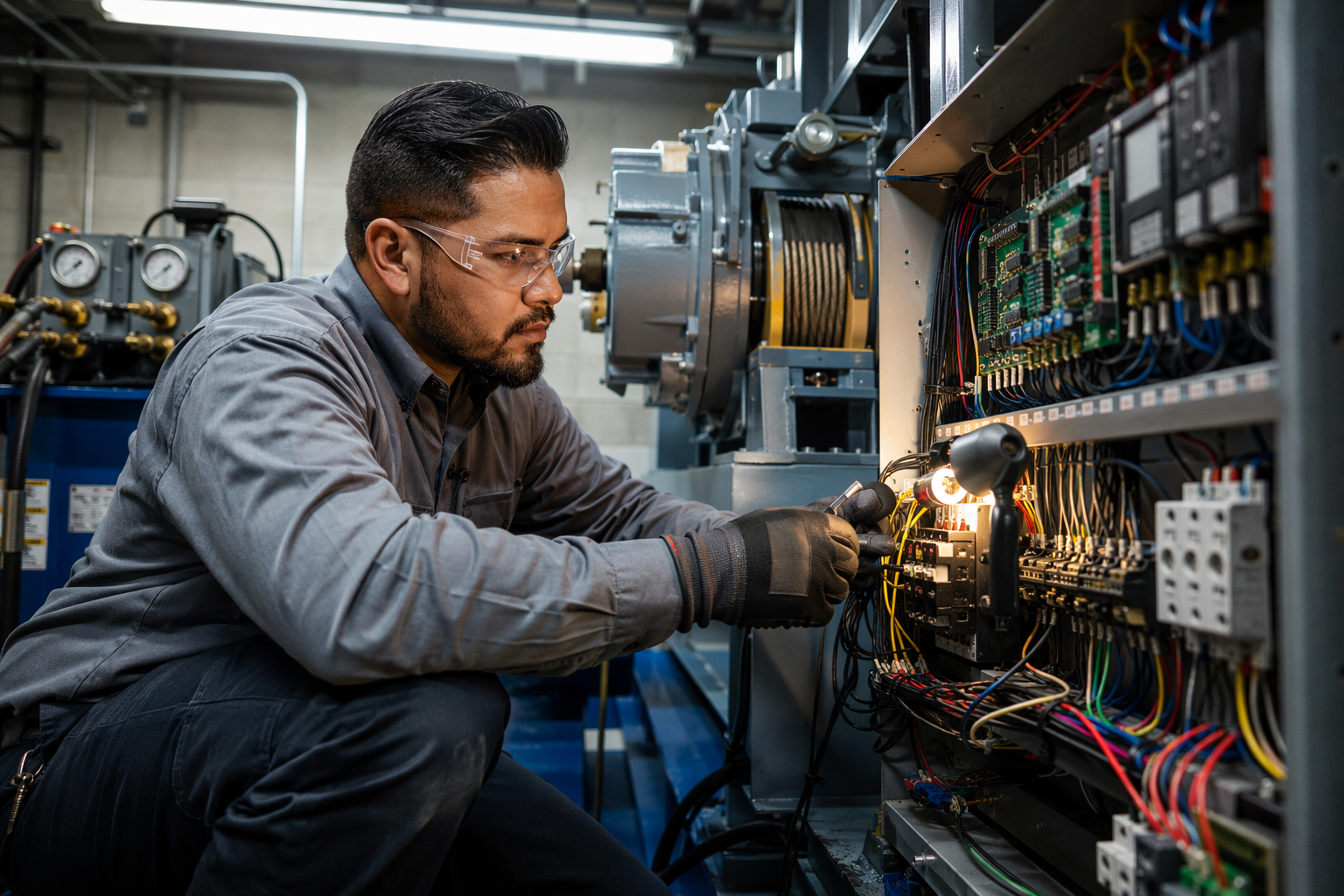
A full maintenance contract is the most comprehensive service agreement available for elevator systems, covering preventive maintenance, all routine labor, most or all parts, emergency callbacks, and repairs needed to maintain safe, code-compliant operation. An oil and grease (O&G) contract, by contrast, is a limited-scope agreement in which the service provider performs only scheduled lubrication, cleaning, and basic operational checks — with any repair work, replacement parts, or emergency calls billed separately to the building owner.
Understanding the practical and financial implications of each contract type is essential for property managers, building owners, and facility directors making decisions in competitive real estate markets such as Houston, Dallas, Austin, San Antonio, Los Angeles, and San Diego. The right choice depends on elevator age, usage volume, budget structure, risk tolerance, and local regulatory requirements.
What Does a Full Maintenance Elevator Contract Actually Include?
A full maintenance contract typically bundles preventive maintenance visits, emergency callback labor, most or all replacement parts, and corrective repairs into a single flat monthly or annual fee.
Under a full maintenance agreement, the service company assumes responsibility for keeping the elevator operational and code-compliant throughout the contract term. Covered items generally include motor and controller inspections, door operator adjustments and parts, brake adjustments, lubrication of all moving components, safety device testing, rope or belt inspections, and emergency callback response for unplanned outages. Some contracts extend coverage to major components such as hoist machines, controllers, and hydraulic power units, while others carve these out as exclusions.
Building owners negotiating a full maintenance contract should request a clear written list of included and excluded parts. Common exclusions even in full maintenance agreements include cab interior finishes, lighting fixtures, vandalism damage, and obsolete or proprietary components that require special-order parts. Reading the exclusion schedule carefully is as important as reviewing the inclusions.
What Does an Oil and Grease Elevator Contract Include?
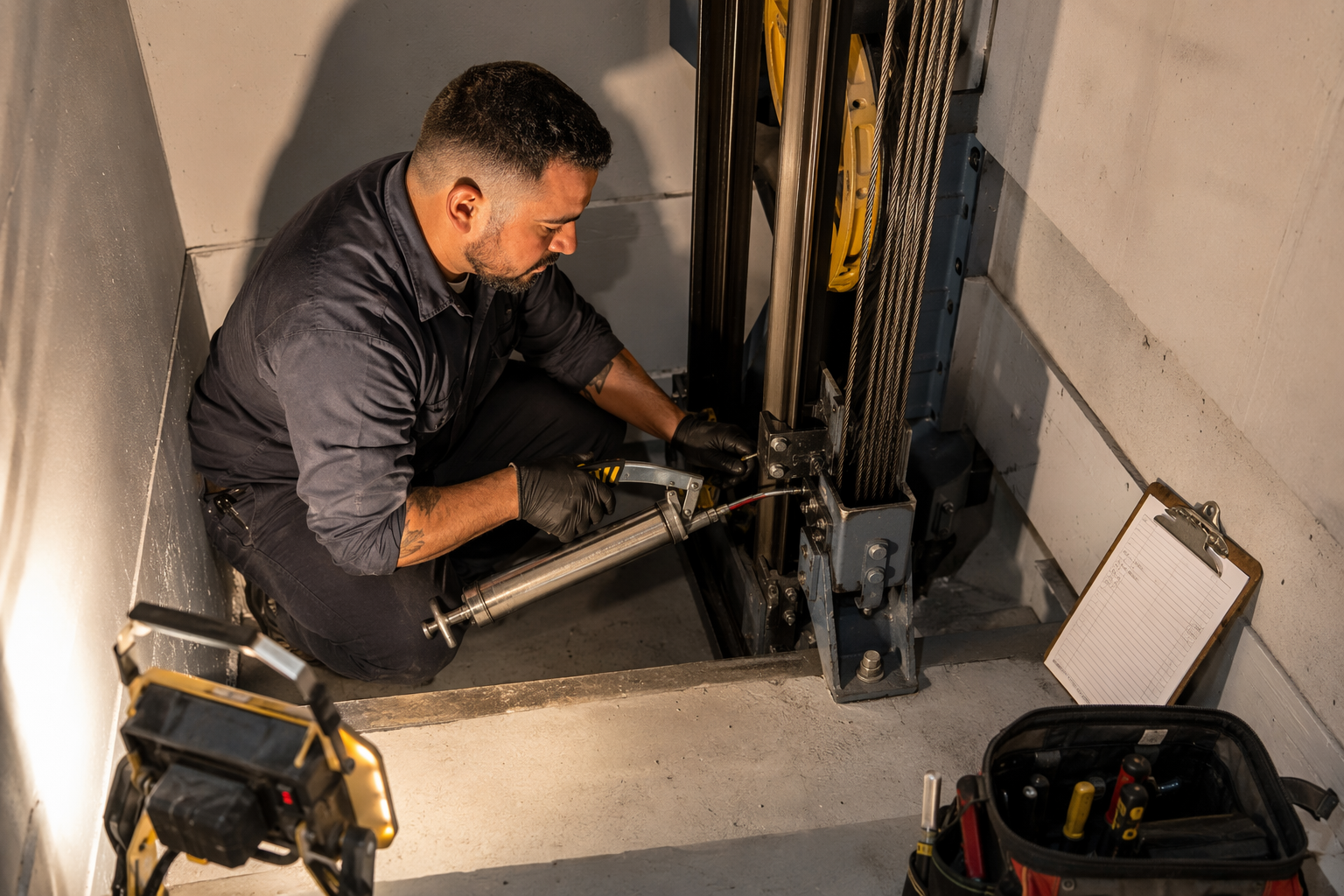
An oil and grease contract covers only scheduled lubrication services, cleaning, and minor adjustments — everything else is a billable extra.
During an O&G visit, a technician will lubricate guide rails, cables, sheaves, and other friction points; clean the machine room and pit; check fluid levels on hydraulic units; and perform a basic operational test. The technician will typically note any deficiencies observed during the visit, but the cost of correcting those deficiencies falls entirely on the building owner as a time-and-materials charge. Emergency callbacks are billed at hourly labor rates, which can be substantially higher than standard rates.
O&G contracts are sometimes chosen by owners of newer elevators still under manufacturer warranty, owners of low-traffic residential elevators with minimal wear, or building operators with in-house maintenance teams capable of handling minor repairs. For high-traffic commercial elevators, the accumulated cost of individual repair invoices frequently exceeds what a full maintenance contract would have cost over the same period.
How Do Full Maintenance and Oil and Grease Contracts Compare Side by Side?
The table below summarizes the key differences between contract types to help property managers make an informed decision.
| Feature | Full Maintenance Contract | Oil & Grease Contract |
|---|---|---|
| Scheduled preventive maintenance visits | Included | Included |
| Lubrication & cleaning | Included | Included |
| Routine adjustments (doors, brakes, limits) | Included | Usually extra |
| Replacement parts (standard) | Included or partially included | Extra (time & materials) |
| Major components (hoist machine, controller) | Often included or negotiable | Extra (time & materials) |
| Emergency callback labor | Included | Extra (billed at field labor rate) |
| Budget predictability | High — fixed monthly cost | Low — variable repair invoices |
| Best suited for | High-traffic, aging, or commercial elevators | New elevators under warranty; very low traffic |
| Owner repair liability | Low (contractor assumes risk) | High (owner assumes all repair risk) |
| Compliance support | Usually included | Limited — owner coordinates separately |
Which Contract Type Is Better for High-Traffic Commercial Buildings?
Full maintenance contracts are generally the better choice for high-traffic commercial buildings because the frequency of wear-related issues makes unpredictable repair costs financially risky for building owners.
Office towers, hotels, hospitals, shopping centers, and multifamily residential buildings with multiple elevator units and daily heavy use will generate far more repair calls than a low-traffic residential installation. Door operators, door contacts, selector systems, and brake components wear proportionally with use cycles. Under an O&G contract, each of these repairs arrives as a separate invoice — often at premium callback labor rates — making annual elevator maintenance costs difficult to forecast and budget. A full maintenance agreement converts these variable costs into a predictable monthly expense, which simplifies capital planning for property managers and asset managers alike.
What Are the Code and Compliance Implications of Each Contract Type?
Regardless of contract type, building owners bear ultimate legal responsibility for maintaining elevators in compliance with applicable codes, including the ASME A17.1 Safety Code for Elevators and Escalators and applicable state and local amendments.
The ASME A17.1 standard governs the design, construction, installation, operation, inspection, testing, maintenance, alteration, and repair of elevators and related conveyances throughout North America. Texas and California both adopt and amend ASME A17.1 through their respective state agencies — the Texas Department of Insurance (TDI) oversees elevator safety in Texas, while the California Division of Occupational Safety and Health (Cal/OSHA) administers elevator safety under the California Elevator Safety Act. Inspection intervals, test frequencies, and documentation requirements derive from these regulatory frameworks.
Under an O&G contract, the burden of scheduling statutory inspections, coordinating required five-year full-load tests and other periodic tests, and ensuring that identified deficiencies are corrected within required timeframes falls squarely on the building owner or their representative. Full maintenance contracts typically include coordination of mandatory inspections and tests as part of the service, reducing compliance risk. Workplace safety obligations under OSHA standards also apply to elevator maintenance environments, and a qualified service provider ensures that maintenance work meets those requirements.
How Do ADA Requirements Factor Into Elevator Maintenance Contracts?
The Americans with Disabilities Act (ADA) requires that elevators providing vertical access in covered facilities remain operational and accessible — placing a compliance burden on building owners that extends directly into maintenance contract decisions.
ADA Standards for Accessible Design specify requirements for elevator cab dimensions, control button placement, door timing, audible signals, and Braille signage. When components related to accessibility — such as door timing sensors, audible annunciators, or floor indicator systems — fail, the building may be out of ADA compliance until repairs are completed. Under a full maintenance agreement, these repairs are typically addressed promptly as part of the contract. Under an O&G contract, the building owner must authorize and pay for each repair individually, potentially extending the period of non-compliance and associated legal exposure.
What Is the Typical Structure of an Elevator Maintenance Contract Term?
Elevator maintenance contracts are typically structured as one-year, three-year, or five-year agreements, with automatic renewal clauses that can significantly affect a building owner’s flexibility.
Longer contract terms generally result in more favorable pricing, but they also reduce a building owner’s ability to switch vendors if service quality declines. Auto-renewal provisions with short notice windows — sometimes as little as 30 to 90 days — are standard in the industry and have caught many property managers off guard. Before signing any elevator maintenance agreement, owners should review the contract term, renewal mechanics, termination for cause provisions, and any price escalation clauses tied to labor cost indices or material costs. This applies equally to full maintenance and O&G agreements.
How Should Building Owners Evaluate What Is Actually Excluded From a Full Maintenance Contract?
Building owners should request and review the exclusion schedule as carefully as the list of inclusions, since broad exclusion language can significantly reduce the practical value of a full maintenance agreement.
Common exclusions across the industry include: structural building components (hoistway walls, pit floors, overhead beams); cab interior finishes, flooring, and lighting; vandalism, misuse, or accident damage; proprietary or obsolete parts that a non-OEM vendor cannot source; modernization components; and violations or corrections required due to changes in code after installation. Some contracts also exclude hydraulic cylinder replacements, which can be among the most expensive single repairs on a hydraulic elevator. Evaluating whether these exclusions represent an acceptable residual risk requires understanding the specific equipment, its age, and its maintenance history.
What Are the Hidden Costs of an Oil and Grease Contract?
The most significant hidden cost of an O&G contract is the accumulation of time-and-materials repair invoices that arrive unpredictably throughout the year, often at premium labor rates for emergency callbacks.
Beyond direct repair costs, O&G contract holders also absorb indirect costs including elevator downtime that affects tenant satisfaction, staff time spent managing vendor communications and invoice approvals, potential penalties or liability exposure during periods of code non-compliance, and the reputational impact of frequent out-of-service units. For multi-elevator properties, these indirect costs can be substantial. A transparent comparison between the annual cost of an O&G contract plus realistic repair estimates versus the annual cost of a full maintenance agreement often reveals that the price difference between contract types is narrower than initially assumed.
When Does an Oil and Grease Contract Make Financial Sense?
An O&G contract makes the most financial sense for elevators that are relatively new, under an active manufacturer warranty, subject to very low traffic, or located in a building where the owner has the in-house technical and administrative capacity to manage repairs independently.
A residential elevator in a single-family home or small low-rise building operated by knowledgeable ownership may accumulate very few repair needs, making the premium cost of a full maintenance contract difficult to justify. Similarly, a recently installed commercial elevator still within its warranty period — during which the manufacturer covers parts and certain repairs — may be best served by an O&G agreement that preserves the warranty relationship and avoids duplicating coverage. The key is an honest assessment of projected repair frequency based on equipment age, manufacturer reliability data, and usage patterns.
How Often Are Maintenance Visits Required Under Each Contract Type?
Visit frequency requirements are driven by applicable state regulations and local authority having jurisdiction (AHJ) rules, and these requirements apply regardless of the contract type chosen.
The ASME A17.1 code establishes maintenance, inspection, and testing requirements that serve as the baseline adopted by Texas and California. State amendments may increase minimum frequency. In Texas, the TDI enforces elevator inspection requirements, typically mandating annual inspections by a licensed elevator inspector. In California, Cal/OSHA requires periodic inspections with certificates of inspection posted in the elevator cab. Both full maintenance and O&G contracts must be structured to meet or exceed these minimum visit frequencies — but full maintenance contracts typically include more frequent planned maintenance visits aligned with equipment-specific needs, while O&G contracts may only provide the minimum required visits.
What Should Building Owners Do When Switching from an O&G Contract to a Full Maintenance Agreement?
Transitioning from an oil and grease contract to a full maintenance agreement requires a structured process to establish baseline equipment condition, negotiate fair contract terms, and avoid gaps in coverage.
- Conduct a condition assessment: Have a qualified elevator technician perform a comprehensive assessment of the elevator’s mechanical, electrical, and safety systems to document existing deficiencies before the new contract takes effect.
- Request a pre-contract deficiency list: Ask the prospective full maintenance contractor to provide a written list of any items they identify as requiring repair before they will assume full maintenance responsibility — this prevents disputes later about whether a failure predated the contract.
- Review the existing contract’s termination provisions: Check the auto-renewal dates and required notice periods on the current O&G contract to avoid inadvertent renewal or early termination penalties.
- Obtain multiple bids: Full maintenance pricing varies significantly by vendor, market, equipment type, and included scope. Comparing at least two to three proposals ensures competitive pricing and clarity on what each agreement covers.
- Verify contractor licensing: In Texas, elevator contractors must be licensed through the TDI. In California, Elevator Mechanic certifications are regulated under Cal/OSHA. Confirm that any contractor holding your maintenance agreement meets applicable state licensing requirements.
- Negotiate transition terms: Request a grace period or reduced rate during the first billing period to allow time for identified pre-existing deficiencies to be addressed without immediately triggering covered-repair obligations.
How Does Elevator Age Affect the Choice Between Full Maintenance and O&G Contracts?
Elevator age is one of the strongest predictors of repair frequency, and it should be a primary factor in contract type selection — older equipment statistically requires more corrective maintenance than newer installations.
Elevators that are more than 15 to 20 years old are more likely to have aging controllers, worn mechanical components, and electrical systems that require repair or modernization. Sourcing parts for older units can be challenging and expensive, particularly for obsolete proprietary components. A full maintenance contract on older equipment provides predictable cost coverage and incentivizes the service company to keep the unit running efficiently. Conversely, an O&G contract on aging equipment can expose building owners to large, unpredictable repair bills. AmeriTex Elevator recommends that owners of elevators approaching or exceeding 20 years of age carefully evaluate whether a full maintenance agreement provides better long-term value than a lubrication-only contract.
What Role Does Elevator Type Play in Contract Selection?
The type of elevator — hydraulic, traction, or machine-room-less (MRL) — influences both the expected maintenance scope and the relative value of each contract type.
Hydraulic elevators have a power unit with a pump, motor, valve assembly, and hydraulic fluid that require regular fluid monitoring and potential replacement, as well as environmental compliance around hydraulic fluid containment. Traction elevators — both geared and gearless — involve hoist machines, wire ropes, sheaves, and counterweight systems with distinct maintenance needs. MRL traction elevators often have proprietary drive and control systems that require technicians trained on specific equipment. These differences affect parts costs, labor complexity, and the probability of needing corrective repairs between scheduled visits. Understanding how these factors apply to the specific equipment in a building is essential to evaluating which contract type provides appropriate coverage.
How Do Texas and California Elevator Regulations Affect Maintenance Contract Requirements?
Both Texas and California have active state-level regulatory frameworks governing elevator safety that impose obligations on building owners independent of the contract type they choose with their service provider.
In Texas, the Elevator Safety Act (Texas Occupations Code, Chapter 754) requires that elevators be maintained in a safe condition and inspected by a licensed elevator inspector. The Texas Department of Insurance administers the associated licensing and inspection certificate programs. In California, the Elevator Safety Act (Health and Safety Code Section 7300 et seq.) assigns regulatory authority to Cal/OSHA, which requires permits, periodic inspections, and certificates of compliance. Both states impose penalties for operating elevators without current inspection certificates. OSHA standards apply federally to the safety of workers performing maintenance tasks. Building owners in Houston, Dallas, Austin, San Antonio, Los Angeles, and San Diego should confirm that their maintenance contractor is current on all applicable state and local licensing requirements.
What Questions Should Building Owners Ask Before Signing Any Elevator Maintenance Contract?
Before committing to either a full maintenance or oil and grease contract, building owners should ask a structured set of questions to ensure the agreement meets their needs and provides genuine value.
Key questions include: What specific parts and components are included and excluded? How is “normal wear” defined versus “damage”? What is the callback response commitment, and how are after-hours callbacks handled? Are inspection coordination and state permit fees included? How are price increases structured over multi-year terms? What happens if a major component — such as a hoist machine or hydraulic cylinder — fails: is that covered or excluded? What are the contract termination provisions, and how much notice is required? Asking these questions in writing and requiring written answers before signing protects building owners from contract language that appears comprehensive but contains significant gaps. AmeriTex Elevator provides prospective clients with transparent scope documentation to support informed decision-making.
How Can Building Owners Verify That Their Elevator Is Being Properly Maintained Under Either Contract?
Verifying adequate maintenance performance requires establishing documentation standards, reviewing service records, and conducting periodic independent evaluations.
Building owners should require that technicians leave a signed service report after every visit documenting work performed, components inspected, lubrication points serviced, and any deficiencies noted. These records should be retained in a physical logbook kept in the machine room, as required by ASME A17.1 maintenance record provisions. Owners can compare service reports across visits to identify patterns of repeated deficiencies or gaps in documented maintenance tasks. Requesting an independent third-party inspection periodically — separate from the contracted service provider — provides an unbiased assessment of equipment condition and maintenance quality. AmeriTex Elevator supports documentation practices aligned with ASME A17.1 requirements across all markets served, including Houston, Dallas, Austin, San Antonio, Los Angeles, and San Diego.
What Are the Key Red Flags in an Elevator Maintenance Contract?
Certain contract provisions — in both full maintenance and O&G agreements — should prompt caution and negotiation before signing.
Red flags to watch for include: automatic renewal periods with very short notice windows (30 days or fewer); broadly written exclusions that effectively convert a “full maintenance” contract into something closer to O&G coverage; language that limits callback response to “normal business hours” without clear definition; provisions allowing unilateral price increases without notice or cap; clauses that void the contract if any third party touches the equipment; and the absence of a performance or termination-for-cause provision. In markets with high real estate activity — such as Houston and Los Angeles — elevator contractors may use standardized form contracts that favor the service company. Independent legal review of any long-term, high-value elevator service agreement is a prudent step for commercial building owners.
How Can Building Owners Reduce Elevator Repair Costs Regardless of Contract Type?
Regardless of which contract type a building owner selects, proactive practices at the building level can reduce overall elevator repair frequency and cost.
Educating building staff and tenants on proper elevator use — avoiding door obstruction, preventing overloading, and reporting unusual sounds or behavior promptly — reduces wear-related failures. Ensuring the machine room is kept clean, dry, and at appropriate temperature reduces stress on electrical and mechanical components. Addressing identified deficiencies promptly, rather than deferring repairs, prevents minor issues from escalating into major failures. Maintaining accurate maintenance records supports warranty claims, insurance adjustments, and future contract negotiations. These practices complement — but do not substitute for — a well-structured maintenance contract with a qualified, licensed service provider.
Get Expert Guidance on the Right Elevator Maintenance Contract
Choosing between a full maintenance contract and an oil and grease agreement is a significant financial and compliance decision. AmeriTex Elevator works with building owners and property managers across Houston, Dallas, Austin, San Antonio, Los Angeles, and San Diego to evaluate equipment condition, explain contract options, and structure agreements that align with both budget and risk tolerance.
Contact AmeriTex Elevator for a free elevator assessment.
Call us today at 866-679-4313 to speak with a qualified service representative about the right maintenance contract for your building.
Need elevator service you can rely on? AmeriTex Elevator is ready to help.