What Is Included in an Elevator Maintenance Contract? A Complete FAQ Guide
Understanding exactly what an elevator maintenance contract covers is essential for building owners, property managers, and facilities directors who want to protect their investment, ensure passenger safety, and stay compliant with federal and state elevator codes. This comprehensive FAQ guide breaks down every component of a standard elevator maintenance agreement — from routine lubrication schedules to emergency callback provisions — so decision-makers in Texas and California can evaluate contracts with confidence.
What is an elevator maintenance contract?
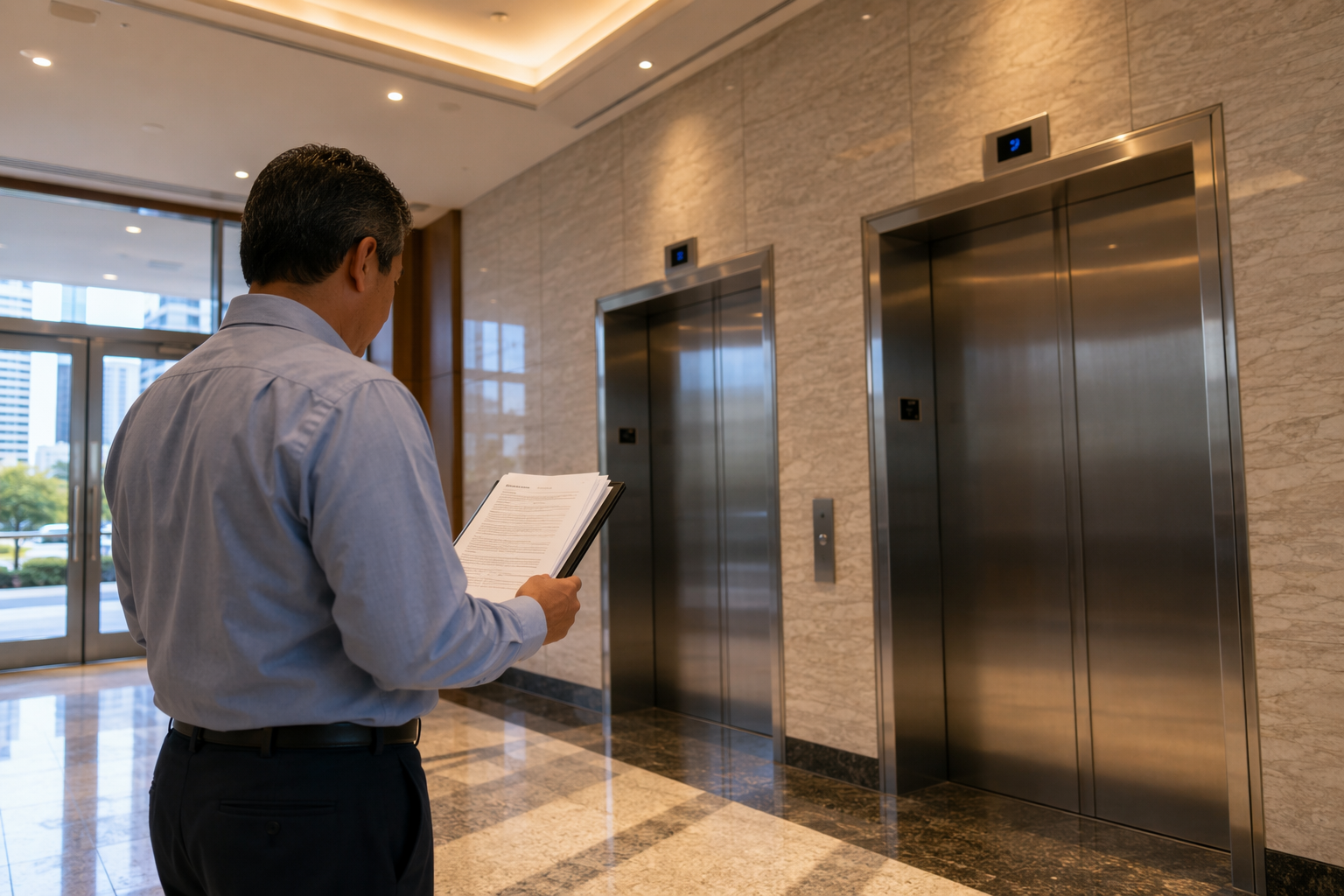
An elevator maintenance contract is a legally binding service agreement between a building owner or property manager and a licensed elevator service company that defines the scope, frequency, and cost of all maintenance, inspection, testing, and repair activities performed on an elevator system.
These agreements are not optional luxuries — they are widely required by local building codes and are central to keeping elevator systems compliant with the ASME A17.1 Safety Code for Elevators and Escalators, the foundational national standard governing elevator safety in the United States. Contracts formalize the relationship between the building owner’s duty of care and the technical expertise of the service provider, creating a clear paper trail for inspections, repairs, and liability purposes.
What core services are included in a standard elevator maintenance contract?
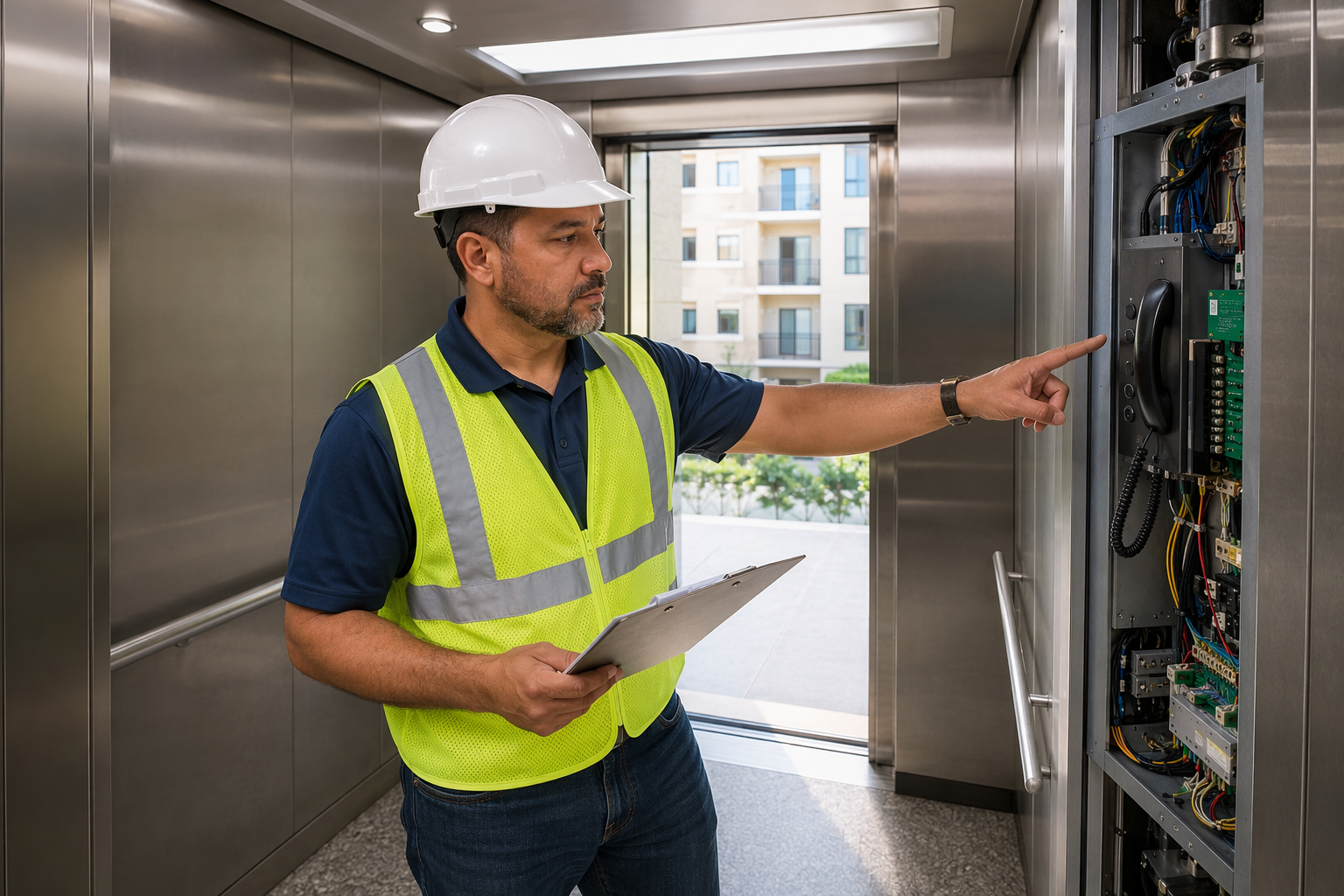
A standard elevator maintenance contract covers scheduled preventive maintenance visits, lubrication and adjustment of moving parts, safety device testing, callback service for breakdowns, and the documentation required to demonstrate regulatory compliance.
Most full-service contracts include the following core elements:
- Preventive maintenance (PM) visits on a defined schedule (monthly, quarterly, or semi-annual depending on building use and elevator type)
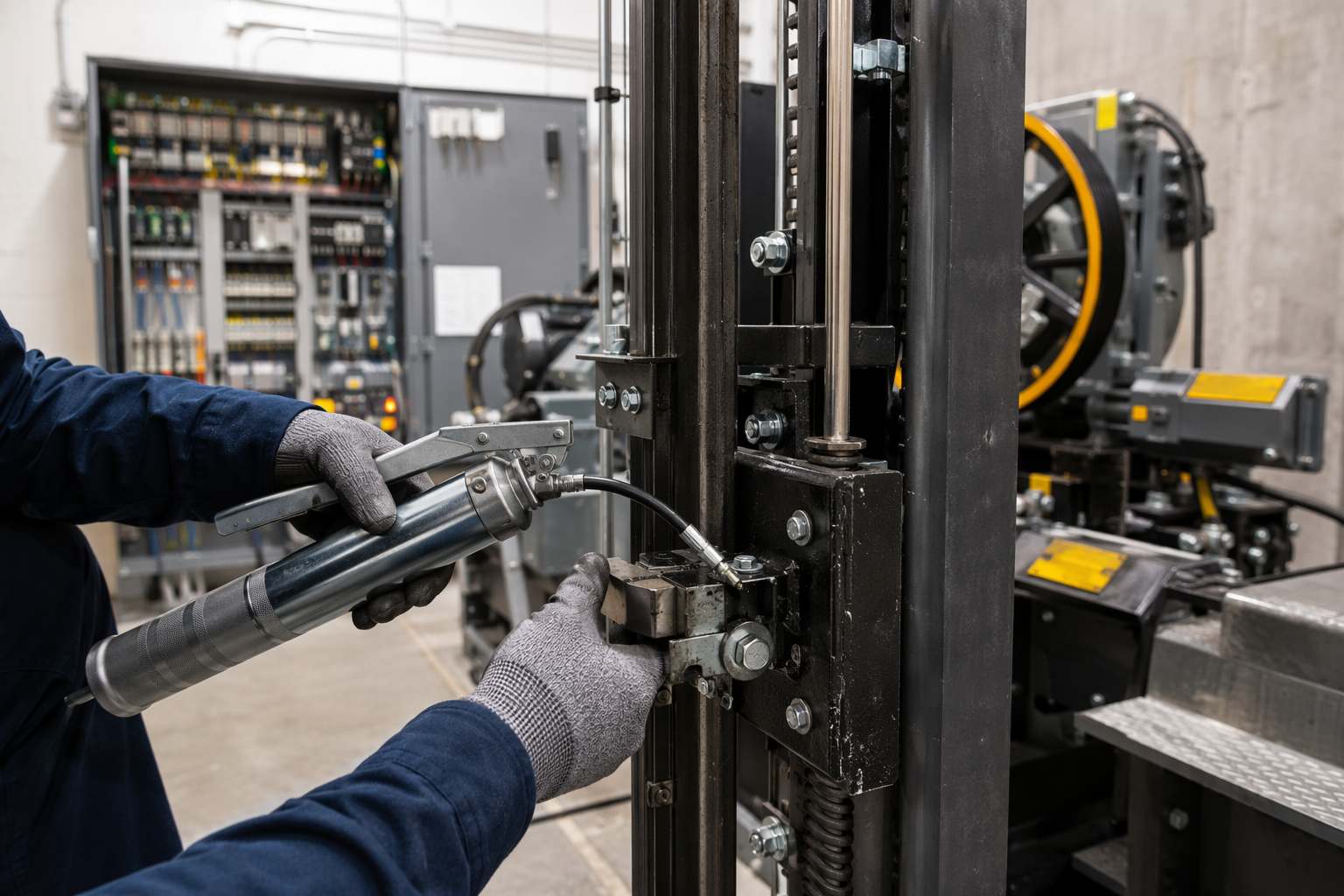
- Lubrication of guide rails, cables, bearings, and mechanical linkages
- Adjustment and calibration of door operators, leveling systems, and limit switches
- Safety device testing including governor, safeties, buffers, and interlocks
- Controller and electrical component inspection
- Emergency lighting and communication system checks
- Callback or emergency response service for unplanned breakdowns
- Maintenance log and service record documentation
The exact scope varies depending on whether the contract is a “full maintenance” agreement or a “periodic maintenance” agreement — a distinction covered in detail below.
What is the difference between a full maintenance contract and a periodic maintenance contract?
A full maintenance contract covers parts, labor, and callbacks under a single monthly fee, while a periodic maintenance contract covers only scheduled inspection and lubrication visits, with parts and additional labor billed separately.
Full maintenance (sometimes called “comprehensive” or “all-inclusive”) contracts are generally recommended for high-traffic buildings — commercial office towers, hospitals, hotels, and apartment complexes — because the predictable monthly cost simplifies budgeting and ensures the service provider has a financial incentive to keep the equipment running efficiently. Periodic or “oil and grease” contracts may be more cost-effective for low-use elevators such as those in small residential buildings or storage facilities where wear rates are minimal.
Building owners should read contract language carefully to confirm exactly which parts categories are covered, which are excluded, and whether major modernization components (cab interiors, hydraulic cylinders, motors) fall under the agreement.
How often are preventive maintenance visits required?
The required frequency of preventive maintenance visits depends on elevator type, usage volume, building classification, and applicable state and local codes — but monthly visits are industry standard for most commercial elevators.
High-traffic elevators in commercial buildings, hospitals, and hotels typically receive monthly maintenance visits. Lower-traffic residential or limited-use elevators may be serviced quarterly. The ASME A17.1 Safety Code for Elevators and Escalators sets baseline maintenance requirements, but Texas and California each have state-specific amendments and inspection frequencies enforced by their respective labor departments. In Texas, elevator inspections are governed by the Texas Department of Insurance (TDI), while in California, the Division of Occupational Safety and Health (Cal/OSHA) oversees elevator safety under Title 8 of the California Code of Regulations.
What safety devices are tested under an elevator maintenance contract?
Maintenance contracts require technicians to regularly test and verify the proper operation of all critical safety devices mandated by the ASME A17.1 code, including the overspeed governor, car and counterweight safeties, oil buffers, final limit switches, door interlocks, and emergency stop switches.
Each of these devices exists to prevent a specific failure mode. The overspeed governor and safeties work together to stop a free-falling car. Door interlocks prevent the elevator from moving unless all hoistway doors are fully closed and locked. Buffer testing ensures the deceleration mechanism at the pit bottom will absorb a car traveling at rated speed. These tests are not performed at every PM visit but are scheduled at code-required intervals, documented, and made available to inspectors. Failure to test and document safety device performance is among the most common reasons elevators receive violations during state inspections.
Does an elevator maintenance contract include compliance with ADA requirements?
A maintenance contract typically ensures that ADA-required features — such as audible signals, Braille call buttons, door reopening devices, and cab dimensions — remain functional, but the contract does not cover ADA retrofit or modernization work needed to bring a non-compliant elevator up to code.
The Americans with Disabilities Act (ADA) mandates that elevators in public accommodations remain accessible and that communication systems, buttons, and signals be maintained in working order. Routine maintenance contracts will include inspection of door reversal devices, audible indicators, and tactile controls as part of the standard PM checklist. However, if a building’s elevator was constructed before current ADA standards and requires physical modifications, that scope falls outside a standard maintenance agreement and must be addressed through a separate modernization or accessibility upgrade project.
What parts and components are typically covered under the contract?
Most full maintenance contracts cover consumable and wear items such as brake linings, drive belts, door rollers, contacts, fuses, lamps, and lubricants, while typically excluding major capital components like motors, controllers, hydraulic cylinders, and cab enclosures.
Contract language around parts coverage is one of the most negotiated areas in elevator service agreements. Building owners should request a clear written list of included and excluded parts categories before signing. Some service providers — including AmeriTex Elevator — offer tiered contract options that allow customers in Houston, Dallas, Austin, San Antonio, Los Angeles, and San Diego to select the level of parts coverage that aligns with their equipment age and risk tolerance.
Is emergency or callback service included?
Most elevator maintenance contracts include some form of callback or emergency response service, though the number of included callbacks per year, after-hours availability, and response expectations can vary significantly between providers and contract tiers.
A callback occurs when an elevator malfunctions between scheduled PM visits and a technician must be dispatched to restore service. Full maintenance contracts generally include an unlimited number of callbacks during normal business hours, with after-hours emergency callbacks sometimes included in premium tiers. Building owners should confirm whether after-hours, weekend, and holiday callbacks are included, whether a callback limit exists, and how “emergency” is defined in the contract. Passenger entrapment situations always require immediate response regardless of contract terms, in accordance with OSHA general duty requirements for employee and public safety.
What documentation and recordkeeping does the contract include?
A properly structured elevator maintenance contract requires the service provider to maintain a maintenance control program (MCP) — a written, systematic record of all maintenance tasks, intervals, and completed service — as mandated by the ASME A17.1 Safety Code for Elevators and Escalators.
The 2019 and subsequent editions of the ASME A17.1 Safety Code for Elevators and Escalators formally require a written Maintenance Control Program for all elevators. This document must be kept on-site in the machine room or a designated location and made available to inspectors on request. The MCP defines what maintenance tasks are performed, at what intervals, and by whom. Service records, test results, and callback logs all feed into this program. Building owners should verify that their contract explicitly includes MCP maintenance and that they retain access to these records if they change service providers.
What happens during a scheduled elevator maintenance visit?
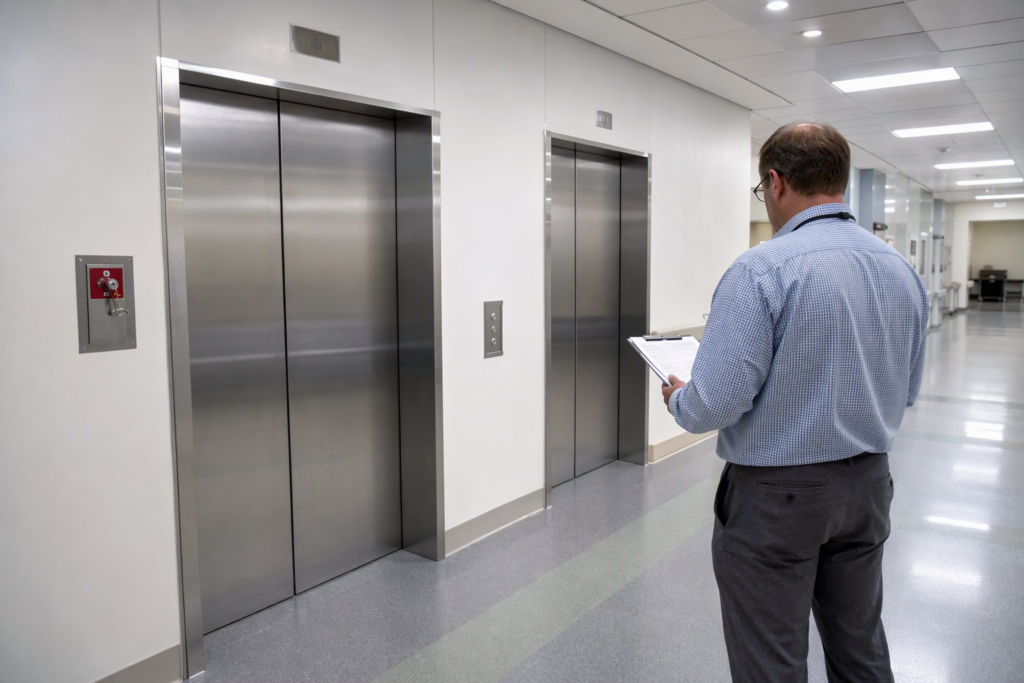
During a scheduled preventive maintenance visit, a certified elevator mechanic inspects, lubricates, tests, and adjusts all major elevator components in a structured sequence designed to identify wear, prevent failures, and ensure code-compliant operation.
A typical maintenance visit follows this sequence:
- Machine room inspection: Check motor, controller, drive unit, brake, and governor for wear, overheating, noise, or oil leaks.
- Overhead inspection: Inspect sheaves, ropes or hydraulic cylinders (depending on type), and counterweight components.
- Hoistway inspection: Examine guide rails, rail lubrication, safeties, limit switches, and compensation equipment.
- Car top inspection: Check car top switches, lighting, door operator, car guide shoes, and rope tension.
- In-car inspection: Test all floor buttons, door open/close buttons, emergency lighting, alarm bell, intercom or phone, and leveling accuracy.
- Pit inspection: Check pit lighting, pit stop switch, buffer condition, sump pump (if applicable), and hydraulic unit (for hydraulic elevators).
- Operational testing: Run the elevator through all floors, test door timing, check leveling at each landing, and verify smooth ride quality.
- Documentation: Complete service report, update MCP records, and note any deficiencies requiring follow-up repair.
Are annual and periodic safety tests included in the maintenance contract?
Annual and periodic safety tests — including Category 1, Category 3, and Category 5 tests as defined by ASME A17.1 — may be included in full maintenance contracts but are sometimes billed separately, so contract language should be reviewed carefully.
ASME A17.1 establishes a tiered testing schedule. Category 1 tests (no-load safety and governor tests) are required annually for traction elevators. Category 5 tests (full-load, rated-speed safety tests) are required every five years and are significantly more involved, often requiring the elevator to be taken out of service for an extended period. Because Category 5 tests involve specialized equipment and potential risk of component wear, some service providers exclude them from standard contracts and invoice them separately. Building owners should confirm in writing how each test category is handled before signing.
How do elevator maintenance contracts differ for hydraulic versus traction elevators?
Hydraulic elevator maintenance contracts emphasize fluid condition, cylinder integrity, and power unit servicing, while traction elevator contracts focus on wire rope condition, sheave wear, brake adjustment, and motor performance — reflecting the fundamentally different mechanical systems involved.
Hydraulic elevators use pressurized fluid to raise and lower the car via a cylinder and piston. Maintenance visits include checking hydraulic fluid levels and condition, inspecting for underground or above-ground cylinder leaks (a significant environmental concern regulated by state environmental agencies in Texas and California), and servicing the power unit pump and valve. Traction elevators use steel wire ropes and a counterweight system driven by a motor and gearbox or gearless drive machine. Their maintenance focuses on rope inspection, groove wear in sheaves, brake adjustment, and controller diagnostics. Machine-room-less (MRL) traction elevators introduce additional considerations around electronic drive systems and remote machine access that technicians must be trained specifically to service.
What exclusions should building owners watch for in elevator maintenance contracts?
Common contract exclusions include vandalism damage, modernization or code upgrade work, cosmetic cab repairs, building-caused damage (water intrusion, power surges), and major capital components such as motors, hydraulic cylinders, and complete controller replacements.
Before signing any elevator maintenance agreement, building owners should request clarity on the following exclusions:
- Acts of vandalism or misuse
- Damage from flooding, fire, or power quality issues
- Code-mandated upgrades and modernization (e.g., fire service, seismic requirements in California)
- Cosmetic or cab interior repairs
- Proprietary parts for elevators installed by certain manufacturers that restrict third-party servicing
- Work performed by non-contract technicians
Understanding exclusions is just as important as understanding inclusions. AmeriTex Elevator provides transparent contract documentation that clearly delineates included and excluded scope, helping property managers in Texas and California avoid unexpected invoices.
Do elevator maintenance contracts cover multiple elevator units in a building?
Yes, maintenance contracts can and typically should cover all elevator units in a building under a single agreement, with pricing structured per unit while allowing coordinated scheduling, shared documentation, and consistent safety standards across the entire vertical transportation system.
Multi-unit buildings — including high-rise office towers, hotels, and large apartment complexes — benefit significantly from a single-vendor contract covering all elevators. This approach ensures that all units receive the same maintenance standard, that service records are centrally managed, and that the service provider develops deep familiarity with the specific equipment mix in the building. It also simplifies coordination during annual inspections and reduces administrative overhead for facilities managers.
How do state regulations in Texas and California affect elevator maintenance contracts?
Texas and California each impose state-specific inspection frequencies, licensing requirements for elevator mechanics, and documentation standards that directly shape what a compliant maintenance contract must include in those jurisdictions.
In Texas, the Texas Department of Insurance (TDI) administers the Elevator Safety Act, which mandates periodic inspections by licensed third-party inspection agencies and requires building owners to maintain a valid elevator inspection certificate. In California, the Division of Occupational Safety and Health (Cal/OSHA) under the Department of Industrial Relations oversees elevator safety under the Elevator Safety Labor Code. California has its own amendments to ASME A17.1 and requires elevators to be inspected annually by a Cal/OSHA-certified inspector. Maintenance contracts for elevators in Los Angeles or San Diego must account for California-specific requirements including seismic safety provisions and state elevator mechanic licensing. Contracts for elevators in Houston, Dallas, Austin, or San Antonio must align with TDI inspection schedules and Texas administrative code. AmeriTex Elevator holds the applicable state certifications required to service elevators across both Texas and California, ensuring maintenance agreements automatically reflect local regulatory requirements.
How should a building owner evaluate and compare elevator maintenance contract proposals?
Building owners should compare proposals across six key dimensions: scope of included services, parts coverage categories, callback terms, documentation practices, technician qualifications, and contract exit provisions — using a structured comparison rather than evaluating on price alone.
The following table provides a benchmark comparison framework for evaluating elevator maintenance contract proposals:
| Evaluation Criterion | Full Maintenance Contract | Periodic Maintenance Contract | Questions to Ask the Vendor |
|---|---|---|---|
| PM Visit Frequency | Monthly (typical for commercial) | Quarterly or semi-annual | How many visits per year are guaranteed? |
| Parts Coverage | Wear items included; major components negotiable | Labor only; parts billed separately | Which parts categories are explicitly included/excluded? |
| Callbacks | Unlimited or defined number included | Billed per callback | Are after-hours callbacks included? Is there a limit? |
| Safety Testing (Cat 1/5) | Often included in premium tiers | Typically billed separately | Are Category 1 and Category 5 tests included or extra? |
| MCP Documentation | Provided and maintained on-site | Basic records only | Who owns the MCP? Can you access it if you change vendors? |
| ADA Feature Maintenance | Included in PM checklist | Inspected but not always repaired | Are ADA-required device repairs included or excluded? |
| Contract Term & Exit Clause | Typically 1–3 years with termination notice | Often shorter term, more flexible | What is the notice period to terminate? Are there penalties? |
| State Compliance Coverage | Should include jurisdiction-specific requirements | May not address state-specific code amendments | Does the contract explicitly reference TX or CA state codes? |
What qualifications should elevator maintenance technicians have?
Elevator maintenance technicians should be licensed elevator mechanics under applicable state law, trained in accordance with ASME A17.1 standards, and where applicable, hold certifications recognized by their state’s elevator safety authority.
In Texas, elevator mechanics must be licensed by the Texas Department of Insurance. In California, elevator mechanics must be certified under the Cal/OSHA elevator mechanic certification program. Beyond state licensing, many service companies employ technicians trained through the National Elevator Industry Educational Program (NEIEP) or equivalent apprenticeship programs. Building owners should ask any prospective service provider to confirm that all technicians dispatched to their property hold the appropriate state licenses for the jurisdiction in which the building is located. This is a non-negotiable compliance requirement, not simply a quality differentiator.
What should building owners do if their elevator fails between maintenance visits?
If an elevator fails between scheduled maintenance visits, building owners should immediately follow a defined emergency protocol to ensure passenger safety, notify the maintenance contractor, and document the event for compliance and insurance purposes.
- If passengers are trapped: Contact emergency services (911) immediately. Do not attempt to open doors or extract passengers without trained personnel.
- Take the elevator out of service: Post signage and disable the elevator at the lobby panel to prevent further use until the malfunction is assessed.
- Contact the maintenance contractor: Notify the service provider via the emergency callback line specified in the contract.
- Document the incident: Record the date, time, nature of the failure, and any passenger involvement. Photograph any visible damage or unusual conditions.
- Do not restore service independently: The elevator should not be returned to service until a licensed elevator mechanic has inspected and cleared it.
- Notify the state elevator authority if required: Certain malfunctions — particularly those involving personal injury — may require notification to TDI (Texas) or Cal/OSHA (California).
- File an incident report: Retain all documentation in your elevator maintenance file alongside the MCP records.
How does an elevator maintenance contract affect building liability and insurance?
A well-documented elevator maintenance contract significantly reduces a building owner’s liability exposure by demonstrating a structured duty of care, and many commercial property insurers require proof of a current maintenance agreement as a condition of coverage.
Courts and insurance adjusters examining elevator injury claims consistently look at whether the building owner maintained the elevator in accordance with applicable codes and manufacturer recommendations. A complete service record — including signed PM reports, safety test results, callback logs, and a current MCP — provides the documentation trail needed to demonstrate reasonable care. Conversely, gaps in maintenance records or the absence of a formal contract can increase both legal liability and insurance premiums. Building owners in Houston, Dallas, Austin, San Antonio, Los Angeles, and San Diego should verify with their insurance broker that their elevator maintenance coverage meets policy requirements.
When should a building owner consider replacing or upgrading the maintenance contract?
Building owners should review and consider upgrading their elevator maintenance contract when elevator equipment ages beyond its designed service life, when the frequency of breakdowns increases, when a code-mandated upgrade is required, or when the current contract no longer reflects the building’s occupancy and usage patterns.
As elevator equipment ages — particularly systems more than 20 years old — the risk profile changes significantly. Older controllers, hydraulic systems, and mechanical components may require more frequent attention than a basic periodic contract provides. In these situations, upgrading to a full maintenance agreement or initiating a modernization discussion ensures that maintenance coverage remains aligned with actual equipment needs. AmeriTex Elevator offers contract review consultations for building owners in Texas and California who want an independent assessment of whether their current agreement provides adequate coverage for their equipment’s condition and usage level.
How can building owners get started with an elevator maintenance contract through AmeriTex Elevator?
Building owners can initiate an elevator maintenance agreement with AmeriTex Elevator by requesting a free on-site assessment, during which a qualified technician evaluates the current condition of the elevator system and recommends the appropriate contract tier and service frequency.
AmeriTex Elevator serves commercial and residential properties across Houston, Dallas, Austin, San Antonio, Los Angeles, and San Diego, providing maintenance contracts calibrated to both Texas and California regulatory requirements. The assessment process identifies any existing deficiencies, documents the current maintenance status, and provides a clear foundation for building a contract that protects the building owner’s compliance obligations, passenger safety, and long-term equipment investment.
Get a Free Elevator Assessment Today
Don’t leave elevator safety and compliance to chance. Contact AmeriTex Elevator for a free elevator assessment and a customized maintenance contract proposal tailored to your building’s equipment, usage, and local regulatory requirements in Texas and California.
Call AmeriTex Elevator: 866-679-4313
Serving Houston TX, Dallas TX, Austin TX, San Antonio TX, Los Angeles CA, and San Diego CA.
Need elevator service you can rely on? AmeriTex Elevator is ready to help.