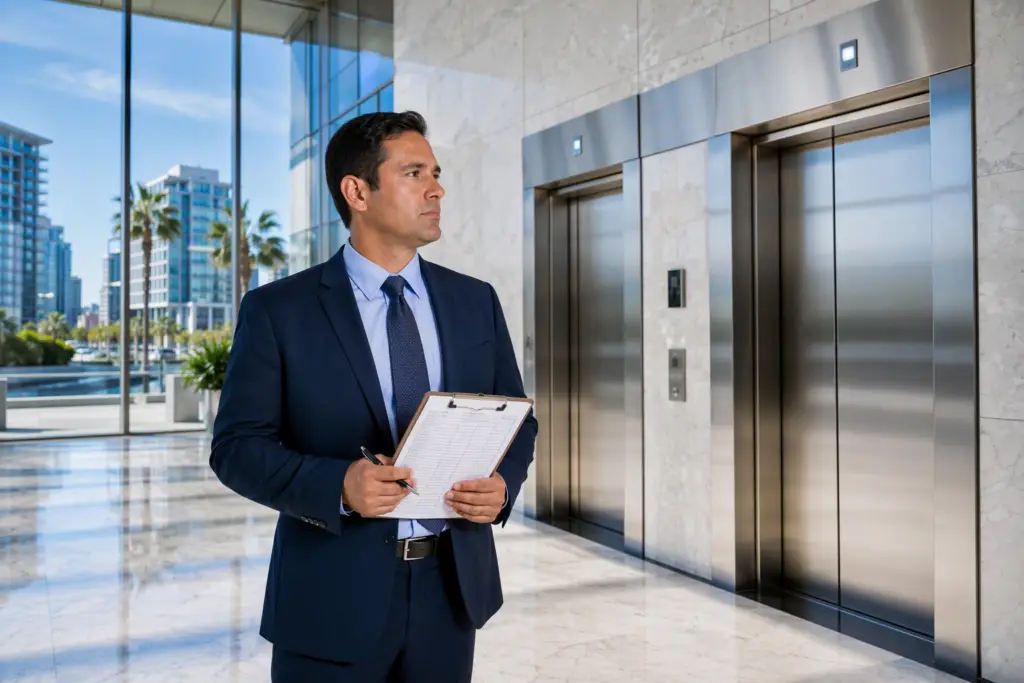

Choosing the wrong elevator maintenance contract can quietly drain a building’s operating budget or leave ownership exposed to large, unplanned repair bills. This guide breaks down both contract structures, compares their true costs and risk profiles, and provides a decision framework suited to different building types — from mid-rise office towers to residential condominiums.
What Is a Full-Service Elevator Maintenance Contract?
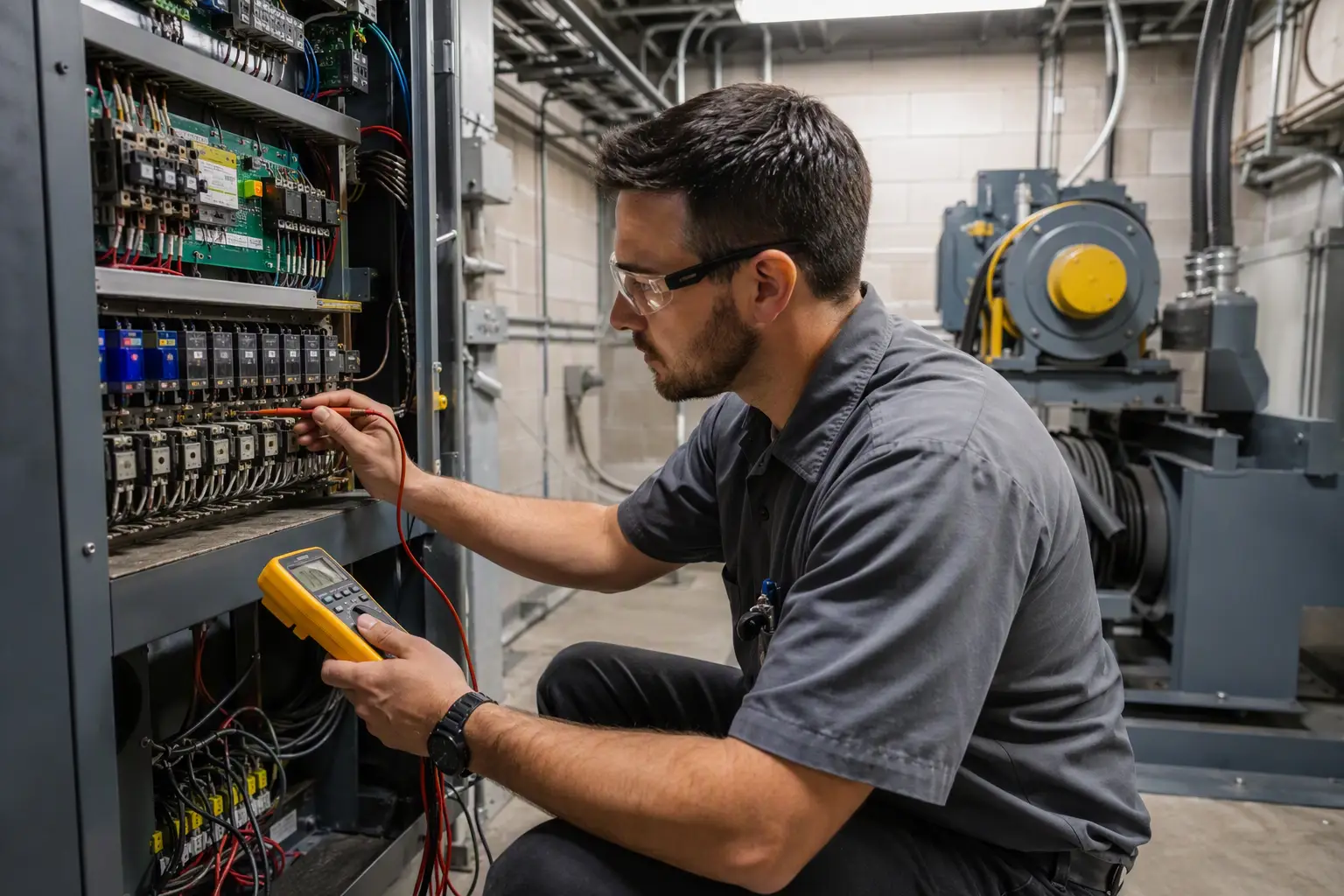
A full-service (sometimes called “comprehensive” or “all-inclusive”) elevator maintenance contract covers routine preventive maintenance and the cost of most replacement parts and labor when components fail. Under this structure, the service provider assumes the financial risk of parts wear and breakage in exchange for a higher recurring monthly or annual premium.
Full-service contracts typically cover:
- Scheduled preventive maintenance visits
- Emergency callbacks
- Replacement of worn mechanical and electrical components
- Labor for unscheduled repairs
- Regulatory compliance documentation support
What full-service contracts commonly exclude:
- Vandalism or misuse damage
- Cab interior cosmetic repairs
- Major modernization projects
- Damage from building flooding or fire
What Is a Parts-and-Labor Elevator Contract?
A parts-and-labor (P&L) contract — also called a “maintenance-only” or “oil-and-grease” contract — covers scheduled preventive maintenance visits and the labor associated with those visits. When a component fails outside of routine maintenance, the building owner pays separately for both the replacement part and the technician time to install it.
Parts-and-labor contracts typically cover:
- Scheduled lubrication, inspection, and adjustments
- Labor for routine maintenance visits
- Basic safety testing as required by applicable codes
Parts-and-labor contracts commonly exclude:
- Replacement parts of any kind
- Emergency callback labor beyond a set number of visits
- Controller board replacements
- Motor and hydraulic pump repairs
How Do the Two Contract Types Compare Side by Side?
| Factor | Full-Service Contract | Parts-and-Labor Contract |
|---|---|---|
| Monthly Premium | Higher fixed cost | Lower fixed cost |
| Unexpected Repair Bills | Mostly absorbed by provider | Paid entirely by building owner |
| Budget Predictability | High — costs are fixed | Low — costs vary by equipment condition |
| Best Equipment Age | Older or mid-life equipment (higher parts risk) | Newer equipment under manufacturer warranty |
| Best Usage Volume | High-traffic buildings | Low-traffic or single-elevator buildings |
| Provider Incentive | Provider profits by keeping equipment healthy | Provider profits on each repair call |
| Compliance Documentation | Often included | May be billed separately |
| Risk Holder | Service provider | Building owner |
| Contract Flexibility | Longer terms common (2–5 years) | Shorter terms more available |
| Ideal For | HOAs, hospitals, hotels, older office stock | New construction, low-rise, owner-managed buildings |
What Are the Pros and Cons of Each Contract Type?
Full-Service Contract — Pros and Cons
| Pros | Cons |
|---|---|
| Predictable monthly operating cost | Higher baseline premium |
| No surprise invoices for worn parts | Provider may use lower-cost replacement components |
| Provider is incentivized to perform thorough PM | Contracts can be difficult to exit early |
| Reduces administrative burden on property managers | Exclusions (vandalism, modernization) still apply |
| Supports compliance with inspection schedules | May bundle services you do not need |
Parts-and-Labor Contract — Pros and Cons
| Pros | Cons |
|---|---|
| Lower monthly fixed expense | Large repair invoices possible at any time |
| Good fit for newer equipment still under warranty | Budgeting for capital reserves becomes complicated |
| Shorter contract terms often available | Emergency callback costs add up in high-use buildings |
| Flexibility to source parts independently | Provider has less financial stake in PM quality |
| Transparent per-repair pricing | Requires knowledgeable property management oversight |
Which Contract Type Is Right for My Building’s Equipment Age?
Equipment age is one of the most reliable predictors of which contract delivers better value. As elevator components age, the probability of wear-related failures increases. Hydraulic seals, controller boards, door operators, and motor windings all have service lives that can be affected by usage volume, environmental conditions, and maintenance history.
Buildings with equipment that has seen many years of service tend to benefit from the cost protection a full-service contract provides. Conversely, a building that has recently installed new equipment — or recently completed a full modernization — often finds that a parts-and-labor contract is sufficient for the early years when manufacturer warranties may still apply.
It is worth confirming any applicable manufacturer warranty terms before signing either contract type, since some warranties require maintenance by a certified provider to remain valid.
How Do Compliance Requirements Affect My Contract Choice?
Elevator compliance is non-negotiable. In the United States, elevator safety is governed primarily by the ASME A17.1 Safety Code for Elevators and Escalators, which establishes inspection and testing requirements. Most jurisdictions adopt ASME A17.1 or a state-specific variant of it.
Accessibility requirements for elevators in buildings open to the public are also addressed under the Americans with Disabilities Act (ADA), and workplace elevator safety considerations may intersect with OSHA standards depending on building type.
Key compliance considerations when choosing a contract:
- Annual inspections: Most jurisdictions require periodic third-party inspections. A full-service contract often includes documentation support; a P&L contract may not.
- Test witnessing: Required safety tests (such as Category 1 and Category 5 tests under ASME A17.1) need to be scheduled and supported. Clarify which contract type includes this coordination.
- Corrective work orders: When an inspection uncovers deficiencies, corrective repairs must be completed within the jurisdiction’s timeframe. A full-service contract typically covers most corrective labor and parts; a P&L contract does not.
- Record keeping: ASME A17.1 requires maintenance logs. Confirm which party is responsible for maintaining these under your contract structure.
What Should I Look for in the Contract Language Before Signing?
Before executing either contract type, building owners and property managers should scrutinize the following clauses:
- Define “full service” precisely. Ask the provider to list, in writing, every component category that is included and excluded. Vague language such as “all normal wear parts” can lead to disputes.
- Review the callback policy. Understand how many emergency callbacks per year are included at no additional charge, and what the billing rate is for callbacks beyond that threshold.
- Examine auto-renewal and termination clauses. Many elevator contracts auto-renew for multi-year terms with significant early-termination penalties. Know your exit options before signing.
- Check parts sourcing language. Full-service contracts sometimes allow providers to use refurbished or non-OEM components. If equipment age or warranty status matters, negotiate original-manufacturer-equivalent parts language.
- Confirm regulatory compliance support. Specify which party schedules inspections, coordinates test witnesses, and maintains the required maintenance log.
- Clarify modernization exclusions. Neither contract type typically covers major modernization work. Confirm this boundary so capital planning can account for it.
- Ask about subcontracting. Some providers subcontract maintenance to third parties. Understand who will actually service your equipment and what qualifications they hold.
- Understand price escalation terms. Multi-year contracts often include annual price escalation provisions. Know the cap or formula in advance.
Is a Full-Service Contract Always More Expensive Over Time?
Not necessarily. The total cost of ownership under a parts-and-labor contract is difficult to predict because it depends on how often components fail, current parts pricing, and labor rates at the time of each repair. A single major repair event — such as a controller board replacement or hydraulic pump failure — can produce an invoice that exceeds an entire year’s premium difference between the two contract types.
The value proposition of a full-service contract is not simply paying less; it is transferring financial risk and achieving cost certainty. For building owners operating on fixed budgets, managing capital reserve funds, or overseeing buildings where elevator downtime creates significant tenant dissatisfaction, that certainty has real operational value beyond the raw numbers.
What Questions Should I Ask Elevator Service Providers Before Choosing a Contract?
When evaluating providers and contract options, building owners should ask the following:
- What specific parts and labor are excluded from your full-service agreement?
- How do you handle repairs that fall in a gray area between “maintenance” and “modernization”?
- What is your callback response process, and how is emergency service dispatched?
- Who maintains our maintenance log and inspection records?
- What happens to our contract if you are acquired by another company?
- Can we audit the maintenance log at any time?
- How are price escalations structured in a multi-year agreement?
- What is the process for disputing a repair invoice or parts charge?
How Does Building Type Influence the Right Contract Choice?
Building use and occupancy patterns directly affect elevator wear rates and the frequency of service calls. Consider these scenarios:
| Building Type | Typical Usage Pattern | Recommended Contract Approach |
|---|---|---|
| High-rise residential / HOA | Constant daily use, multiple units dependent on elevator | Full-service — cost predictability and uptime priority |
| Class A office tower | Peak morning/evening loads, tenant lease obligations | Full-service — downtime has lease and reputation consequences |
| Hospital or healthcare facility | 24/7 critical use | Full-service — compliance and uptime are non-negotiable |
| Hotel or hospitality | Variable seasonal load, guest experience priority | Full-service recommended; P&L viable for newer installs |
| Low-rise retail or mixed-use | Moderate, business-hours use | P&L viable if equipment is newer; full-service for older stock |
| New construction (first 3–5 years) | Break-in period, manufacturer warranty active | P&L may be sufficient — verify warranty terms |
| Warehouse or industrial | Heavy freight loads, less frequent but demanding use | Full-service — mechanical stress increases parts risk |
What Steps Should I Follow to Evaluate and Switch Elevator Contracts?
- Audit your current equipment. Document the age, model, maintenance history, and any open repair items for every elevator in your building. This establishes your baseline risk profile.
- Review your current contract for termination terms. Identify the notice period required, any early-termination fees, and the contract’s renewal date.
- Request proposals from multiple qualified service providers. Ask for both full-service and parts-and-labor quotes so you can compare structures side by side.
- Define your building’s operational priorities. Determine whether budget predictability, minimizing downtime, or lowest possible fixed cost is the primary goal for your ownership or management team.
- Analyze the exclusions list for each proposal. A full-service contract with an extensive exclusions list may offer less protection than it appears.
- Consult your property insurance carrier. Some policies have provisions related to elevator maintenance documentation; confirm your chosen contract structure satisfies those requirements.
- Negotiate key terms before signing. Auto-renewal clauses, price escalation caps, and callback limits are often negotiable, particularly for multi-elevator buildings.
- Execute the new contract with a clear transition plan. Confirm how maintenance records will be transferred from the outgoing provider and establish a schedule for the new provider’s initial inspection.
Why Work with an Independent Elevator Service Company?
Building owners have a choice between manufacturer-affiliated service providers and independent elevator service companies. Independent providers — such as AmeriTex Elevator — are not contractually tied to any single equipment manufacturer, which means they can service a wide range of elevator brands and source components without being restricted to a single supply chain.
AmeriTex Elevator is a certified elevator service company serving building owners and property managers across its service area. AmeriTex Elevator offers both full-service and parts-and-labor contract structures, allowing clients to select the agreement type that best matches their equipment profile, budget, and operational requirements. Because AmeriTex Elevator operates as an independent provider, recommendations are based on the building’s actual needs rather than manufacturer-driven sales incentives.
Working with AmeriTex Elevator means building owners receive a transparent review of both contract options, a clear explanation of what each agreement covers and excludes, and ongoing support for regulatory compliance documentation as required under the ASME A17.1 Safety Code for Elevators and Escalators.
What Are the Most Common Mistakes Building Owners Make When Choosing an Elevator Contract?
Understanding what to avoid is as important as knowing what to look for. Common errors include:
- Choosing based on monthly premium alone without accounting for the total cost of ownership including potential parts expenses under a P&L structure.
- Not reading the exclusions list on a full-service contract, which can make a comprehensive agreement appear more inclusive than it actually is.
- Signing long-term contracts without flexibility provisions, leaving buildings locked in for years after equipment has been modernized or usage patterns have changed.
- Neglecting compliance documentation requirements and discovering during an inspection that maintenance records are incomplete.
- Assuming all full-service contracts are equivalent — coverage scope varies significantly between providers and must be compared line by line.
- Failing to account for elevator age when selecting a parts-and-labor contract, which can result in unexpected repair costs shortly after signing.
Decision Summary: Which Contract Is Right for You?
| If Your Situation Is… | Consider This Contract Type |
|---|---|
| Equipment is older or has a history of frequent repairs | Full-Service |
| Building operates on a fixed annual budget | Full-Service |
| High-traffic use or 24/7 operation | Full-Service |
| Tenant or resident satisfaction is tied to uptime | Full-Service |
| Equipment is new or recently modernized | Parts-and-Labor |
| Building has strong capital reserves for repairs | Parts-and-Labor |
| Low-traffic, single-elevator building | Parts-and-Labor |
| Property management team has technical oversight capacity | Parts-and-Labor |
Get Expert Guidance Before You Sign
Selecting the right elevator maintenance contract is a decision that affects operating budgets, tenant experience, and regulatory compliance for years. AmeriTex Elevator’s team reviews your existing equipment, usage patterns, and contract history to provide a clear, no-pressure recommendation — whether a full-service or parts-and-labor agreement best serves your building.
Contact AmeriTex Elevator for a free elevator assessment: 866-679-4313
Need elevator service you can rely on? AmeriTex Elevator is ready to help.