What Happens If My Elevator Fails Inspection in Texas or California — And How Do I Get It Back in Service Fast?
When an elevator fails its annual or periodic safety inspection in Texas or California, the consequences move quickly. The inspecting authority posts an out-of-service notice, building owners face potential liability exposure, and tenants or residents lose access to a critical vertical transportation asset. Understanding the exact regulatory sequence — and the fastest compliant path back to operation — is essential for every building owner, facilities manager, and property manager in Houston, Dallas, Austin, San Antonio, Los Angeles, and San Diego.
What exactly happens the moment an elevator fails inspection?
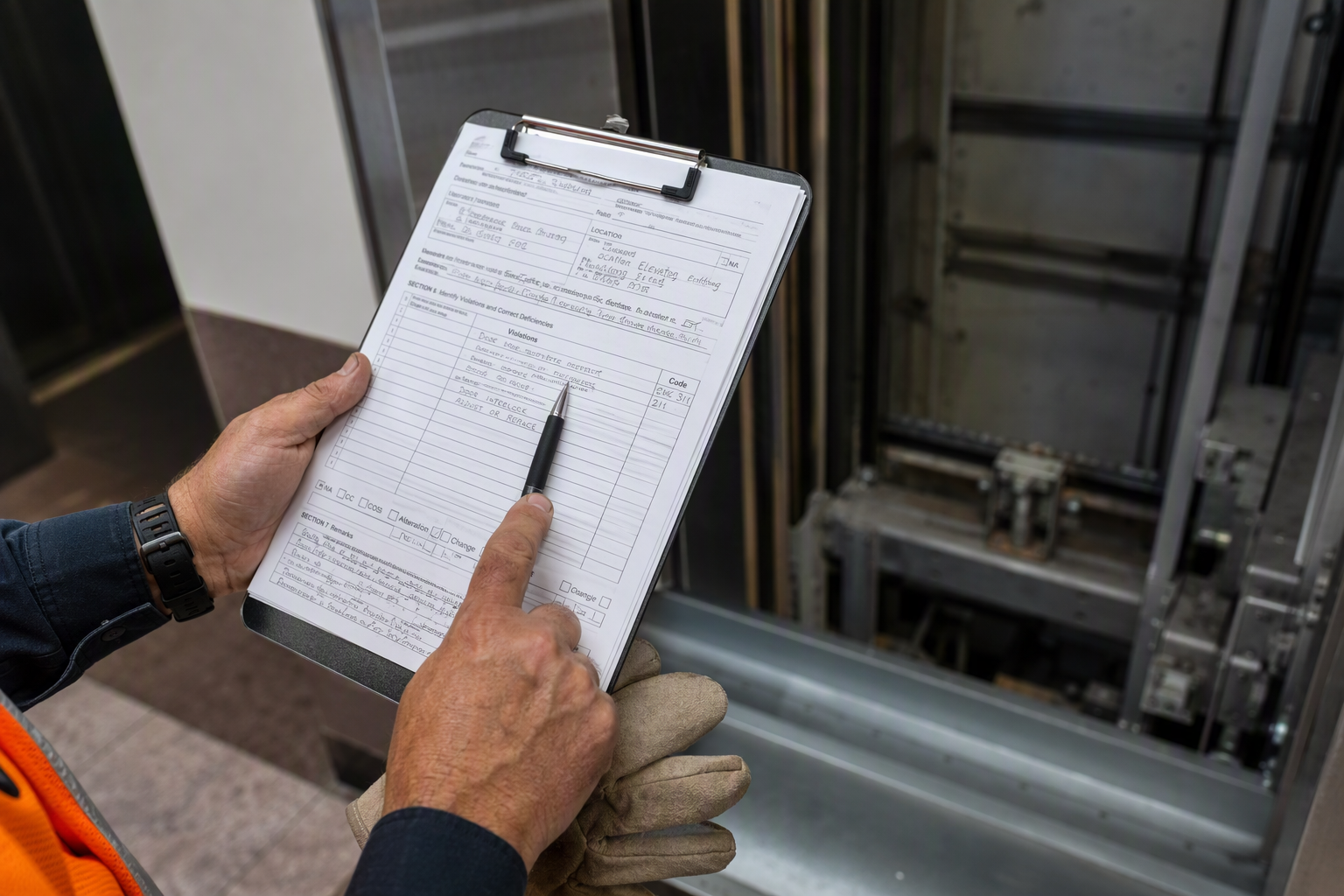
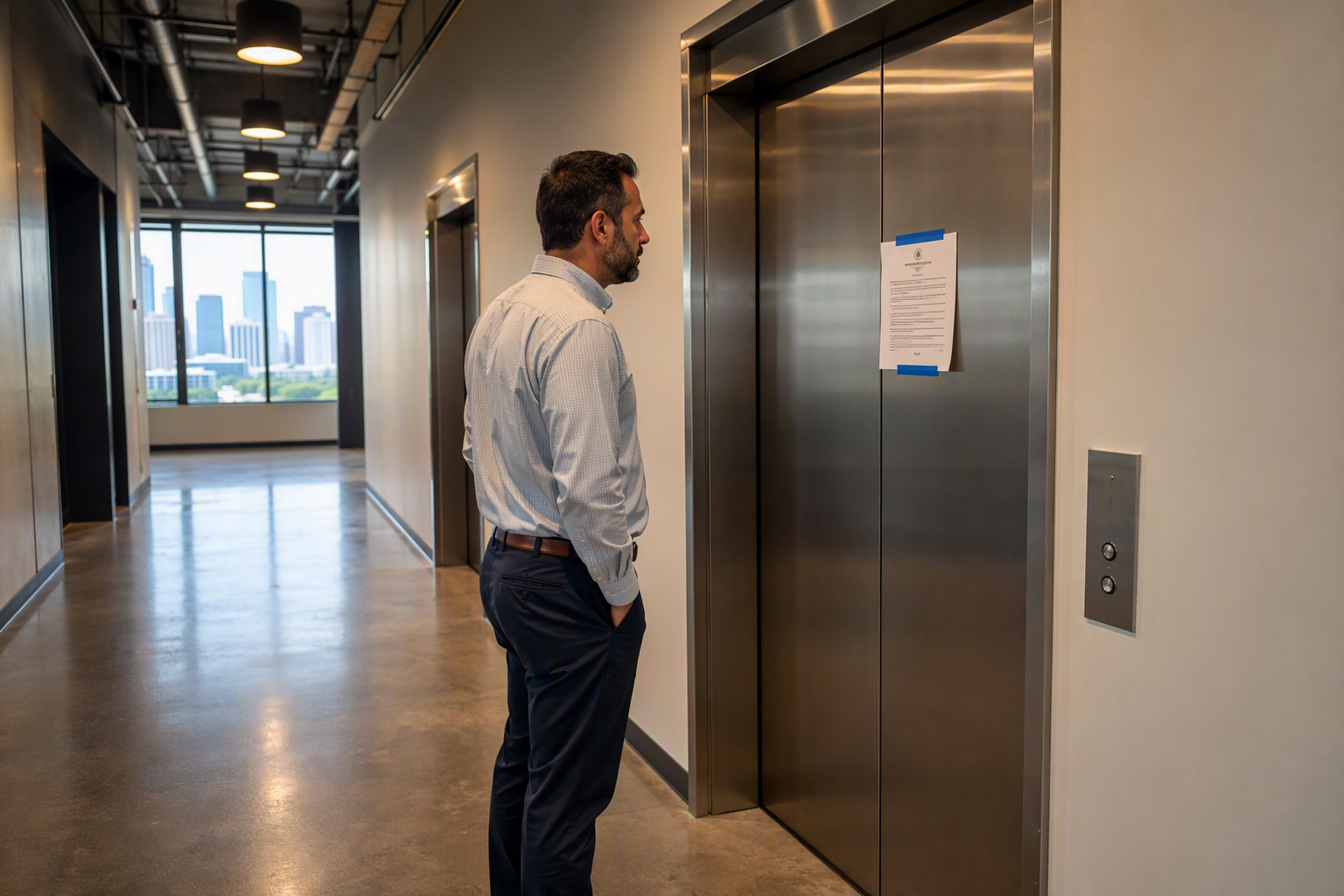
The inspecting authority immediately issues a written violation report and, depending on the severity of deficiencies, may affix an out-of-service or “unsafe” placard to the elevator cab, legally prohibiting its use until corrections are verified.
In Texas, elevator inspections are governed by the Texas Department of Insurance (TDI) under the Elevator Safety Act, Texas Occupations Code Chapter 754. In California, the Division of Occupational Safety and Health (Cal/OSHA) Elevator Unit administers the Elevator Safety Law under California Labor Code. In both states, an inspector who finds a condition that poses an imminent hazard — such as a broken safety device, failed governor, or defective door interlock — has the authority to order immediate shutdown without waiting for the building owner to respond. Less critical violations may result in a conditional permit with a compliance deadline rather than an immediate stop-work order.
The written report itemizes each deficiency by code section, typically referencing the ASME A17.1 Safety Code for Elevators and Escalators (for new installations) or ASME A17.3 Safety Code for Existing Elevators and Escalators (for existing equipment). Building owners must retain this report and provide a copy to their elevator contractor immediately.
What are the most common reasons elevators fail inspection in Texas and California?
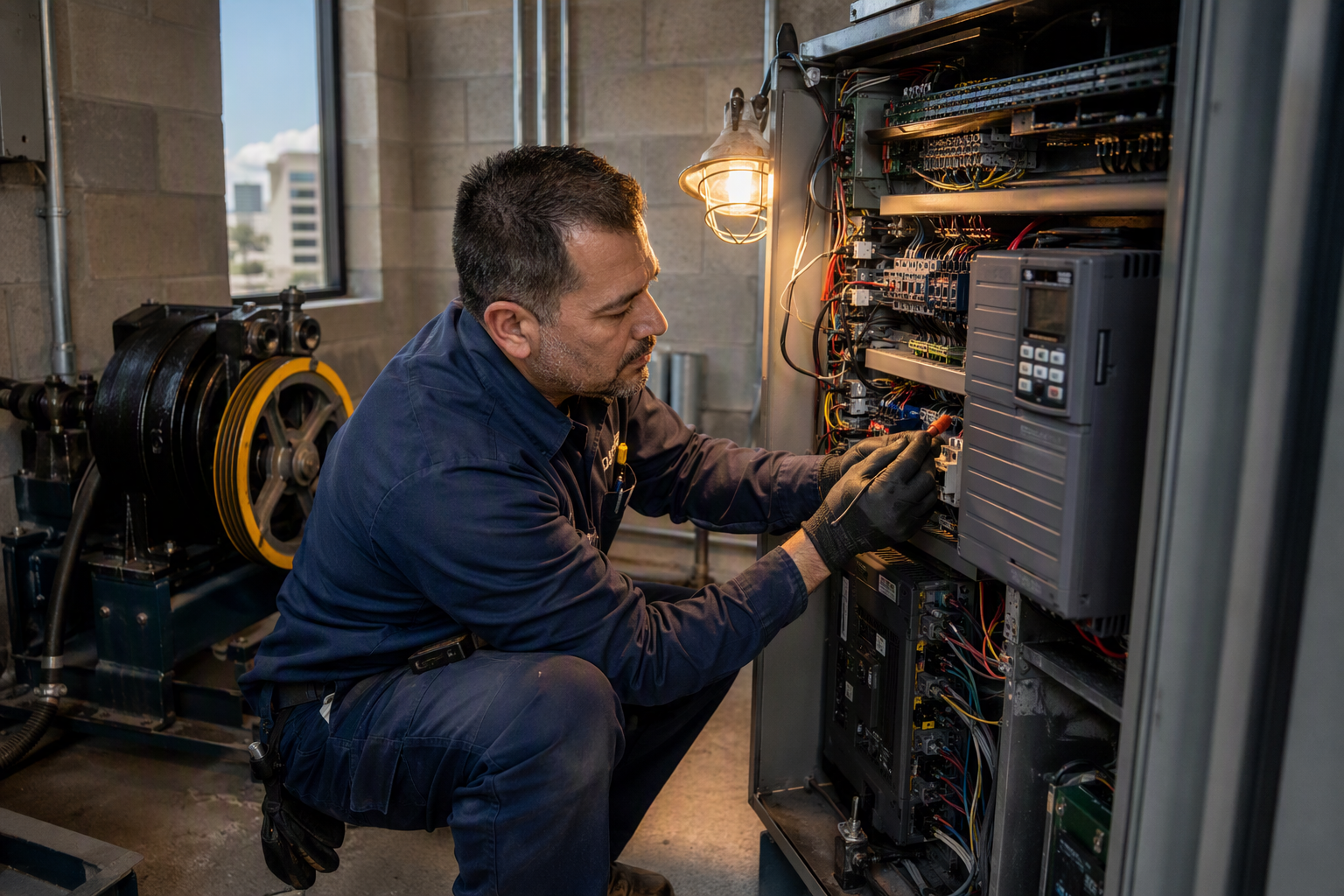
The most frequently cited deficiencies involve door interlock failures, worn or broken safety components, overdue maintenance, lighting deficiencies, and non-functioning emergency systems.
Across both states, inspectors follow the ASME A17.1/A17.3 codes as the primary technical benchmark. The most common failure categories include:
- Door and gate hardware: Defective door interlocks, worn gibs, non-compliant door reopening devices, or doors that do not meet required closing force limits.
- Safety and governor systems: Governors that are overdue for testing, safety mechanisms that fail drop tests, or oil buffers that are not properly charged.
- Emergency communication: Non-functional two-way communication systems required by ASME A17.1 and the Americans with Disabilities Act (ADA).
- Lighting and ventilation: Cab lighting below required lux levels or inoperative emergency lighting.
- Pit and machine room conditions: Water intrusion, missing pit lighting, unsecured electrical panels, or lack of a properly functioning pit stop switch.
- Load test documentation: Missing or expired load test records, particularly for hydraulic elevator relief valve tests.
- Overdue maintenance cycles: Elevators that have not received documented preventive maintenance per their maintenance control program (MCP), which is required under ASME A17.1.
What is the difference between a violation with conditional operation and a mandatory shutdown?
A conditional operation order allows an elevator to remain in limited service while non-critical deficiencies are corrected within a specified timeframe, whereas a mandatory shutdown order prohibits all use until deficiencies are resolved and re-inspection is passed.
Texas TDI and California’s Cal/OSHA Elevator Unit both use a tiered enforcement approach. Imminent hazard violations — anything that could cause injury to a passenger — trigger immediate shutdown. Examples include a failed door interlock on a hoistway door, a malfunctioning car safety, or evidence of hydraulic fluid leaks threatening fire risk. Administrative or documentation deficiencies, such as a missing inspection certificate posted in the cab, may allow continued operation with a short compliance window, typically ranging from a few days to thirty days depending on the AHJ’s determination. Building owners should never assume a conditional order is permanent permission to continue full normal operation; the elevator must still be brought into full compliance before the deadline.
What are the legal penalties for operating an elevator under a shutdown order in Texas or California?
Operating an elevator that has been ordered out of service exposes building owners and operators to civil penalties, increased liability in personal injury claims, and potential criminal charges depending on the jurisdiction.
In Texas, the Elevator Safety Act authorizes TDI to impose administrative penalties for violations of elevator safety orders. California’s Elevator Safety Law under the Labor Code similarly empowers Cal/OSHA to issue citations and assess penalties for non-compliance. Beyond regulatory fines, operating a unit under a shutdown order dramatically increases civil liability exposure if any incident occurs during that period. Insurance carriers may also deny coverage for claims arising from operation of an equipment that was known to be out-of-service ordered. Building owners should document that they have immediately restricted access to the elevator upon receiving a shutdown order and have notified their insurance carrier.
What are the step-by-step actions to take immediately after an elevator fails inspection?
Building owners must act systematically and without delay to protect occupants, limit liability, and begin the re-qualification process.
- Restrict access immediately. If a shutdown order is posted, physically lock out the elevator, disable call buttons where possible, and post clear out-of-service signage at every landing to prevent occupant entry.
- Read the full violation report. Carefully review every cited deficiency, noting whether each is classified as imminent hazard (requiring immediate shutdown) or correctable deficiency (with a compliance deadline).
- Notify your elevator service contractor. Contact a licensed elevator contractor — such as AmeriTex Elevator, which serves Houston, Dallas, Austin, San Antonio, Los Angeles, and San Diego — and provide a complete copy of the inspection report so technicians can assess parts, labor, and scheduling requirements.
- Notify your property manager, insurance carrier, and legal counsel. Document the out-of-service condition and your response actions in writing to create a liability protection record.
- Request an expedited repair assessment. Ask your contractor to prioritize a job-site visit to physically assess each cited deficiency and confirm the scope of corrective work needed.
- Order required parts promptly. For hydraulic components, door hardware, safety devices, or control boards, parts lead time is often the primary delay — the sooner parts are ordered, the sooner repairs can be completed.
- Complete all corrections and document them. Ensure your contractor produces written documentation — including replacement parts records, test results, and any required load test certifications — for every corrected item.
- Request re-inspection from the AHJ. In Texas, contact the TDI-approved elevator inspection provider. In California, contact the Cal/OSHA Elevator Unit or the certified competent inspector for your jurisdiction. Provide all correction documentation in advance to streamline the inspection appointment.
- Confirm the new certificate of operation is posted. Once the elevator passes re-inspection, verify the updated inspection certificate is posted in the cab as required by both Texas and California law before resuming normal service.
How long does it typically take to get a failed elevator back in service?
The timeline to return a failed elevator to service depends entirely on the nature of the deficiencies, parts availability, and AHJ scheduling, but ranges from same-day correction for minor issues to several weeks for complex mechanical or electrical repairs.
Simple deficiencies — such as replacing a burned-out cab light, resetting a pit stop switch, or producing missing documentation — can often be corrected and re-inspected within one to three business days. Door interlock replacements or emergency phone repairs typically fall in the three-to-seven-day range assuming standard parts are in stock. Major repairs involving safety device replacements, hydraulic unit work, controller upgrades, or structural components can extend timelines to two to six weeks, particularly if custom or obsolete parts must be sourced. In Texas and California, AHJ scheduling backlogs for re-inspection appointments can add additional days; experienced contractors who maintain working relationships with inspectors and inspection agencies can sometimes facilitate faster scheduling. AmeriTex Elevator’s familiarity with the inspection agencies across its Texas and California service markets supports more efficient re-inspection coordination for building owners in those regions.
What codes and standards govern elevator inspections in Texas?
Texas elevator safety is governed by Texas Occupations Code Chapter 754, administered by the Texas Department of Insurance (TDI), with technical requirements based on the ASME A17.1 and A17.3 codes.
Texas requires that all elevators in public buildings hold a valid certificate of operation issued by TDI or a TDI-approved inspection company. Inspections must be performed by a licensed elevator inspector. The technical standards applied during inspection derive from the ASME A17.1 Safety Code for Elevators and Escalators for newer installations and ASME A17.3 for existing equipment. Texas also mandates that elevator contractors performing installation, alteration, or maintenance be registered with TDI. Building owners should confirm their service contractor holds valid Texas TDI registration before authorizing any corrective repair work — hiring an unregistered contractor can itself create a compliance violation.
What codes and standards govern elevator inspections in California?
California elevator safety is governed by the California Elevator Safety Law under the Labor Code, enforced by the Cal/OSHA Elevator Unit, with technical requirements based on ASME A17.1 and A17.3 as adopted by the state.
California requires a valid permit to operate issued by the Division of Occupational Safety and Health (Cal/OSHA) or a certified competent inspector for each conveyance. The state adopts the ASME A17.1 Safety Code for Elevators and Escalators with California-specific amendments. Elevator contractors operating in California must hold a valid California contractor’s license with the appropriate classification. The Cal/OSHA Elevator Unit maintains jurisdiction over most public and commercial elevators, though some counties and cities operate under local enforcement programs where a certified competent inspector issues the operating permit. Building owners in Los Angeles and San Diego should confirm which authority — state Cal/OSHA or their local AHJ — holds permit authority for their specific building type and occupancy.
How do ADA requirements interact with elevator inspection failures?
An elevator that fails inspection and is taken out of service triggers ADA obligations for building owners to provide equivalent accessible service or alternative accessible routes for people with disabilities.
The Americans with Disabilities Act (ADA) requires that buildings covered under Title II (public entities) and Title III (public accommodations) maintain accessible routes and vertical access. When an elevator is out of service, even temporarily, building owners have an obligation to notify affected users and, where feasible, provide an accessible alternative. For multi-story buildings where the elevator is the sole accessible means of vertical travel, extended downtime can constitute an ADA violation independent of the elevator code issue. The ADA also has specific requirements for two-way emergency communication systems in elevator cabs — a commonly cited deficiency that overlaps both the ASME code requirements and ADA compliance obligations. Correcting emergency communication deficiencies therefore addresses both the state inspection requirement and federal ADA exposure simultaneously.
What is a maintenance control program and how does it affect inspection outcomes?
A maintenance control program (MCP) is a documented, systematic plan for elevator maintenance required by ASME A17.1, and its absence or inadequacy is a directly citable deficiency that can contribute to inspection failure.
ASME A17.1 requires that every elevator have a written maintenance control program specifying the tasks, intervals, and procedures for maintaining all equipment components. Inspectors in both Texas and California may review MCP documentation during periodic inspections. An MCP that is incomplete, outdated, or shows no evidence of actual execution — such as missing maintenance logs or unsigned task checklists — can result in cited violations. More importantly, a poorly executed MCP is itself a leading cause of the mechanical failures that produce inspection failures in the first place. Engaging a qualified elevator service company to develop and maintain a compliant MCP is one of the most effective preventive strategies available to building owners. AmeriTex Elevator provides ongoing preventive maintenance programs across its Texas and California service markets to help building owners maintain complete and compliant maintenance records ahead of every inspection cycle.
What inspection intervals are required for elevators in Texas and California?
Both Texas and California require periodic elevator inspections, with the specific frequency determined by equipment type, use classification, and applicable code edition adopted by each state’s authority.
| Equipment Type | Texas (TDI) | California (Cal/OSHA Elevator Unit) | Governing Code Reference |
|---|---|---|---|
| Traction Elevators (General Use) | Annual inspection required | Annual inspection required | ASME A17.1 / A17.3 |
| Hydraulic Elevators (General Use) | Annual inspection required | Annual inspection required | ASME A17.1 / A17.3 |
| Governor / Safety Device Test (Traction) | Required at defined periodic intervals per adopted code | Required at defined periodic intervals per adopted code | ASME A17.1 |
| Hydraulic Relief Valve Test | Required at defined periodic intervals per adopted code | Required at defined periodic intervals per adopted code | ASME A17.1 |
| Full Load Test (Traction) | Required at defined periodic intervals per adopted code | Required at defined periodic intervals per adopted code | ASME A17.1 |
| Escalators and Moving Walks | Annual inspection required | Annual inspection required | ASME A17.1 / A17.3 |
Note: Exact testing intervals for safety devices, governors, and load tests are specified within the applicable ASME code edition adopted by each state. Building owners should confirm currently adopted code editions with their AHJ or elevator service contractor.
Can a building owner use any licensed elevator contractor for re-inspection corrections, or are there restrictions?
Corrective work must be performed by a contractor licensed or registered in the applicable state — Texas TDI registration for Texas properties, California contractor licensing for California properties — and inspectors may verify contractor credentials as part of the re-inspection process.
In Texas, elevator contractors must hold a current TDI registration, and elevator mechanics performing work must hold a TDI-issued license. In California, contractors must hold a valid state contractor’s license with the appropriate classification for elevator work, and mechanics working on elevators must hold a valid elevator mechanic certification. Using an unlicensed contractor not only risks creating additional code violations but may also invalidate the repair documentation that inspectors review during re-inspection. When selecting a contractor for post-failure corrective work, building owners should request proof of state licensure and registration documentation before work begins.
How should building owners communicate with tenants and occupants during an elevator outage?
Proactive, documented tenant communication during an elevator outage reduces legal exposure, maintains trust, and satisfies accessibility obligations under the ADA.
Building management should post clear, professionally produced out-of-service notices at every elevator landing within hours of a shutdown order, specifying that the elevator is out of service for required safety repairs and providing an estimated restoration timeline when known. For residential buildings, written notification to all tenants — particularly those with mobility impairments who rely on the elevator — is a best practice that also supports ADA compliance documentation. For commercial properties, notifying anchor tenants, medical practices, or other high-dependency occupants early allows them to make alternative access arrangements. Building owners should preserve copies of all tenant communications as part of the overall compliance file for the outage period.
What documentation should be compiled before requesting a re-inspection?
A complete re-inspection package — including correction documentation, parts records, test results, and contractor certifications — accelerates the AHJ review and reduces the likelihood of additional delays caused by missing paperwork.
Before contacting the AHJ to schedule a re-inspection, building owners and their contractors should compile the following:
- A copy of the original violation report with each cited item annotated to show the corrective action taken.
- Parts invoices and replacement records for any components replaced.
- Test result documentation for any systems requiring functional testing (e.g., door force tests, governor trip speed tests, hydraulic pressure tests).
- Updated maintenance log entries showing completion of any overdue maintenance tasks.
- Contractor certification or sign-off that all corrections have been completed in compliance with the applicable ASME code edition.
- Current proof of contractor licensure/registration in Texas or California.
Submitting this documentation to the inspector in advance of the re-inspection appointment, where the AHJ permits, demonstrates good-faith compliance and often results in a more efficient on-site review.
What is the role of the ASME A17.3 code for existing elevators, and why does it matter during a failure?
ASME A17.3 establishes the minimum safety requirements specifically for existing elevators already in service, and it is the primary technical benchmark inspectors apply to older equipment that was installed under earlier code editions.
While ASME A17.1 governs new installations, the A17.3 code recognizes that buildings cannot retroactively rebuild all elevator equipment to meet the latest new-installation standard every time the code is updated. Instead, A17.3 specifies which safety requirements from A17.1 must be retroactively applied to existing equipment over time, and under what conditions. When an elevator fails inspection on an older building, the violations cited by inspectors in both Texas and California are frequently drawn from A17.3 retroactive requirements. This distinction matters to building owners because it affects the scope and cost of corrective work: a deficiency cited under A17.3 may require a specific upgrade rather than a full replacement, and an experienced elevator contractor can advise on the minimum compliant correction versus a broader modernization scope.
When does a failed inspection trigger a required modernization instead of a simple repair?
A failed inspection triggers a modernization requirement when cited deficiencies involve obsolete equipment for which code-compliant components are no longer manufactured, or when the AHJ determines that the existing equipment cannot be brought into compliance through repair alone.
Older elevators — particularly those installed in the 1970s through early 1990s — may have controllers, door operators, or safety components that cannot be updated to meet current ASME A17.3 retroactive requirements using original or equivalent parts. In these cases, a partial or full modernization — replacing the controller, door operator, or hydraulic unit — may be the only viable path to re-qualification. While modernization represents a larger upfront investment than a targeted repair, it typically also resets the elevator’s compliance timeline, reduces ongoing maintenance costs, and may improve energy efficiency and ride quality. Building owners facing a failed inspection on aging equipment should request a specific assessment from their elevator contractor distinguishing between repair-eligible and modernization-required items in the violation report.
How can building owners reduce the risk of future elevator inspection failures?
The most effective approach to avoiding inspection failures is consistent preventive maintenance under a documented MCP, combined with proactive pre-inspection assessments to identify and correct deficiencies before the official inspection occurs.
Building owners should ensure their elevator service agreement includes a written maintenance control program that meets ASME A17.1 requirements, with documented task completion at every scheduled visit. Retaining complete maintenance records — including technician notes, parts replaced, and test results — creates a defensible compliance history that also helps inspectors verify that equipment has been properly maintained. Many building owners in Houston, Dallas, Austin, San Antonio, Los Angeles, and San Diego also commission a voluntary pre-inspection audit in the weeks before their annual inspection, using their elevator contractor to walk through the same checklist an inspector will use and correct any emerging issues before they become formal citations. AmeriTex Elevator offers preventive maintenance programs and pre-inspection assessments designed to help building owners across its Texas and California service markets maintain continuous compliance and minimize the risk of unexpected shutdowns.
What is OSHA’s role in elevator safety at commercial and construction sites?
The Occupational Safety and Health Administration (OSHA) has jurisdiction over elevator safety in workplace settings, including construction hoists and material lifts, and may independently cite workplace elevator violations that overlap with state inspection authority.
While the state elevator inspection program (TDI in Texas, Cal/OSHA Elevator Unit in California) administers the operating permit and periodic inspection for permanent elevators, OSHA retains enforcement authority over worker safety in connection with elevator-related hazards in the workplace. This is particularly relevant in settings where employees ride or work on or around elevators — such as hotel, hospital, or large commercial properties — and where a machine room, pit, or hoistway access creates a confined space or electrical hazard. A failed state inspection that involves worker safety hazards in these areas may prompt parallel OSHA enforcement action in addition to the state elevator agency citation. Building owners should treat any inspection failure involving machine room or pit conditions with particular urgency to address both regulatory frameworks simultaneously.
How does AmeriTex Elevator help building owners navigate an inspection failure?
AmeriTex Elevator provides licensed elevator repair and maintenance services across Houston, Dallas, Austin, San Antonio, Los Angeles, and San Diego, supporting building owners through the full post-failure sequence from initial assessment to re-inspection clearance.
When a building owner in AmeriTex Elevator’s service markets receives a violation notice, the company’s technicians can perform an on-site assessment to evaluate every cited deficiency against the applicable ASME code requirements, identify the fastest compliant path to correction, and manage parts procurement and repair scheduling. AmeriTex Elevator’s experience working with Texas TDI inspection processes and California Cal/OSHA Elevator Unit protocols means that documentation is prepared in the format inspectors expect, reducing delays caused by incomplete re-inspection submissions. For building owners who want to avoid future failures, AmeriTex Elevator also offers ongoing preventive maintenance programs structured around the ASME A17.1 maintenance control program requirements.
What should building owners ask before hiring an elevator contractor to correct inspection failures?
Building owners should verify state licensure, confirm familiarity with the cited code sections, request a written scope of work for each correction, and ask specifically how the contractor will support the re-inspection scheduling and documentation process.
Key questions to ask any elevator contractor before authorizing corrective work following a failed inspection include:
- Are you currently registered with Texas TDI (for Texas properties) or licensed under California’s elevator contractor requirements (for California properties)?
- Can you provide written documentation of all corrections performed, including parts records and test results, in a format the AHJ will accept for re-inspection?
- Have your technicians worked directly on this elevator type and manufacturer’s equipment before?
- Do you have the parts for the cited deficiencies in stock, or what is the realistic parts lead time?
- How will you coordinate with the AHJ to schedule the re-inspection appointment?
- Do you offer a preventive maintenance program that includes a written MCP to reduce future inspection risk?
Asking these questions upfront protects building owners from selecting a contractor who may perform the repairs but leave the documentation, coordination, and re-inspection scheduling in the building owner’s hands — creating additional delays and administrative burden at an already stressful time.
Need elevator service you can rely on? AmeriTex Elevator is ready to help.